



 Chat with AI
Exam 13: The Lives of Stars From Birth Through Middle Age

Exam 1: Discovering the Night Sky374 Questions
Exam 2: Gravitation and the Motion of the Planets356 Questions
Exam 3: Light and Telescopes275 Questions
Exam 4: Atomic Physics and Spectra223 Questions
Exam 5: Exoplanets and the Formation of Planetary Systems98 Questions
Exam 6: Formation of the Solar System121 Questions
Exam 7: Earth and the Moon305 Questions
Exam 8: The Other Terrestrial Planets265 Questions
Exam 9: The Outer Planets360 Questions
Exam 10: Vagabonds of the Solar System198 Questions
Exam 11: The Sun: Our Extraordinary Star248 Questions
Exam 12: Characterizing Stars254 Questions
Exam 13: The Lives of Stars From Birth Through Middle Age325 Questions
Exam 14: The Death of Stars235 Questions
Exam 15: Black Holes: Matters of Gravity178 Questions
Exam 16: The Milky Way Galaxy157 Questions
Exam 17: Galaxies207 Questions
Exam 18: Quasars and Other Active Galaxies118 Questions
Exam 19: Cosmology217 Questions
Exam 20: Astrobiology71 Questions
Select questions type


The Pleiades cluster consists of a number of bright stars wrapped in a cloud of gas and dust that appears blue. This cluster is an example of
(Multiple Choice)
4.9/5  (86)
(86) Horizontal-branch stars have a wide range of temperatures and luminosities between 50 and 100 times that of the Sun, so they are in what stage of their lives?
(Multiple Choice)
4.8/5 (81)
(81) Some protostars, when they evolve onto the main sequence, are fully convective and use convection to transport material all the way from the core to the surface. Which stars show this characteristic?
(Multiple Choice)
4.8/5 (82)
(82) After it leaves the main sequence, a star of more than 1 solar mass moves generally to the right on the H-R diagram because the star's
(Multiple Choice)
5.0/5 (82)
(82) In the first stage after main-sequence hydrogen fusion, the envelope of the star is pushed outward to expand. The nuclear reactions that produce the outward pressure for this expansion are
(Multiple Choice)
4.8/5 (72)
(72) In a list of the 100 brightest stars in the sky, MOST of them are
(Multiple Choice)
4.9/5 (73)
(73) Suppose that an astronomy news item announces the discovery of a brown dwarf. What is it that has been discovered?
(Multiple Choice)
4.8/5 (80)
(80) Main-sequence stars apparently are not larger than a few hundred solar masses. The reason stars of larger mass do NOT exist is that
(Multiple Choice)
4.9/5 (70)
(70) What physical mechanism is responsible for the oscillations in brightness that a Cepheid variable star undergoes?
(Multiple Choice)
4.7/5 (74)
(74) Which of these mechanisms is NOT a common way in which star formation is triggered or started?
(Multiple Choice)
4.9/5 (80)
(80) Which of these properties is NOT a characteristic of T Tauri stars?
(Multiple Choice)
4.9/5 (88)
(88) In the H-R diagram shown in Figure 13-31b in the text, the brightest stars in the Pleiades cluster are not on the main sequence but away from it toward the upper right. Explain. 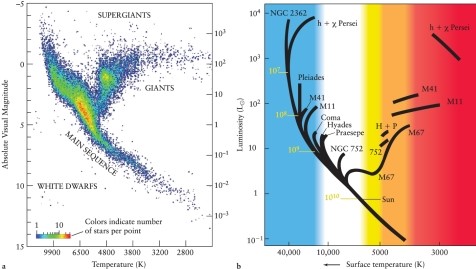
(Multiple Choice)
4.8/5 (79)
(79) What wavelengths have astronomers used to map and study the distribution of the giant molecular clouds in space?
(Multiple Choice)
4.9/5 (69)
(69) Consider stars of these masses (in solar masses). Which one would NOT be expected to experience a helium flash?
(Multiple Choice)
4.9/5 (77)
(77) 
Filters
- Essay(0)
- Multiple Choice(0)
- Short Answer(0)
- True False(0)
- Matching(0)