



 Chat with AI
Exam 13: The Lives of Stars From Birth Through Middle Age

Exam 1: Discovering the Night Sky374 Questions
Exam 2: Gravitation and the Motion of the Planets356 Questions
Exam 3: Light and Telescopes275 Questions
Exam 4: Atomic Physics and Spectra223 Questions
Exam 5: Exoplanets and the Formation of Planetary Systems98 Questions
Exam 6: Formation of the Solar System121 Questions
Exam 7: Earth and the Moon305 Questions
Exam 8: The Other Terrestrial Planets265 Questions
Exam 9: The Outer Planets360 Questions
Exam 10: Vagabonds of the Solar System198 Questions
Exam 11: The Sun: Our Extraordinary Star248 Questions
Exam 12: Characterizing Stars254 Questions
Exam 13: The Lives of Stars From Birth Through Middle Age325 Questions
Exam 14: The Death of Stars235 Questions
Exam 15: Black Holes: Matters of Gravity178 Questions
Exam 16: The Milky Way Galaxy157 Questions
Exam 17: Galaxies207 Questions
Exam 18: Quasars and Other Active Galaxies118 Questions
Exam 19: Cosmology217 Questions
Exam 20: Astrobiology71 Questions
Select questions type


Which range of electromagnetic radiation is MOST useful for observing newborn protostars in their gas and dust nebulae?
(Multiple Choice)
4.7/5  (69)
(69) What is unusual about main-sequence stars that are about 75 percent the mass of the Sun?
(Multiple Choice)
4.7/5 (75)
(75) Electron degeneracy, which is a result of the Pauli exclusion principle, is important in
(Multiple Choice)
4.9/5 (71)
(71) At what stage in its life does a star pass through the protostar phase?
(Multiple Choice)
4.9/5 (75)
(75) At what temperature do nuclear reactions begin in the core of a pre-main-sequence star?
(Multiple Choice)
4.9/5 (80)
(80) Evidence of massive amounts of hydrogen gas surrounding some young, hot stars comes from
(Multiple Choice)
4.9/5 (84)
(84) What name is given to a young, cool star (spectral class G, K, or M) that is ejecting gas into the interstellar medium?
(Multiple Choice)
4.8/5 (73)
(73) The spectrum of stars in an open cluster is found to contain spectral lines from many heavy elements; the stars are known as "metal-rich." What is the source of these heavy elements?
(Multiple Choice)
4.9/5 (70)
(70) How long does a star of 3 times the Sun's mass live compared with the lifetime of the Sun?
(Multiple Choice)
4.8/5 (78)
(78) What is believed to be the MOST important factor determining whether a collapsing region (dense core) in an interstellar cloud becomes a single-star or a multiple-star system?
(Multiple Choice)
4.7/5 (72)
(72) The distinct blue color of the nebulosity around stars in young clusters such as the Pleiades (see Figure 13-4 in the text) is caused by 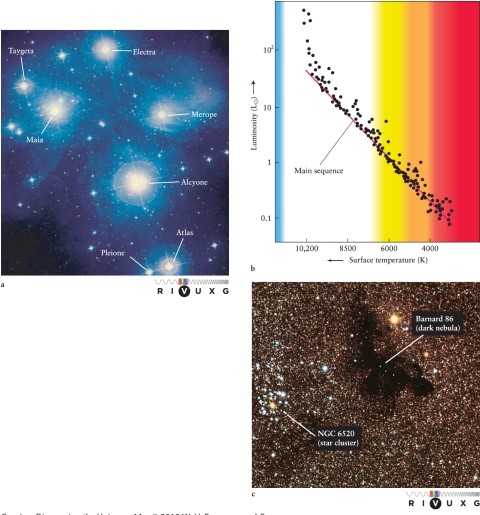
(Multiple Choice)
4.9/5 (68)
(68) What appears to be the limit to the amount of mass that can accumulate as a star before energy from intense nuclear fusion, emitted in the form of electromagnetic radiation, ejects further mass away from the star?
(Multiple Choice)
4.8/5 (84)
(84) The apparent reddening of light from stars after its passage through the interstellar medium is caused by
(Multiple Choice)
4.8/5 (67)
(67) 
Filters
- Essay(0)
- Multiple Choice(0)
- Short Answer(0)
- True False(0)
- Matching(0)