



 Chat with AI
Exam 21: Carbohydrate Metabolism

Exam 1: Chemistry - Methods and Measurement104 Questions
Exam 2: The Structure of the Atom and the Periodic Table115 Questions
Exam 3: Structure and Properties of Ionic and Covalent Compounds93 Questions
Exam 4: Calculations, chemical Changes, and the Chemical Equation85 Questions
Exam 5: States of Matter: Gases, liquids, and Solids76 Questions
Exam 6: Solutions69 Questions
Exam 7: Energy,rate and Equilibrium67 Questions
Exam 8: Acids and Bases67 Questions
Exam 9: The Nucleus, radioactivity, and Nuclear Medicine86 Questions
Exam 10: An Introduction to Organic Chemistry104 Questions
Exam 11: The Unsaturated Hydrocarbons: Alkenes, alkynes, and Aromatics74 Questions
Exam 12: Alcohols, phenols, thiols, and Ethers69 Questions
Exam 13: Aldehydes and Ketones63 Questions
Exam 14: Carboxylic Acids and Carboxylic Acid Derivatives83 Questions
Exam 15: Amines and Amides82 Questions
Exam 16: Carbohydrates81 Questions
Exam 17: Lipids and Their Functions in Biochemical Systems78 Questions
Exam 18: Protein Structure and Function75 Questions
Exam 19: Enzymes74 Questions
Exam 20: Introduction to Molecular Genetics85 Questions
Exam 21: Carbohydrate Metabolism76 Questions
Exam 22: Aerobic Respiration and Energy Production75 Questions
Exam 23: Fatty Acid Metabolism75 Questions
Select questions type


Which statement best describes how the interconversion of ATP and ADP is responsible for storing and providing energy for cellular reactions? 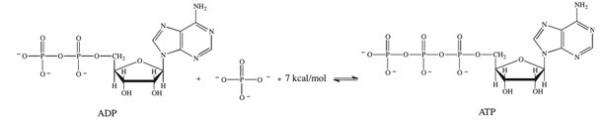

Free
(Multiple Choice)
4.8/5  (77)
(77) Correct Answer: Verified
D
Approximately how much energy,in kilocalories/mol,is released by one mole of ATP in the reaction shown below? ATP + water → ADP + Pi + energy
Free
(Multiple Choice)
4.8/5 (87)
(87) Correct Answer:Verified
VerifiedA
Why is the pentose phosphate pathway important?
Free
(Multiple Choice)
4.9/5 (85)
(85) Correct Answer:Verified
VerifiedB
What term describes the synthesis of glucose from non-carbohydrate sources?
(Multiple Choice)
4.9/5 (77)
(77) The liver takes up excess lactate from the blood.Into what product is the lactate first converted?
(Multiple Choice)
4.7/5 (92)
(92) Aldolase splits fructose-1,6-bisphosphate into two compounds.One is glyceraldehyde-3-phosphate.What is the other product of this reaction?
(Multiple Choice)
4.7/5 (88)
(88) The end products of fermentation are ethylene glycol and carbon dioxide.
(True/False)
4.9/5 (80)
(80) What is an important result of the lactate and ethanol fermentation processes?
(Multiple Choice)
4.9/5 (87)
(87) The last step of glycolysis is the kinase catalyzed reaction represented below.What is the identity of the missing product? phosphoenolpyruvate + ADP → ATP + ?
(Multiple Choice)
4.9/5 (92)
(92) The hormone insulin stimulates which of the following biochemical pathways?
(Multiple Choice)
4.8/5 (78)
(78) Which coenzyme form must be reoxidized so that glycolysis can continue to produce ATP for the cell?
(Multiple Choice)
4.8/5 (85)
(85) In glycolysis,a molecule of glucose is converted into 2 molecules of lactate.
(True/False)
4.9/5 (76)
(76) Which of the following statements concerning the digestion of food groups is FALSE?
(Multiple Choice)
4.8/5 (74)
(74) In glycogen synthesis,glycogen synthase catalyzes the linking of glucose units to the growing glycogen chain by the formation of α (1,4)glycosidic bonds.What is the immediate source of glucose for this reaction?
(Multiple Choice)
4.7/5 (83)
(83) Which of the statements concerning gluconeogenesis is FALSE?
(Multiple Choice)
4.8/5 (80)
(80) Step 7 in glycolysis is shown below.Which statement concerning this step is TRUE? 
(Multiple Choice)
4.9/5 (82)
(82) In the first step of glycogenolysis,the enzyme glycogen phosphorylase acts on glycogen to produce glucose-1-phosphate.What must happen to this product before it can enter the glycolysis pathway?
(Multiple Choice)
4.7/5 (73)
(73) Skeletal muscle cannot contribute to blood glucose as it lacks the enzyme necessary to convert glucose-6-phosphate to glucose.
(True/False)
5.0/5 (83)
(83) ATP,the universal energy currency of the cell,stands for adenosine triphosphate.
(True/False)
4.9/5 (97)
(97) 
Filters
- Essay(0)
- Multiple Choice(0)
- Short Answer(0)
- True False(0)
- Matching(0)