



 Chat with AI
Exam 13: Monopoly and Antitrust Policy

Exam 1: The Scope and Method of Economics241 Questions
Exam 2: The Economic Problem: Scarcity and Choice218 Questions
Exam 3: Demand, Supply, and Market Equilibrium309 Questions
Exam 4: Demand and Supply Applications173 Questions
Exam 5: Elasticity188 Questions
Exam 6: Household Behavior and Consumer Choice272 Questions
Exam 7: The Production Process: the Behavior of Profit-Maximizing Firms287 Questions
Exam 8: Short-Run Costs and Output Decisions386 Questions
Exam 9: Long-Run Costs and Output Decisions363 Questions
Exam 10: Input Demand: the Labor and Land Markets200 Questions
Exam 11: Input Demand: the Capital Market and the Investment Decision218 Questions
Exam 12: General Equilibrium and the Efficiency of Perfect Competition202 Questions
Exam 13: Monopoly and Antitrust Policy394 Questions
Exam 14: Oligopoly219 Questions
Exam 15: Monopolistic Competition235 Questions
Exam 16: Externalities, Public Goods, and Common Resources275 Questions
Exam 17: Uncertainty and Asymmetric Information134 Questions
Exam 18: Income Distribution and Poverty197 Questions
Exam 19: Public Finance: the Economics of Taxation281 Questions
Exam 20: International Trade, Comparative Advantage, and Protectionism287 Questions
Exam 21: Economic Growth in Developing Economies133 Questions
Exam 22: Critical Thinking About Research104 Questions
Select questions type


Refer to the information provided in Figure 13.9 below to answer the question(s) that follow.  Figure 13.9
-Refer to Figure 13.9. The amount of consumer surplus under monopoly is equal to area
Figure 13.9
-Refer to Figure 13.9. The amount of consumer surplus under monopoly is equal to area (Multiple Choice)
4.9/5  (75)
(75) For products with close substitutes, the demand curve slopes down.
(True/False)
4.8/5 (83)
(83) Refer to the information provided in Figure 13.9 below to answer the question(s) that follow. Figure 13.9
-Refer to Figure 13.9. If Ohio Edison is forced to act as a perfect competitor (instead of the monopoly level), the net social gain is
Figure 13.9
-Refer to Figure 13.9. If Ohio Edison is forced to act as a perfect competitor (instead of the monopoly level), the net social gain is (Multiple Choice)
4.8/5 (73)
(73) Refer to the information provided in Figure 13.7 below to answer the question(s) that follow.  Figure 13.7
-Refer to Figure 13.7. If the government regulates Armstrong Cable so they can earn only a normal return, the price would be set at
Figure 13.7
-Refer to Figure 13.7. If the government regulates Armstrong Cable so they can earn only a normal return, the price would be set at (Multiple Choice)
4.9/5 (91)
(91) Refer to the information provided in Figure 13.11 below to answer the question(s) that follow.  Figure 13.11
-Refer to Figure 13.11. Suppose a monopolist faces the demand and costs in the figure and is able to perfectly price discriminate. If the monopoly supplies 400 widgets, it will
Figure 13.11
-Refer to Figure 13.11. Suppose a monopolist faces the demand and costs in the figure and is able to perfectly price discriminate. If the monopoly supplies 400 widgets, it will (Multiple Choice)
4.9/5 (79)
(79) Refer to the information provided in Figure 13.2 below to answer the question(s) that follow. 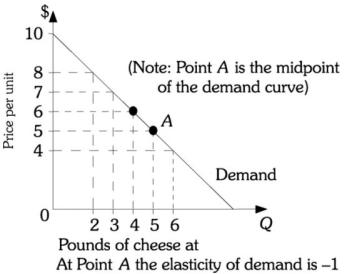 Figure 13.2
-Refer to Figure 13.2. This firm's marginal revenue will be negative at
Figure 13.2
-Refer to Figure 13.2. This firm's marginal revenue will be negative at (Multiple Choice)
5.0/5 (86)
(86) Refer to the information provided in Table 13.1 below to answer the question(s) that follow.
Table 13.1
Price (\ ) Quantity 4.00 2,000 3.50 2,400 3.00 2,800 2.50 3,200 2.00 3,600 1.50 4,000 1.00 4,400
-Refer to Table 13.1. If a monopoly faces the demand schedule given in the table, what is its marginal revenue from the 4,000th unit it sells?
(Multiple Choice)
4.9/5 (76)
(76) A coffee manufacturer raises the price of its coffee by 10%, and the quantity demanded of its coffee falls by only 12%. This firm has
(Multiple Choice)
4.8/5 (72)
(72) If a monopolist is able to practice perfect price discrimination, there will be no deadweight loss.
(True/False)
4.8/5 (86)
(86) The condition for profit-maximization for competitive firms and monopolies is the same: marginal revenue equals marginal cost. Hence, monopolies are efficient.
(True/False)
4.8/5 (72)
(72) When a monopolist's marginal profit is negative, then it follows that
(Multiple Choice)
4.8/5 (84)
(84) The barrier to entry protecting cable companies is primarily
(Multiple Choice)
4.8/5 (73)
(73) The ________ broadly we define a market, the less difficult it becomes to find ________.
(Multiple Choice)
4.8/5 (90)
(90) Related to the Economics in Practice on page 274: According to the Economics in Practice, in industries such as electronics and computers, the patent policies of a country ________ when a company in that industry looks at different countries in which to locate its activities.
(Multiple Choice)
4.9/5 (82)
(82) Government-led antitrust actions are far more common than private antitrust cases.
(True/False)
4.9/5 (89)
(89) The Time-for-a-Change wristwatch company holds a patent on holographic wristwatches. The company can earn a profit on the sale of holographic wristwatches
(Multiple Choice)
4.8/5 (88)
(88) An important distinction between perfect competition and monopoly is that in
(Multiple Choice)
5.0/5 (84)
(84) Refer to the information provided in Figure 13.8 below to answer the question that follows.  Figure 13.8
-Refer to Figure 13.8. The only firm producing electricity has the long-run average total cost curve shown. The total amount of demand for kilowatts is 100,000 per hour. It makes economic sense for this firm to be the only producer of electricity because this firm
Figure 13.8
-Refer to Figure 13.8. The only firm producing electricity has the long-run average total cost curve shown. The total amount of demand for kilowatts is 100,000 per hour. It makes economic sense for this firm to be the only producer of electricity because this firm (Multiple Choice)
5.0/5 (90)
(90) Antitrust cases against Eastman Kodak, International Harvester, United Shoe Machinery, and United States Steel resulted in the firms
(Multiple Choice)
4.8/5 (75)
(75) 
Filters
- Essay(0)
- Multiple Choice(0)
- Short Answer(0)
- True False(0)
- Matching(0)