



 Chat with AI
Exam 13: Monopoly and Antitrust Policy

Exam 1: The Scope and Method of Economics241 Questions
Exam 2: The Economic Problem: Scarcity and Choice218 Questions
Exam 3: Demand, Supply, and Market Equilibrium309 Questions
Exam 4: Demand and Supply Applications173 Questions
Exam 5: Elasticity188 Questions
Exam 6: Household Behavior and Consumer Choice272 Questions
Exam 7: The Production Process: the Behavior of Profit-Maximizing Firms287 Questions
Exam 8: Short-Run Costs and Output Decisions386 Questions
Exam 9: Long-Run Costs and Output Decisions363 Questions
Exam 10: Input Demand: the Labor and Land Markets200 Questions
Exam 11: Input Demand: the Capital Market and the Investment Decision218 Questions
Exam 12: General Equilibrium and the Efficiency of Perfect Competition202 Questions
Exam 13: Monopoly and Antitrust Policy394 Questions
Exam 14: Oligopoly219 Questions
Exam 15: Monopolistic Competition235 Questions
Exam 16: Externalities, Public Goods, and Common Resources275 Questions
Exam 17: Uncertainty and Asymmetric Information134 Questions
Exam 18: Income Distribution and Poverty197 Questions
Exam 19: Public Finance: the Economics of Taxation281 Questions
Exam 20: International Trade, Comparative Advantage, and Protectionism287 Questions
Exam 21: Economic Growth in Developing Economies133 Questions
Exam 22: Critical Thinking About Research104 Questions
Select questions type


For a non-discriminating monopolist to sell one more unit, it must
(Multiple Choice)
4.8/5  (69)
(69) Refer to the information provided in Figure 13.4 below to answer the question(s) that follow.  Figure 13.4
-Refer to Figure 13.4. The ________ level of output for this monopolist is 22 units of output.
Figure 13.4
-Refer to Figure 13.4. The ________ level of output for this monopolist is 22 units of output. (Multiple Choice)
4.8/5 (87)
(87) A firm must be able to ________ competition if it is to exercise control over the price of its product.
(Multiple Choice)
4.8/5 (74)
(74) Related to the Economics in Practice on page 281: The foreign visitors to the temples of Laos are typically much richer than the local Laotians. This tends to make the foreign visitors ________ buyers when it comes to ticket prices to enter the temples.
(Multiple Choice)
4.7/5 (81)
(81) The rule of reason is the criterion introduced by the courts for determining whether a firm's action was illegal under the Clayton Act.
(True/False)
4.8/5 (94)
(94) Assuming demand is linear, the shape of a monopolist's total revenue schedule is a
(Multiple Choice)
4.7/5 (94)
(94) We call a market where there is only one producer of a good or service a monopoly.
(True/False)
4.9/5 (77)
(77) Monopolies, oligopolies, and monopolistic competitive industries all
(Multiple Choice)
4.7/5 (85)
(85) Because the monopolist is the sole producer of a good, it can never incur a loss.
(True/False)
4.9/5 (95)
(95) Refer to the information provided in Figure 13.1 below to answer the question that follows.  Figure 13.1
-Refer to Figure 13.1. The demand curve for insulin is most likely represented by
Figure 13.1
-Refer to Figure 13.1. The demand curve for insulin is most likely represented by (Multiple Choice)
4.9/5 (83)
(83) Refer to the information provided in Figure 13.5 below to answer the question that follows. 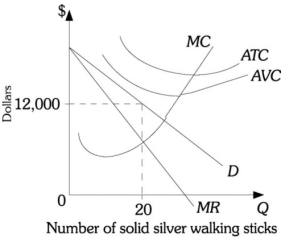 Figure 13.5
-Refer to Figure 13.5. The Silver Exchange has a monopoly over the sale of solid silver walking sticks. The Silver Exchange has hired you as an economic consultant. You should advise this monopolist to
Figure 13.5
-Refer to Figure 13.5. The Silver Exchange has a monopoly over the sale of solid silver walking sticks. The Silver Exchange has hired you as an economic consultant. You should advise this monopolist to (Multiple Choice)
4.9/5 (83)
(83) One of the administrative bodies responsible for initiating actions on behalf of the U.S. government against individuals or companies violating antitrust laws is the
(Multiple Choice)
5.0/5 (79)
(79) Refer to the information provided in Figure 13.11 below to answer the question(s) that follow.  Figure 13.11
-Refer to Figure 13.11. Suppose a monopolist faces the demand and costs in the figure and is able to perfectly price discriminate. What is the societal loss from having a monopoly instead of a perfectly competitive industry supplying widgets?
Figure 13.11
-Refer to Figure 13.11. Suppose a monopolist faces the demand and costs in the figure and is able to perfectly price discriminate. What is the societal loss from having a monopoly instead of a perfectly competitive industry supplying widgets? (Multiple Choice)
4.9/5 (87)
(87) Refer to the information provided in Figure 13.3 below to answer the question(s) that follow.  Figure 13.3
-Refer to Figure 13.3. The marginal revenue of the sixth pound of burritos is
Figure 13.3
-Refer to Figure 13.3. The marginal revenue of the sixth pound of burritos is (Multiple Choice)
4.8/5 (91)
(91) The notion that the government becomes the tool of the rent seeker and makes the allocation of resources even less efficient than before is known as ________ and is described in ________.
(Multiple Choice)
4.9/5 (75)
(75) Barriers to entry include economies of scale and network effects.
(True/False)
4.8/5 (84)
(84) When a demand curve is a downward sloping straight line, the slope of the demand curve is ________ the marginal revenue curve.
(Multiple Choice)
4.8/5 (79)
(79) 
Filters
- Essay(0)
- Multiple Choice(0)
- Short Answer(0)
- True False(0)
- Matching(0)