



 Chat with AI
Exam 13: Monopoly and Antitrust Policy

Exam 1: The Scope and Method of Economics241 Questions
Exam 2: The Economic Problem: Scarcity and Choice218 Questions
Exam 3: Demand, Supply, and Market Equilibrium309 Questions
Exam 4: Demand and Supply Applications173 Questions
Exam 5: Elasticity188 Questions
Exam 6: Household Behavior and Consumer Choice272 Questions
Exam 7: The Production Process: the Behavior of Profit-Maximizing Firms287 Questions
Exam 8: Short-Run Costs and Output Decisions386 Questions
Exam 9: Long-Run Costs and Output Decisions363 Questions
Exam 10: Input Demand: the Labor and Land Markets200 Questions
Exam 11: Input Demand: the Capital Market and the Investment Decision218 Questions
Exam 12: General Equilibrium and the Efficiency of Perfect Competition202 Questions
Exam 13: Monopoly and Antitrust Policy394 Questions
Exam 14: Oligopoly219 Questions
Exam 15: Monopolistic Competition235 Questions
Exam 16: Externalities, Public Goods, and Common Resources275 Questions
Exam 17: Uncertainty and Asymmetric Information134 Questions
Exam 18: Income Distribution and Poverty197 Questions
Exam 19: Public Finance: the Economics of Taxation281 Questions
Exam 20: International Trade, Comparative Advantage, and Protectionism287 Questions
Exam 21: Economic Growth in Developing Economies133 Questions
Exam 22: Critical Thinking About Research104 Questions
Select questions type


If a monopoly earns a loss in the short run and market conditions do not change, then it should exit the industry in the long run.
(True/False)
4.8/5  (86)
(86) The demand for Ben & Jerry's ice cream will likely be ________ the demand for dessert.
(Multiple Choice)
4.9/5 (91)
(91) Stereo Sound Unlimited has a monopoly over the installation of surround sound systems. If Stereo Sound Unlimited's total revenue from installing 10 sound systems is $20,000 and its total revenue from installing 11 sound systems is $18,000, what is the marginal revenue of the eleventh sound system?
(Multiple Choice)
4.9/5 (88)
(88) ________ is an industry market structure with many firms each able to differentiate their products.
(Multiple Choice)
4.9/5 (70)
(70) In 1911, the U.S. Supreme Court made clear that the Sherman Act did not outlaw every action that seemed to restrain trade.
(True/False)
4.9/5 (64)
(64) The monopolist's total revenue curve is represented graphically by a positively sloped line.
(True/False)
4.7/5 (82)
(82) Patent protection in the United States is granted for 20 years from the date the patent application was filed.
(True/False)
4.9/5 (69)
(69) We know government failure as the notion that ________ becomes the tool of ________ and makes the allocation of resources even less efficient than before, and this is described in public choice theory.
(Multiple Choice)
4.9/5 (81)
(81) When a monopolist sells two units of output its total revenue is $150. When a monopolist sells three units of output its total revenue, is $210. When the monopolist sells three units of output, the price per unit is
(Multiple Choice)
4.9/5 (68)
(68) Refer to the information provided in Figure 13.3 below to answer the question(s) that follow. 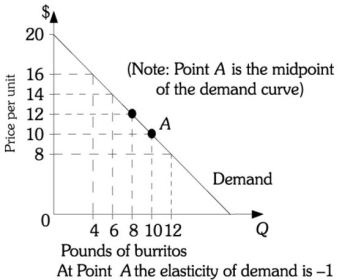 Figure 13.3
-Refer to Figure 13.3. This firm's marginal revenue will be positive at
Figure 13.3
-Refer to Figure 13.3. This firm's marginal revenue will be positive at (Multiple Choice)
4.8/5 (78)
(78) Refer to the information provided in Figure 13.3 below to answer the question(s) that follow. Figure 13.3
-Refer to Figure 13.3. The marginal revenue of the 12th pound of burritos is
Figure 13.3
-Refer to Figure 13.3. The marginal revenue of the 12th pound of burritos is (Multiple Choice)
4.8/5 (82)
(82) Monopoly pricing creates a social loss that is captured by no one.
(True/False)
4.8/5 (87)
(87) Relative to a profit-maximizing competitively organized industry that is producing 6,000 units of output at a price of $7 per unit, firms acting collusively under the same circumstances would produce ________ units of output and charge a price of ________ per unit.
(Multiple Choice)
4.9/5 (80)
(80) Refer to the information provided in Figure 13.11 below to answer the question(s) that follow.  Figure 13.11
-Refer to Figure 13.11. Suppose a monopolist faces the demand and costs in the figure and is able to perfectly price discriminate. How many widgets does the monopoly supply when they act so as to maximize their profits?
Figure 13.11
-Refer to Figure 13.11. Suppose a monopolist faces the demand and costs in the figure and is able to perfectly price discriminate. How many widgets does the monopoly supply when they act so as to maximize their profits? (Multiple Choice)
4.7/5 (76)
(76) Refer to the information provided in Figure 13.6 below to answer the question that follows.  Figure 13.6
-Refer to Figure 13.6. The Memory Company's ________ level of output is 200 high school yearbooks.
Figure 13.6
-Refer to Figure 13.6. The Memory Company's ________ level of output is 200 high school yearbooks. (Multiple Choice)
4.9/5 (76)
(76) Because the marginal revenue curve for a monopolist lies below its demand curve, the profit-maximizing price of the monopolist will be above marginal cost.
(True/False)
5.0/5 (66)
(66) Which of the following is not an example of price discrimination?
(Multiple Choice)
4.7/5 (88)
(88) 
Filters
- Essay(0)
- Multiple Choice(0)
- Short Answer(0)
- True False(0)
- Matching(0)