



 Chat with AI
Exam 13: Monopoly and Antitrust Policy

Exam 1: The Scope and Method of Economics241 Questions
Exam 2: The Economic Problem: Scarcity and Choice218 Questions
Exam 3: Demand, Supply, and Market Equilibrium309 Questions
Exam 4: Demand and Supply Applications173 Questions
Exam 5: Elasticity188 Questions
Exam 6: Household Behavior and Consumer Choice272 Questions
Exam 7: The Production Process: the Behavior of Profit-Maximizing Firms287 Questions
Exam 8: Short-Run Costs and Output Decisions386 Questions
Exam 9: Long-Run Costs and Output Decisions363 Questions
Exam 10: Input Demand: the Labor and Land Markets200 Questions
Exam 11: Input Demand: the Capital Market and the Investment Decision218 Questions
Exam 12: General Equilibrium and the Efficiency of Perfect Competition202 Questions
Exam 13: Monopoly and Antitrust Policy394 Questions
Exam 14: Oligopoly219 Questions
Exam 15: Monopolistic Competition235 Questions
Exam 16: Externalities, Public Goods, and Common Resources275 Questions
Exam 17: Uncertainty and Asymmetric Information134 Questions
Exam 18: Income Distribution and Poverty197 Questions
Exam 19: Public Finance: the Economics of Taxation281 Questions
Exam 20: International Trade, Comparative Advantage, and Protectionism287 Questions
Exam 21: Economic Growth in Developing Economies133 Questions
Exam 22: Critical Thinking About Research104 Questions
Select questions type


The Federal Trade Commission was created by Congress in the same year that the Clayton Act was passed.
(True/False)
4.9/5  (67)
(67) A profit-maximizing monopolist will ________ where marginal revenue is equal to marginal cost.
(Multiple Choice)
4.8/5 (74)
(74) Farmers lobbying the government for agricultural price supports are engaging in rent-seeking behavior.
(True/False)
5.0/5 (89)
(89) If a monopolist is producing an output at a point where ATC > P > MC, then it is
(Multiple Choice)
4.8/5 (84)
(84) When a monopolist sells two units of output its total revenue is $600. When a monopolist sells three units of output its total revenue is $690. In order to sell three units of output instead of only two, the monopolist must
(Multiple Choice)
4.9/5 (73)
(73) Refer to the information provided in Table 13.1 below to answer the question(s) that follow.
Table 13.1
Price (\ ) Quantity 4.00 2,000 3.50 2,400 3.00 2,800 2.50 3,200 2.00 3,600 1.50 4,000 1.00 4,400
-Refer to Table 13.1. If a monopoly faces the demand schedule given in the table and has a constant marginal and average cost of $1 per unit of providing the product, what price should it charge per unit of output so as to maximize its profits?
(Multiple Choice)
4.9/5 (94)
(94) Which of the following made tying contracts illegal and banned price discrimination with the intent to monopolize?
(Multiple Choice)
4.7/5 (88)
(88) Refer to the information provided in Figure 13.6 below to answer the question that follows.  Figure 13.6
-Refer to Figure 13.6. The Memory Company's ________ is $800.
Figure 13.6
-Refer to Figure 13.6. The Memory Company's ________ is $800. (Multiple Choice)
4.9/5 (88)
(88) A monopolist who has a horizontal ATC schedule and perfectly price discriminates
(Multiple Choice)
4.7/5 (87)
(87) A monopolist will ________ if marginal revenue is negative.
(Multiple Choice)
4.8/5 (76)
(76) When a monopolist incurs a loss in the short run, it will stop producing if
(Multiple Choice)
4.8/5 (95)
(95) Refer to the information provided in Figure 13.3 below to answer the question(s) that follow. 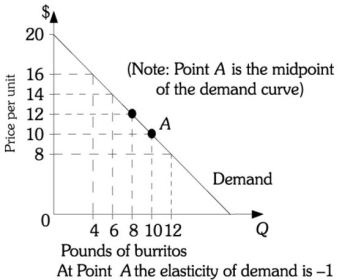 Figure 13.3
-Refer to Figure 13.3. This firm's ________ will be maximized at a price of $10.
Figure 13.3
-Refer to Figure 13.3. This firm's ________ will be maximized at a price of $10. (Multiple Choice)
4.9/5 (84)
(84) Refer to the information provided in Figure 13.6 below to answer the question that follows. Figure 13.6
-Refer to Figure 13.6. The profit-maximizing price for the Memory Company's high school yearbook is
Figure 13.6
-Refer to Figure 13.6. The profit-maximizing price for the Memory Company's high school yearbook is (Multiple Choice)
5.0/5 (76)
(76) When a monopolist sells two units of output its total revenue is $600. When a monopolist sells three units of output its total revenue is $690. When the monopolist sells three units of output, the price per unit is
(Multiple Choice)
5.0/5 (99)
(99) 
Filters
- Essay(0)
- Multiple Choice(0)
- Short Answer(0)
- True False(0)
- Matching(0)