



 Chat with AI
Exam 14: Chemical Kinetics

Exam 1: Introduction: Matter and Measurement118 Questions
Exam 2: Atoms, Molecules, and Ions201 Questions
Exam 3: Stoichiometry: Calculations With Chemical Formulas and Equations134 Questions
Exam 4: Aqueous Reactions and Solution Stoichiometry147 Questions
Exam 6: Electronic Structure of Atoms161 Questions
Exam 7: Periodic Properties of the Elements149 Questions
Exam 8: Basic Concepts of Chemical Bonding116 Questions
Exam 10: Gases146 Questions
Exam 11: Intermolecular Forces, Liquids, and Solids103 Questions
Exam 12: Modern Materials47 Questions
Exam 13: Properties of Solutions121 Questions
Exam 14: Chemical Kinetics110 Questions
Exam 15: Chemical Equilibrium58 Questions
Exam 16: Acid-Base Equilibria97 Questions
Exam 17: Additional Aspects of Equilibria88 Questions
Exam 18: Chemistry of the Environment105 Questions
Exam 19: Chemical Thermodynamics101 Questions
Exam 20: Electrochemistry90 Questions
Exam 21: Nuclear Chemistry128 Questions
Exam 22: Chemistry of the Nonmetals176 Questions
Exam 23: Metals and Metallurgy112 Questions
Exam 24: Chemistry of Coordination Compounds124 Questions
Exam 25: The Chemistry of Life: Organic and Biological Chemistry115 Questions
Select questions type


The rate constant for a particular second- order reaction is 0.47 M- 1s- 1. If the initial concentration of reactant is 0.25 mol/L, it takes s for the concentration to decrease to 0.13 mol/L.
(Multiple Choice)
4.9/5  (82)
(82) The average rate of disappearance of I in the initial 400 s is _ M/s.
(Multiple Choice)
4.8/5 (84)
(84) The initial concentration of reactant in a first- order reaction is 0.27 M. The rate constant for the reaction is 0.75 s- 1. What is the concentration (mol/L) of reactant after 1.5 s?
(Multiple Choice)
4.9/5 (75)
(75) Nitrogen dioxide decomposes to nitric oxide and oxygen via the reaction:
2NO2 → 2NO + O2
In a particular experiment at 300°C, [NO2] drops from 0.0100 to 0.00650 M in 100 s. The rate of appearance of O2 for this period is _ M/s.
(Multiple Choice)
4.9/5 (75)
(75) One difference between first- and second- order reactions is that .
(Multiple Choice)
4.9/5 (82)
(82) The reaction A - B is first order in [A]. Consider the following data.  -The rate constant for this reaction is s- 1.
 (Multiple Choice)
4.8/5 (75)
(75) A flask is charged with 0.124 mol of A and allowed to react to form B according to the reaction A(g) -B(g). The following data are obtained for [A] as the reaction proceeds:  -The average rate of disappearance of A between 20 s and 40 s is mol/s.
 (Multiple Choice)
4.9/5 (82)
(82) At elevated temperatures, methylisonitrile (CH3NC) isomerizes to acetonitrile (CH3CN):
CH3NC (g) → CH3CN (g)
The dependence of the rate constant on temperature is studied and the graph below is prepared from the results.
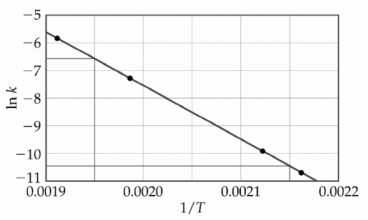 The energy of activation of this reaction is kJ/mol.
 (Multiple Choice)
4.7/5 (80)
(80) At elevated temperatures, methylisonitrile (CH3NC) isomerizes to acetonitrile (CH3CN):
CH3NC (g) → CH33CN (g)
The reaction is first order in methylisonitrile. The attached graph shows data for the reaction obtained at 198.9°C.
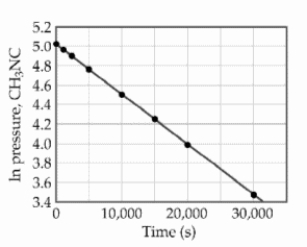 The rate constant for the reaction is s- 1.
 (Multiple Choice)
4.8/5 (74)
(74) The data in the table below were obtained for the reaction:
2 ClO2 (aq) + 2 OH- (aq) → ClO3- (aq) + ClO2- (aq) + H2O (1) 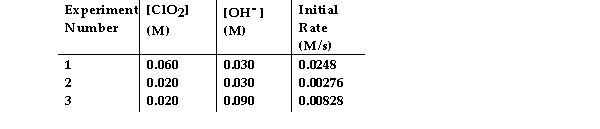 -What is the overall order of the reaction?
 (Multiple Choice)
4.9/5 (77)
(77) The rate of a second order reaction can depend on the concentrations of more than one reactant .
(True/False)
4.8/5 (86)
(86) The average rate of disappearance of I between 1200 s and 1600 s is _ M/s.
(Multiple Choice)
4.9/5 (75)
(75) The half life for a first order rate law depends on the starting concentration.
(True/False)
4.9/5 (92)
(92) A second- order reaction has a half- life of 18 s when the initial concentration of reactant is 0.71 M. The rate constant for this reaction is M- 1s- 1.
(Multiple Choice)
4.8/5 (89)
(89) The overall reactions and rate laws for several reactions are given below. Of these, only _ could represent an elementary step.
(Multiple Choice)
4.9/5 (74)
(74) The instantaneous rate of a reaction can be determined from the graph of molarity versus time at any point on the graph.
(True/False)
4.8/5 (69)
(69) A flask is charged with 0.124 mol of A and allowed to react to form B according to the reaction A(g) -B(g). The following data are obtained for [A] as the reaction proceeds:  -How many moles of B are present at 30 s?
 (Multiple Choice)
4.9/5 (90)
(90) The reaction A (aq) - B (aq) is first order in [A]. A solution is prepared with [A] = 1.22 M. The following data are obtained as the reaction proceeds:
 The rate constant for this reaction is s- 1.
 (Multiple Choice)
4.8/5 (86)
(86) 
Filters
- Essay(0)
- Multiple Choice(0)
- Short Answer(0)
- True False(0)
- Matching(0)