



 Chat with AI
Exam 14: Chemical Kinetics

Exam 1: Introduction: Matter and Measurement118 Questions
Exam 2: Atoms, Molecules, and Ions201 Questions
Exam 3: Stoichiometry: Calculations With Chemical Formulas and Equations134 Questions
Exam 4: Aqueous Reactions and Solution Stoichiometry147 Questions
Exam 6: Electronic Structure of Atoms161 Questions
Exam 7: Periodic Properties of the Elements149 Questions
Exam 8: Basic Concepts of Chemical Bonding116 Questions
Exam 10: Gases146 Questions
Exam 11: Intermolecular Forces, Liquids, and Solids103 Questions
Exam 12: Modern Materials47 Questions
Exam 13: Properties of Solutions121 Questions
Exam 14: Chemical Kinetics110 Questions
Exam 15: Chemical Equilibrium58 Questions
Exam 16: Acid-Base Equilibria97 Questions
Exam 17: Additional Aspects of Equilibria88 Questions
Exam 18: Chemistry of the Environment105 Questions
Exam 19: Chemical Thermodynamics101 Questions
Exam 20: Electrochemistry90 Questions
Exam 21: Nuclear Chemistry128 Questions
Exam 22: Chemistry of the Nonmetals176 Questions
Exam 23: Metals and Metallurgy112 Questions
Exam 24: Chemistry of Coordination Compounds124 Questions
Exam 25: The Chemistry of Life: Organic and Biological Chemistry115 Questions
Select questions type


A flask is charged with 0.124 mol of A and allowed to react to form B according to the reaction A(g) -B(g). The following data are obtained for [A] as the reaction proceeds:  -How many moles of B are present at 10 s?
 (Multiple Choice)
4.7/5  (76)
(76) The data in the table below were obtained for the reaction:
A + B - P 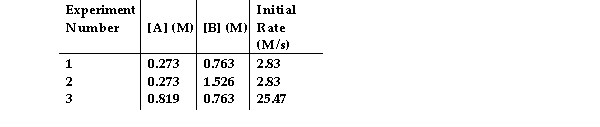 -The order of the reaction in B is _ .
 (Multiple Choice)
4.8/5 (82)
(82) The reaction A - B is first order in [A]. Consider the following data.  -The rate constant for this reaction is s- 1.
 (Multiple Choice)
4.8/5 (82)
(82) SO2Cl2 decomposes in the gas phase by the reaction SO2Cl2 (g) →SO2 (g) + Cl2 (g)
The reaction is first order in SO2Cl2 and the rate constant is 3.0 × 10- 6 s- 1at 600 K. A vessel is charged with 2.4 atm of SO2Cl2 at 600 K. The partial pressure of SO2Cl2 at 3.0 × 10⁵ s is
Atm)
(Multiple Choice)
4.8/5 (85)
(85) The combustion of ethylene proceeds by the reaction C2H4 (g) + 3O2 (g) →2CO2 (g) + 2H2O (g)
When the rate of disappearance of O2 is 0.28 M s- 1, the rate of appearance of CO2 is _ _ M s- 1.
(Multiple Choice)
4.8/5 (90)
(90) Reaction rates are affected by reactant concentrations and temperature. This is accounted for by the .
(Short Answer)
4.9/5 (79)
(79) The isomerization of methylisonitrile to acetonitrile CH3NC (g) → CH3CN (g)
Is first order in CH3NC. The half life of the reaction is 1.60 × 10⁵ s at 444 K. The rate constant when the initial [CH3NC] is 0.030 M is _ s- 1.
(Multiple Choice)
4.8/5 (67)
(67) The relationship of absorbed light to the concentration of the substance absorbing the light is governed by .
(Short Answer)
4.9/5 (85)
(85) The elementary reaction
2NO2 (g) → 2NO (g) + O2 (g)
Is second order in NO2 and the rate constant at 501 K is 7.93 × 10- 3 M- 1s- 1. The reaction half- life at this temperature when [NO2]0 = 0.450 M is s.
(Multiple Choice)
4.9/5 (92)
(92) The data in the table below were obtained for the reaction:
2 ClO2 (aq) + 2 OH- (aq) → ClO3- (aq) + ClO2- (aq) + H2O (1) 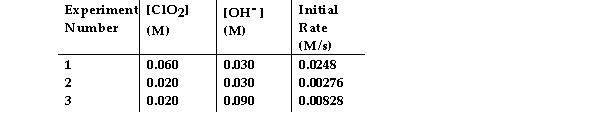 -What is the order of the reaction with respect to OH- ?
 (Multiple Choice)
5.0/5 (86)
(86) If the rate law for the reaction  is first order in A and second order in B, then the rate law is rate = .
 (Multiple Choice)
5.0/5 (87)
(87) At elevated temperatures, methylisonitrile (CH3NC) isomerizes to acetonitrile (CH3CN):
CH3NC (g) → CH3CN (g)
At the start of the experiment, there are 0.200 mol of reactant (CH3NC) and 0 mol of product (CH3CN) in the reaction vessel. After 25 min of reaction, 0.108 mol of reactant (CH3NC) remain. The average rate of decomposition of methyl isonitrile, CH3NC, in this 25 min period is mol/min.
(Multiple Choice)
4.8/5 (88)
(88) Consider the following reaction:
3A - 2B
The average rate of appearance of B is given by O[B]/Ot. Comparing the rate of appearance of B and the rate of disappearance of A, we get O[B]/Ot = × (- O[A]/Ot).
(Multiple Choice)
4.8/5 (87)
(87) A flask is charged with 0.124 mol of A and allowed to react to form B according to the reaction A(g) -B(g). The following data are obtained for [A] as the reaction proceeds:  -The average rate of appearance of B between 20 s and 30 s is mol/s.
 (Multiple Choice)
4.8/5 (68)
(68) The average rate disappearance of A between 20 s and 30 s is mol/s.
(Multiple Choice)
4.9/5 (87)
(87) Nitrogen dioxide decomposes to nitric oxide and oxygen via the reaction:
2NO2 → 2NO + O2
In a particular experiment at 300°C, [NO2] drops from 0.0100 to 0.00650 M in 100 s. The rate of disappearance of NO2 for this period is _ M/s.
(Multiple Choice)
4.9/5 (86)
(86) The number of molecules that participate as reactants defines the of the reaction.
(Short Answer)
5.0/5 (78)
(78) 
Filters
- Essay(0)
- Multiple Choice(0)
- Short Answer(0)
- True False(0)
- Matching(0)