



 Chat with AI
Exam 14: Chemical Kinetics

Exam 1: Introduction: Matter and Measurement118 Questions
Exam 2: Atoms, Molecules, and Ions201 Questions
Exam 3: Stoichiometry: Calculations With Chemical Formulas and Equations134 Questions
Exam 4: Aqueous Reactions and Solution Stoichiometry147 Questions
Exam 6: Electronic Structure of Atoms161 Questions
Exam 7: Periodic Properties of the Elements149 Questions
Exam 8: Basic Concepts of Chemical Bonding116 Questions
Exam 10: Gases146 Questions
Exam 11: Intermolecular Forces, Liquids, and Solids103 Questions
Exam 12: Modern Materials47 Questions
Exam 13: Properties of Solutions121 Questions
Exam 14: Chemical Kinetics110 Questions
Exam 15: Chemical Equilibrium58 Questions
Exam 16: Acid-Base Equilibria97 Questions
Exam 17: Additional Aspects of Equilibria88 Questions
Exam 18: Chemistry of the Environment105 Questions
Exam 19: Chemical Thermodynamics101 Questions
Exam 20: Electrochemistry90 Questions
Exam 21: Nuclear Chemistry128 Questions
Exam 22: Chemistry of the Nonmetals176 Questions
Exam 23: Metals and Metallurgy112 Questions
Exam 24: Chemistry of Coordination Compounds124 Questions
Exam 25: The Chemistry of Life: Organic and Biological Chemistry115 Questions
Select questions type


The combustion of ethylene proceeds by the reaction C2H4 (g) + 3O2 (g) → 2CO2 (g) + 2H2O (g)
When the rate of disappearance of O2 is 0.23 M s- 1, the rate of disappearance of C2H4 is
M s- 1.
(Multiple Choice)
4.9/5  (84)
(84) A burning splint will burn more vigorously in pure oxygen than in air because
(Multiple Choice)
4.8/5 (85)
(85) Which substance in the reaction below either appears or disappears the fastest? 4NH3 + 7O2 → 4NO2 + 6H2O
(Multiple Choice)
4.9/5 (83)
(83) The active site of nitrogenase is a cofactor that contains two transition metals. These transition metals are .
(Multiple Choice)
4.8/5 (89)
(89) The rate law of a reaction is rate = k[D][X]. The units of the rate constant are _ _.
(Multiple Choice)
4.9/5 (78)
(78) A particular first- order reaction has a rate constant of 1.35 × 10² s- 1 at 25°C. What is the magnitude of k at 75°C if Ea = 85.6 kJ/mol?
(Multiple Choice)
4.8/5 (70)
(70) A reaction was found to be zero order in A. Increasing the concentration of A by a factor of 3 will cause the reaction rate to .
(Multiple Choice)
4.8/5 (81)
(81) A first- order reaction has a rate constant of 0.33 min- 1. It takes min for the reactant concentration to decrease from 0.13 M to 0.088 M.
(Multiple Choice)
4.9/5 (86)
(86) The overall order of a reaction is 2. The units of the rate constant for the reaction are .
(Multiple Choice)
4.8/5 (84)
(84) SO2Cl2 decomposes in the gas phase by the reaction SO2Cl2 (g) →SO2 (g) + Cl2 (g)
The reaction is first order in SO2Cl2 and the rate constant is 3.0 × 10- 6 s- 1at 600 K. A vessel is charged with 3.3 atm of SO2Cl2 at 600 K. The partial pressure of SO2 at 3.0 × 10⁵ s is _ _ atm.
(Multiple Choice)
4.8/5 (87)
(87) The reaction A - B is first order in [A]. Consider the following data.  -The half- life of this reaction is s.
 (Multiple Choice)
4.7/5 (95)
(95) The rate law of the overall reaction  is rate = k[A]2. Which of the following will not increase the rate of the reaction?
 (Multiple Choice)
5.0/5 (77)
(77) The reaction A - B is first order in [A]. Consider the following data.  -The concentration of A is M after 40.0 s.
 (Multiple Choice)
4.7/5 (86)
(86) Of the following, will lower the activation energy for a reaction.
(Multiple Choice)
4.9/5 (88)
(88) The data in the table below were obtained for the reaction:
2 ClO2 (aq) + 2 OH- (aq) →ClO3- (aq) + ClO2- (aq) + H2O (1) 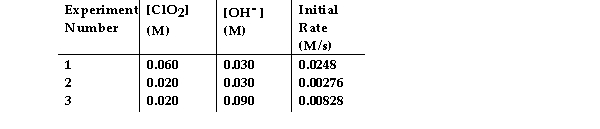 -What is the order of the reaction with respect to ClO2?
 (Multiple Choice)
4.9/5 (69)
(69) As the temperature of a reaction is increased, the rate of the reaction increases because the
(Multiple Choice)
4.8/5 (91)
(91) 
Filters
- Essay(0)
- Multiple Choice(0)
- Short Answer(0)
- True False(0)
- Matching(0)