



 Chat with AI
Exam 3: Topics in Deifferentiation

Exam 1: Limits and Continuity186 Questions
Exam 2: The Derivative198 Questions
Exam 3: Topics in Deifferentiation171 Questions
Exam 4: The Derivative in Graphing and Applications656 Questions
Exam 5: Integration323 Questions
Exam 6: Applications of the Definite Integral in Geometry, Science and Engineering314 Questions
Exam 7: Principle of Integral Evaluation269 Questions
Exam 8: Mathematical Modeling With Differential Equations77 Questions
Exam 9: Infinte Series288 Questions
Exam 10: Parametric and Polar Curves; Conic Sections199 Questions
Exam 11: Three-Dimensional Space; Vectors173 Questions
Exam 12: Vector-Valued Functions147 Questions
Exam 13: Partial Derivatives194 Questions
Exam 14: Multiple Integrals117 Questions
Exam 15: Topics in Vector Calculus149 Questions
Select questions type


 .

When a spherical ball of metal is heated, the radius of the sphere increases by 0.3% per degree increase in temperature. Use differentials to estimate the percentage increase in the surface area and volume of the ball per degree increase in temperature. 
(Essay)
4.8/5  (83)
(83) 
Answer true or false. A plane is approaching an observer with a horizontal speed of 140ft/s and is currently 7,000ft from being directly overhead at an altitude of 12,000ft. The rate at which the angle of elevation, , is changing with respect to time, d /dt = (1/x)dy/dt. Where x is the horizontal distance and y is the altitude.
(True/False)
4.9/5 (75)
(75) When a cubical block of metal is heated, each edge increases by 0.1% per degree increase in temperature. Use differentials to estimate the percentage increase in the surface area and volume of the block per degree increase in temperature.
(Essay)
4.9/5 (78)
(78) 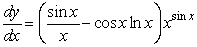 .
The magnetic force F acting on a particle is given by  , where r is the distance from the magnetic source and k is a constant. r is measured to be 4cm with a possible error of ±3%. Use differentials to estimate the error in the calculated value of F.
 (Essay)
4.9/5 (87)
(87)  .
 .
Gravitational force is inversely proportional to the distance between two objects squared. If F =  at a distance d = 3m, how fast is the force diminishing if the objects are moving away from each other at 1.2 m/s?
 (Short Answer)
4.8/5 (84)
(84) The power in watts for a circuit is given by P = I 2R. How fast is the power changing if the resistance, R, of the circuit is 900 , the current, I, is 7.7A, and the current is decreasing with respect to time at a rate of 0.025 A/s? (Assume the resistance is constant.)
(Short Answer)
4.9/5 (89)
(89)  if
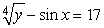 .
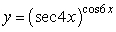 , find
 .
Answer true or false. Suppose z = 3yx. Then dz/dt = 3x(dy/dt)+3y(dx/dt).
(True/False)
4.9/5 (76)
(76) 
Filters
- Essay(0)
- Multiple Choice(0)
- Short Answer(0)
- True False(0)
- Matching(0)