



 Chat with AI
Exam 3: Topics in Deifferentiation

Exam 1: Limits and Continuity186 Questions
Exam 2: The Derivative198 Questions
Exam 3: Topics in Deifferentiation171 Questions
Exam 4: The Derivative in Graphing and Applications656 Questions
Exam 5: Integration323 Questions
Exam 6: Applications of the Definite Integral in Geometry, Science and Engineering314 Questions
Exam 7: Principle of Integral Evaluation269 Questions
Exam 8: Mathematical Modeling With Differential Equations77 Questions
Exam 9: Infinte Series288 Questions
Exam 10: Parametric and Polar Curves; Conic Sections199 Questions
Exam 11: Three-Dimensional Space; Vectors173 Questions
Exam 12: Vector-Valued Functions147 Questions
Exam 13: Partial Derivatives194 Questions
Exam 14: Multiple Integrals117 Questions
Exam 15: Topics in Vector Calculus149 Questions
Select questions type


The number of board feet of lumber in a log that is 10 feet long is given by the formula  , where D is the diameter of the tree in inches. In a tree that will produce a 10 foot log and has a current diameter of 22 inches, the diameter is changing at a rate of 3.45 inches per year. How fast is the volume increasing?
 (Multiple Choice)
4.8/5  (74)
(74)  .
Let y = x3 - 3. Find dy if dx = 1 and the initial value of x is x = 3.
(Short Answer)
4.9/5 (76)
(76)  .

 . Find
The number of board feet of lumber in a log that is 12 feet long is given by the formula 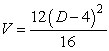 , where D is the diameter of the tree in inches and V is the volume of the tree in ft3. In a tree that will produce a 12 foot log and has a current diameter of 13 inches, the diameter is changing at a rate of 2.1 inches per year. How fast is the volume increasing?
 (Short Answer)
4.8/5 (73)
(73)  .
The sides of an equilateral triangle are increasing at the rate of 8 centimeters per hour. At what rate is the area increasing when the side is 20 centimeters? (Round your answer to three decimal places.)
(Essay)
4.8/5 (87)
(87)  .
 if
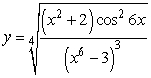 .
 .
 .
The elastic modulus of a piece of steel rod under a load of 1200 pounds, is given by the formula  , L is the original, unloaded, length in inches, A is the cross-sectional area in square inches, and l is the elongation (in inches) due to a load. A 24 inch long steel rod having a cross-sectional area of A = 2.85 square inches, is stretching 0.009 inches under a load of 1200 pounds. Due to changes in temperature, the elastic modulus E of the rod is changing. Find the rate of change of the elastic modulus if the elongation is currently 0.009 and is changing at a rate of 0.00037 in/s.
 (Short Answer)
4.7/5 (74)
(74) 
Filters
- Essay(0)
- Multiple Choice(0)
- Short Answer(0)
- True False(0)
- Matching(0)