



 Chat with AI
Exam 9: Infinte Series

Exam 1: Limits and Continuity186 Questions
Exam 2: The Derivative198 Questions
Exam 3: Topics in Deifferentiation171 Questions
Exam 4: The Derivative in Graphing and Applications656 Questions
Exam 5: Integration323 Questions
Exam 6: Applications of the Definite Integral in Geometry, Science and Engineering314 Questions
Exam 7: Principle of Integral Evaluation269 Questions
Exam 8: Mathematical Modeling With Differential Equations77 Questions
Exam 9: Infinte Series288 Questions
Exam 10: Parametric and Polar Curves; Conic Sections199 Questions
Exam 11: Three-Dimensional Space; Vectors173 Questions
Exam 12: Vector-Valued Functions147 Questions
Exam 13: Partial Derivatives194 Questions
Exam 14: Multiple Integrals117 Questions
Exam 15: Topics in Vector Calculus149 Questions
Select questions type


Find the first three nonzero terms of the Maclaurin series for the function  by using an appropriate substitution in a known Maclaurin series and performing any algebraic operations that are required. State the radius of convergence of the series.
 (Short Answer)
4.8/5  (86)
(86) Determine whether or not the following series converges. If it converges, find its sum. 
(Short Answer)
5.0/5 (91)
(91) Use differentiation to determine whether the sequence is strictly increasing or strictly decreasing, or neither. 
(Short Answer)
4.8/5 (99)
(99) 


Determine whether or not the following sequence converges. If it does converge, what is its limit? Enter "Yes" if the sequence converges, and "No" if it does not. 
(Short Answer)
4.7/5 (78)
(78) Find the first three nonzero terms of the Maclaurin series for the function  by using an appropriate substitution in a known Maclaurin series and performing any algebraic operations that are required.
 (Multiple Choice)
4.8/5 (77)
(77) Find the first three nonzero terms of the Maclaurin series for the function  by using an appropriate substitution in a known Maclaurin series and performing any algebraic operations that are required. State the radius of convergence of the series.
 (Short Answer)
4.9/5 (82)
(82) Classify the following series as absolutely convergent, conditionally convergent, or divergent. 
(Short Answer)
4.9/5 (78)
(78) 
Use a suitable Maclaurin Series to estimate  to five decimal place accuracy.
 (Multiple Choice)
4.8/5 (81)
(81) Use the limit comparison test to determine whether or not the following series converges. 
(Multiple Choice)
4.9/5 (76)
(76) Determine whether or not the following series converges. Enter 'Yes' if the series converges, and 'No' if it diverges. 
(Short Answer)
4.8/5 (83)
(83) Determine whether or not the following series converges. Enter 'Yes' if the series converges, and 'No' if it diverges. 
(Short Answer)
4.8/5 (77)
(77) 
Find the Maclaurin polynomial of order 2 for  by multiplying known Maclaurin series for the two functions.
 (Short Answer)
4.8/5 (79)
(79) Determine whether or not the following series converges. Enter 'Yes' if the series converges, and 'No' if it diverges. 
(Short Answer)
4.8/5 (91)
(91) Use differentiation to determine whether the sequence is strictly increasing or strictly decreasing, or neither. 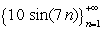
(Short Answer)
5.0/5 (89)
(89) Classify the following series as absolutely convergent, conditionally convergent, or divergent. 
(Multiple Choice)
4.8/5 (77)
(77) 
Filters
- Essay(0)
- Multiple Choice(0)
- Short Answer(0)
- True False(0)
- Matching(0)