



 Chat with AI
Exam 9: Infinte Series

Exam 1: Limits and Continuity186 Questions
Exam 2: The Derivative198 Questions
Exam 3: Topics in Deifferentiation171 Questions
Exam 4: The Derivative in Graphing and Applications656 Questions
Exam 5: Integration323 Questions
Exam 6: Applications of the Definite Integral in Geometry, Science and Engineering314 Questions
Exam 7: Principle of Integral Evaluation269 Questions
Exam 8: Mathematical Modeling With Differential Equations77 Questions
Exam 9: Infinte Series288 Questions
Exam 10: Parametric and Polar Curves; Conic Sections199 Questions
Exam 11: Three-Dimensional Space; Vectors173 Questions
Exam 12: Vector-Valued Functions147 Questions
Exam 13: Partial Derivatives194 Questions
Exam 14: Multiple Integrals117 Questions
Exam 15: Topics in Vector Calculus149 Questions
Select questions type


Find the first four nonzero terms of the Maclaurin series for the function  by using an appropriate substitution in a known Maclaurin series and performing any algebraic operations that are required.
 (Multiple Choice)
4.9/5  (80)
(80) Classify the following series as absolutely convergent, conditionally convergent, or divergent. 
(Short Answer)
4.9/5 (71)
(71) The following are the first five terms of an infinite sequence. Find a formula for the general term starting with n = 1 , and write down the entire sequence. 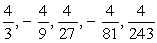
(Multiple Choice)
4.7/5 (89)
(89) Classify the following series as absolutely convergent, conditionally convergent, or divergent. 
(Multiple Choice)
4.9/5 (68)
(68) Determine whether or not the following sequence converges. If it does converge, what is its limit? Enter "Yes" if the sequence converges, and "No" if it does not. 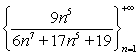
(Short Answer)
4.9/5 (75)
(75) Determine whether or not the following series converges. Enter 'Yes' if the series converges, and 'No' if it diverges. 
(Short Answer)
4.9/5 (76)
(76) Classify the following series as absolutely convergent, conditionally convergent, or divergent. 
(Multiple Choice)
5.0/5 (78)
(78) 


Use the Remainder Estimation Theorem to find an interval containing 0 over which  can be approximated by
 within an accuracy of
 .
can be approximated by within an accuracy of . (Short Answer)
4.9/5 (93)
(93) 
Determine whether or not the following sequence converges. If it does converge, what is its limit? Enter "Yes" if the sequence converges, and "No" if it does not. 
(Short Answer)
4.9/5 (71)
(71) Find the first three nonzero terms of the Maclaurin series for the function  by multiplying the Maclaurin series for the factors.
 (Multiple Choice)
4.7/5 (79)
(79) Classify the following series as absolutely convergent, conditionally convergent, or divergent. 
(Short Answer)
4.9/5 (85)
(85) 

Find the first four nonzero terms of the Maclaurin series for the function  by using an appropriate substitution in a known Maclaurin series and performing any algebraic operations that are required.
 (Multiple Choice)
4.9/5 (85)
(85) 

Filters
- Essay(0)
- Multiple Choice(0)
- Short Answer(0)
- True False(0)
- Matching(0)