



 Chat with AI
Exam 9: Infinte Series

Exam 1: Limits and Continuity186 Questions
Exam 2: The Derivative198 Questions
Exam 3: Topics in Deifferentiation171 Questions
Exam 4: The Derivative in Graphing and Applications656 Questions
Exam 5: Integration323 Questions
Exam 6: Applications of the Definite Integral in Geometry, Science and Engineering314 Questions
Exam 7: Principle of Integral Evaluation269 Questions
Exam 8: Mathematical Modeling With Differential Equations77 Questions
Exam 9: Infinte Series288 Questions
Exam 10: Parametric and Polar Curves; Conic Sections199 Questions
Exam 11: Three-Dimensional Space; Vectors173 Questions
Exam 12: Vector-Valued Functions147 Questions
Exam 13: Partial Derivatives194 Questions
Exam 14: Multiple Integrals117 Questions
Exam 15: Topics in Vector Calculus149 Questions
Select questions type


Classify the following series as absolutely convergent, conditionally convergent, or divergent. 
(Multiple Choice)
4.8/5  (74)
(74)  to three decimal-place accuracy.

Determine whether or not the following sequence converges. If it does converge, what is its limit? Enter "Yes" if the sequence converges, and "No" if it does not. 
(Short Answer)
4.7/5 (75)
(75) Determine whether or not the following series converges. If it converges, find its sum. 
(Multiple Choice)
4.8/5 (72)
(72) 

Determine whether or not the following series converges. If it converges, find its sum. 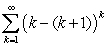
(Multiple Choice)
4.8/5 (63)
(63) 

Determine whether or not the following series converges. If it converges, find its sum. 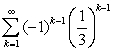
(Short Answer)
4.9/5 (76)
(76)  to three decimal-place accuracy.
Determine whether or not the following sequence converges. If it does converge, what is its limit? Enter "Yes" if the sequence converges, and "No" if it does not. 
(Short Answer)
4.8/5 (73)
(73) 

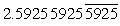


Find the Taylor polynomial of order 3 for the function  centered at
 .
centered at . (Short Answer)
4.7/5 (75)
(75) Use  to determine if the sequence is strictly increasing, strictly decreasing, or neither.

to determine if the sequence is strictly increasing, strictly decreasing, or neither. (Short Answer)
4.9/5 (70)
(70) 
Filters
- Essay(0)
- Multiple Choice(0)
- Short Answer(0)
- True False(0)
- Matching(0)