



 Chat with AI
Exam 18: International Trade and Comparative Advantage

Exam 1: What Is Economics226 Questions
Exam 2: The Economy Myth and Reality152 Questions
Exam 3: The Fundamental Economic Problem Scarcity and Choice250 Questions
Exam 4: Supply and Demand An Initial Look298 Questions
Exam 5: An Introduction To Macroeconomics215 Questions
Exam 6: The Goals Of Macroeconomic Policy211 Questions
Exam 7: Economic Growth Theory And Policy228 Questions
Exam 8: Aggregate Demand and The Powerful Consumer218 Questions
Exam 9: Demand Side Equilibrium Unemployment Or Inflation 212 Questions
Exam 10: Bringing In The Supply Side Unemployment and Inflation 228 Questions
Exam 11: Managing Aggregate Demand Fiscal Policy209 Questions
Exam 12: Money and The Banking System222 Questions
Exam 13: Monetary Policy Conventional and Unconventional204 Questions
Exam 14: The Financial Crisis and The Great Recession61 Questions
Exam 15: The Debate Over Monetary and Fiscal Policy215 Questions
Exam 16: Budget Deficits In The Short and Long Run210 Questions
Exam 17: The Trade Off Between Inflation and Unemployment219 Questions
Exam 18: International Trade and Comparative Advantage207 Questions
Exam 19: The International Monetary System Order Or Disorder 217 Questions
Exam 20: Exchange Rates and The Macroeconomy209 Questions
Select questions type


If a country produces a commodity in the range of decreasing returns to scale,and the country begins to export more in a pure free trade system,the domestic price of the commodity will
(Multiple Choice)
4.9/5  (72)
(72) A program of protection that results in preserving jobs in certain industries
(Multiple Choice)
4.7/5 (88)
(88) If all countries produce the goods for which they have comparative advantages,all countries benefit with the increased production of goods with no additional resources being used.
(True/False)
5.0/5 (78)
(78) In William Safire's 1983 essay,"Smoot-Hawley Lives," he argues that the United States should
(Multiple Choice)
4.9/5 (79)
(79)  -From Figure 22-6,one can infer that
If the production possibilities curves of two countries have the same slope,
(Multiple Choice)
4.9/5 (94)
(94) Voluntary exchange is based on the principle that all parties must gain from trade.
(True/False)
4.9/5 (89)
(89) If the United States imposes a tariff on the import of Japanese cars instead of a quota,the price
(Multiple Choice)
4.9/5 (76)
(76) Figure 22-8  -Table 22-4 presents the demand and supply schedules for television sets in Japan and the United States.If the United States and Japan decide to trade with each other,what will happen to the output of television sets in Japan?
 (Multiple Choice)
4.8/5 (70)
(70) "Dumping" means destroying goods to prevent driving down the price.
(True/False)
4.8/5 (71)
(71) An essential point,among many,in the refutation of the "cheap foreign labor" argument is that
(Multiple Choice)
4.9/5 (94)
(94) Variability in exchange rates of currencies used in international trade
(Multiple Choice)
4.8/5 (69)
(69) Which of the following might lead a nation to engage in international trade?
(Multiple Choice)
4.9/5 (86)
(86) Figure 22-8
-Table 22-4 presents the demand and supply schedules for television sets in Japan and the United States.If Japan and the United States trade with each other,which country will export television sets and how many?
-Table 22-4 presents the demand and supply schedules for television sets in Japan and the United States.If Japan and the United States trade with each other,which country will export television sets and how many? (Multiple Choice)
4.8/5 (87)
(87) Figure 22-4 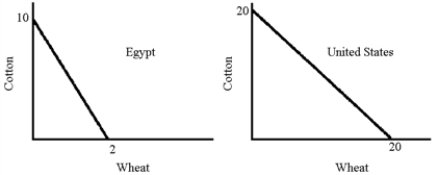 -In Figure 22-4,the opportunity cost of a unit of wheat in terms of cotton is
 (Multiple Choice)
4.8/5 (74)
(74) Figure 22-8
-Figure 22-8 has four sets of production possibility curves for two hypothetical countries.In which case will there be no advantage to trade between the two countries?
-Figure 22-8 has four sets of production possibility curves for two hypothetical countries.In which case will there be no advantage to trade between the two countries? (Multiple Choice)
4.8/5 (83)
(83) A restriction of imports that is accomplished by a quota normally
(Multiple Choice)
4.8/5 (77)
(77) 
Filters
- Essay(0)
- Multiple Choice(0)
- Short Answer(0)
- True False(0)
- Matching(0)