



 Chat with AI
Exam 18: International Trade and Comparative Advantage

Exam 1: What Is Economics226 Questions
Exam 2: The Economy Myth and Reality152 Questions
Exam 3: The Fundamental Economic Problem Scarcity and Choice250 Questions
Exam 4: Supply and Demand An Initial Look298 Questions
Exam 5: An Introduction To Macroeconomics215 Questions
Exam 6: The Goals Of Macroeconomic Policy211 Questions
Exam 7: Economic Growth Theory And Policy228 Questions
Exam 8: Aggregate Demand and The Powerful Consumer218 Questions
Exam 9: Demand Side Equilibrium Unemployment Or Inflation 212 Questions
Exam 10: Bringing In The Supply Side Unemployment and Inflation 228 Questions
Exam 11: Managing Aggregate Demand Fiscal Policy209 Questions
Exam 12: Money and The Banking System222 Questions
Exam 13: Monetary Policy Conventional and Unconventional204 Questions
Exam 14: The Financial Crisis and The Great Recession61 Questions
Exam 15: The Debate Over Monetary and Fiscal Policy215 Questions
Exam 16: Budget Deficits In The Short and Long Run210 Questions
Exam 17: The Trade Off Between Inflation and Unemployment219 Questions
Exam 18: International Trade and Comparative Advantage207 Questions
Exam 19: The International Monetary System Order Or Disorder 217 Questions
Exam 20: Exchange Rates and The Macroeconomy209 Questions
Select questions type


If two countries each are currently producing two goods,and each begins to specialize in the good in which it has a comparative advantage,what will happen to total (world)output?
(Multiple Choice)
4.8/5  (84)
(84) The two primary reasons to adopt measures to restrict trade are that
(Multiple Choice)
4.8/5 (79)
(79) From Table 22-1,the opportunity cost of one bushel of wheat in Great Britain is
(Multiple Choice)
4.8/5 (93)
(93) Trade occurs only when a country has an absolute advantage and not just a comparative advantage over another country.
(True/False)
4.9/5 (83)
(83) The U.S.Constitution prevents tariffs on trade between the individual states.
(True/False)
4.9/5 (88)
(88) Figure 22-8  -Table 22-4 presents the demand and supply schedules for television sets in Japan and the United States.If the United States and Japan trade with each other,what will happen to the output of television sets in the United States?
 (Multiple Choice)
5.0/5 (68)
(68) The basic concept behind strategic trade policy is that free trade is the best policy to pursue,but some countries don't play by those rules.Therefore,
(Multiple Choice)
4.9/5 (78)
(78) The trade philosophy of the Clinton administration is best characterized as
(Multiple Choice)
5.0/5 (75)
(75) Comparative advantage is the rule that ordinarily prevents a nation from independently producing all of the goods it requires.
(True/False)
4.8/5 (96)
(96) Both tariffs and quotas will restrict supplies coming into the country from abroad.
(True/False)
4.8/5 (64)
(64) If a nation imposes a tariff on imports,the portion of the tax paid by citizens depends upon
(Multiple Choice)
4.8/5 (74)
(74) Something other than exploiting cheap foreign labor must be driving international trade.
(True/False)
4.9/5 (73)
(73) Mercantilist policy is to do everything it can to promote exports and to discourage imports.
(True/False)
4.9/5 (73)
(73) Absolute advantage states that a country has an advantage over another if it can produce a good with fewer resources.
(True/False)
4.9/5 (68)
(68) What would be the output combination for two products A and B on the production possibility frontier,if a country uses its entire resources for producing A?
(Multiple Choice)
4.8/5 (81)
(81) Figure 22-8
-Table 22-4 presents the demand and supply schedules for television sets in Japan and the United States.If Japan and the United States trade with each other,what will be the equilibrium price in the world market for television sets?
-Table 22-4 presents the demand and supply schedules for television sets in Japan and the United States.If Japan and the United States trade with each other,what will be the equilibrium price in the world market for television sets? (Multiple Choice)
4.9/5 (89)
(89) An example of a quota that protects an American industry is the quota on
(Multiple Choice)
4.8/5 (77)
(77) Figure 22-3 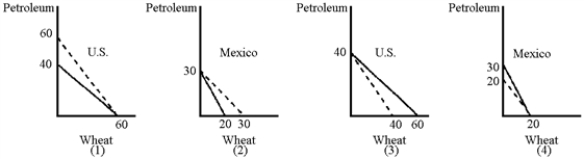 -In Figure 22-3,the solid lines represent the respective production possibilities curves for the United States and Mexico.Which graphs show the correct consumption possibilities curves (dashed lines)after an agreement is reached to trade 1 unit of wheat for 1 unit of petroleum?
 (Multiple Choice)
4.9/5 (66)
(66) If Japan imposes a quota on imports of rice,the effect will be
(Multiple Choice)
4.8/5 (79)
(79) 
Filters
- Essay(0)
- Multiple Choice(0)
- Short Answer(0)
- True False(0)
- Matching(0)