



 Chat with AI
Exam 18: International Trade and Comparative Advantage

Exam 1: What Is Economics226 Questions
Exam 2: The Economy Myth and Reality152 Questions
Exam 3: The Fundamental Economic Problem Scarcity and Choice250 Questions
Exam 4: Supply and Demand An Initial Look298 Questions
Exam 5: An Introduction To Macroeconomics215 Questions
Exam 6: The Goals Of Macroeconomic Policy211 Questions
Exam 7: Economic Growth Theory And Policy228 Questions
Exam 8: Aggregate Demand and The Powerful Consumer218 Questions
Exam 9: Demand Side Equilibrium Unemployment Or Inflation 212 Questions
Exam 10: Bringing In The Supply Side Unemployment and Inflation 228 Questions
Exam 11: Managing Aggregate Demand Fiscal Policy209 Questions
Exam 12: Money and The Banking System222 Questions
Exam 13: Monetary Policy Conventional and Unconventional204 Questions
Exam 14: The Financial Crisis and The Great Recession61 Questions
Exam 15: The Debate Over Monetary and Fiscal Policy215 Questions
Exam 16: Budget Deficits In The Short and Long Run210 Questions
Exam 17: The Trade Off Between Inflation and Unemployment219 Questions
Exam 18: International Trade and Comparative Advantage207 Questions
Exam 19: The International Monetary System Order Or Disorder 217 Questions
Exam 20: Exchange Rates and The Macroeconomy209 Questions
Select questions type


Figure 22-9  -In Figure 22-9,Pestoland exports pasta to Pastaland.The equilibrium price of pasta will be
 (Multiple Choice)
4.9/5  (78)
(78) Specialization permits larger outputs and offers economies of large-scale production.
(True/False)
4.9/5 (81)
(81) A quota reduces quantity sold by operating through the demand side of the market.
(True/False)
4.9/5 (91)
(91) If a nation can produce greater quantities of a good than another nation,it has a(n)
(Multiple Choice)
4.9/5 (65)
(65) Workers in high-wage countries cannot improve their real income when they trade with low-wage countries.
(True/False)
4.8/5 (80)
(80) Trade adjustment assistance in the United States began in 1962.The program
(Multiple Choice)
4.8/5 (70)
(70) Are there impediments to international movement of labor and capital?
(Multiple Choice)
4.9/5 (81)
(81) If two countries have production possibilities curves with different slopes,there is no possibility for gains from trade.
(True/False)
4.8/5 (74)
(74) The way in which a country benefits from trade is that it can
(Multiple Choice)
4.9/5 (80)
(80) Opening trade between a nation that has "cheap labor" and one that has "expensive labor" will
(Multiple Choice)
5.0/5 (83)
(83) A common fallacy that is used to oppose trade is the idea that
(Multiple Choice)
4.7/5 (93)
(93) Figure 22-2  -In Figure 22-2,if the United States and Mexico are negotiating to trade wheat for petroleum,
 (Multiple Choice)
4.8/5 (84)
(84) 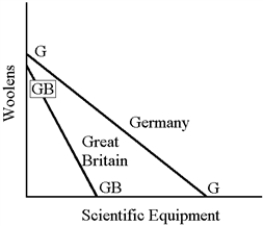 -In Figure 22-1,
If England uses one week's time to produce ten yards of cloth or two barrels of wine and Portugal uses one week's time to produce twelve yards of cloth or six barrels of wine,England has the comparative advantage in both goods.
(True/False)
4.9/5 (82)
(82) When other nations Orient "dump" products on the U.S.market,they
(Multiple Choice)
4.8/5 (76)
(76) The "infant industry argument" recommends protectionism for industries that produce children's clothing.
(True/False)
4.9/5 (83)
(83) 
Filters
- Essay(0)
- Multiple Choice(0)
- Short Answer(0)
- True False(0)
- Matching(0)