



 Chat with AI
Exam 18: International Trade and Comparative Advantage

Exam 1: What Is Economics226 Questions
Exam 2: The Economy Myth and Reality152 Questions
Exam 3: The Fundamental Economic Problem Scarcity and Choice250 Questions
Exam 4: Supply and Demand An Initial Look298 Questions
Exam 5: An Introduction To Macroeconomics215 Questions
Exam 6: The Goals Of Macroeconomic Policy211 Questions
Exam 7: Economic Growth Theory And Policy228 Questions
Exam 8: Aggregate Demand and The Powerful Consumer218 Questions
Exam 9: Demand Side Equilibrium Unemployment Or Inflation 212 Questions
Exam 10: Bringing In The Supply Side Unemployment and Inflation 228 Questions
Exam 11: Managing Aggregate Demand Fiscal Policy209 Questions
Exam 12: Money and The Banking System222 Questions
Exam 13: Monetary Policy Conventional and Unconventional204 Questions
Exam 14: The Financial Crisis and The Great Recession61 Questions
Exam 15: The Debate Over Monetary and Fiscal Policy215 Questions
Exam 16: Budget Deficits In The Short and Long Run210 Questions
Exam 17: The Trade Off Between Inflation and Unemployment219 Questions
Exam 18: International Trade and Comparative Advantage207 Questions
Exam 19: The International Monetary System Order Or Disorder 217 Questions
Exam 20: Exchange Rates and The Macroeconomy209 Questions
Select questions type


Figure 22-8 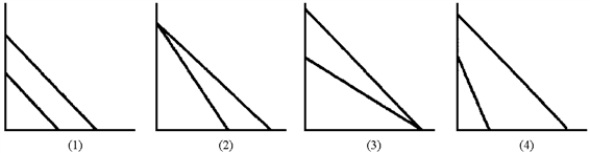 -Table 22-4 presents the demand and supply schedules for television sets in Japan and the United States.If there is no trade between these countries,what are the equilibrium price and quantity in the United States?
 (Multiple Choice)
4.9/5  (73)
(73) An export subsidy helps reduce the selling price of a product by allowing individual producers to charge less and still cover all of their production costs.
(True/False)
4.9/5 (76)
(76) Economists believe that trade is necessary for prosperity because
(Multiple Choice)
4.8/5 (80)
(80) A country's comparative advantage can be illustrated by the graph of the production possibilities frontier.
(True/False)
4.9/5 (89)
(89) One nation can gain from an exchange only at the expense of another.
(True/False)
4.9/5 (85)
(85) If a nation does not have an absolute advantage in producing anything,it
(Multiple Choice)
4.9/5 (84)
(84) By tradition,Japanese employers cannot "lay off" workers.As a result they have goods that they cannot sell on the domestic market without driving down prices.To minimize losses,they sell goods such as steel and televisions in foreign markets at prices well below those in Japan.This is called
(Multiple Choice)
4.9/5 (79)
(79) A country can gain by importing a good that it can make itself if
(Multiple Choice)
4.8/5 (81)
(81) Some nations that seek to produce all of their own needs face the problem that
(Multiple Choice)
4.8/5 (78)
(78) Figure 22-9 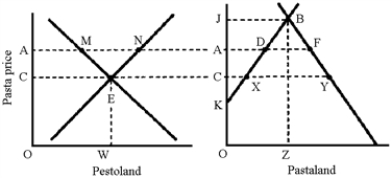 -In Figure 22-9,at price OC total quantity demanded exceeds quantity supplied and price will rise to
 (Multiple Choice)
4.8/5 (80)
(80) Figure 22-7  -In Figure 22-7,CF has the same slope as BG.AB and CD are the production possibilities of Pestoland and Pastaland,respectively.If both countries are given the opportunity to trade at prices indicated by CF,
 (Multiple Choice)
4.9/5 (95)
(95) An import quota on a product normally does all of the following except
(Multiple Choice)
4.8/5 (71)
(71) One of the main reasons that people want to limit imports is the
(Multiple Choice)
4.9/5 (71)
(71) Foreign competition will always put a domestic industry at a disadvantage.This leads to massive trade adjustment assistance on the part of each country.
(True/False)
4.9/5 (89)
(89) If a nation has an absolute advantage in the production of some commodity,it
(Multiple Choice)
4.9/5 (76)
(76) 
Filters
- Essay(0)
- Multiple Choice(0)
- Short Answer(0)
- True False(0)
- Matching(0)