



 Chat with AI
Exam 6: Economic Growth

Exam 1: What Is Economics472 Questions
Exam 2: The Economic Problem432 Questions
Exam 3: Demand and Supply503 Questions
Exam 4: Measuring Gdp and Economic Growth393 Questions
Exam 5: Monitoring Jobs and Inflation398 Questions
Exam 6: Economic Growth343 Questions
Exam 7: Finance, Saving, and Investment233 Questions
Exam 8: Money, the Price Level, and Inflation583 Questions
Exam 9: The Exchange Rate and the Balance of Payments482 Questions
Exam 10: Aggregate Supply and Aggregate Demand411 Questions
Exam 11: Expenditure Multipliers: the Keynesian Model444 Questions
Exam 12: U.S Inflation, Unemployment, and Business Cycle391 Questions
Exam 13: Fiscal Policy251 Questions
Exam 14: Monetary Policy216 Questions
Exam 15: International Trade Policy187 Questions
Review101 Questions
Select questions type


All of the following would increase the growth rate of the economy EXCEPT
(Multiple Choice)
4.7/5  (85)
(85) Labor productivity has grown at almost the same rate each year over the last 40 years in the United States.
(True/False)
4.8/5 (82)
(82) ʺAccording to the neoclassical growth theory, national incentives to save, invest, accumulate human capital, and develop new technology influence the countryʹs growth rate of real GDP.ʺ Comment on the accuracy of the previous statement.
(Essay)
4.7/5 (82)
(82) Between which pair of countries or continents listed below has real GDP per person converged the most since 1960?
(Multiple Choice)
4.7/5 (88)
(88) Moving along the aggregate production function shows the relationship between __________, holding all else constant.
(Multiple Choice)
4.8/5 (85)
(85)  -In the above figure, at a wage rate of $20 per hour,
Neoclassical growth theory is based on the proposition that real GDP per person grows when
(Multiple Choice)
4.9/5 (89)
(89) If the real wage rate is such that the quantity of labor supplied equals the quantity of labor demanded,
(Multiple Choice)
4.8/5 (86)
(86) Suppose the money wage rate and the price level both fall by 5 percent. As a result,
(Multiple Choice)
4.9/5 (72)
(72) 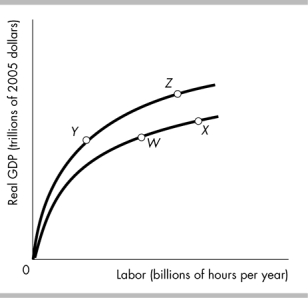 -The figure above shows the U.S. production function. From 1986 to 2008 the United States experienced major advances in technology as well as an increase in the working -age population. The combined effect can best be shown by a
 (Multiple Choice)
5.0/5 (79)
(79) During the 1990s, which of the following experienced the slowest rate of growth in real GDP per person?
(Multiple Choice)
5.0/5 (81)
(81) Of the three economic growth theories, which is the most optimistic about the chances of real GDP per person growing indefinitely? Which is the most pessimistic? What accounts for the differences?
(Essay)
4.9/5 (71)
(71) If real GDP is $800 million and aggregate labor hours are 20 million, labor productivity is
)
(Multiple Choice)
5.0/5 (80)
(80) ʺPremier Liu Chao-shiuan announced Tuesday a government plan to distribute NT$82.9 billion US$2.51 billion) in consumption coupons to Taiwanʹs citizens in a bid to stimulate ... economic growth.ʺ
(Multiple Choice)
4.8/5 (82)
(82) Which of the following is NOT an important factor affecting growth in labor productivity?
(Multiple Choice)
4.8/5 (97)
(97) The United States had the largest real GDP per person until the 2009 when the Chinaʹs real GDP per person overtook and then exceeded that in the United States.
(True/False)
4.7/5 (65)
(65) 
Filters
- Essay(0)
- Multiple Choice(0)
- Short Answer(0)
- True False(0)
- Matching(0)