



 Chat with AI
Exam 21: The Evolution of Populations

Exam 1: Introduction: Evolution and the Foundations of Biology36 Questions
Exam 2: The Chemical Context of Life135 Questions
Exam 3: Carbon and the Molecular Diversity of Life136 Questions
Exam 4: A Tour of the Cell75 Questions
Exam 5: Membrane Transport and Cell Signaling86 Questions
Exam 6: An Introduction to Metabolism79 Questions
Exam 7: Cellular Respiration and Fermentation99 Questions
Exam 8: Photosynthesis68 Questions
Exam 9: The Cell Cycle57 Questions
Exam 10: Meiosis and Sexual Life Cycles59 Questions
Exam 11: Mendel and the Gene Idea57 Questions
Exam 12: The Chromosomal Basis of Inheritance43 Questions
Exam 13: The Molecular Basis of Inheritance62 Questions
Exam 14: Gene Expression: From Gene to Protein77 Questions
Exam 15: Regulation of Gene Expression48 Questions
Exam 16: Development,stem Cells,and Cancer34 Questions
Exam 17: Viruses35 Questions
Exam 18: Genomes and Their Evolution31 Questions
Exam 19: Descent With Modification61 Questions
Exam 20: Phylogeny72 Questions
Exam 21: The Evolution of Populations81 Questions
Exam 22: The Origin of Species75 Questions
Exam 23: Broad Patterns of Evolution60 Questions
Exam 24: Early Life and the Diversification of Prokaryotes99 Questions
Exam 25: The Origin and Diversification of Eukaryotes80 Questions
Exam 26: The Colonization of Land by Plants and Fungi128 Questions
Exam 27: The Rise of Animal Diversity93 Questions
Exam 28: Plant Structure and Growth67 Questions
Exam 29: Resource Acquisition,nutrition,and Transport in Vascular Plants115 Questions
Exam 30: Reproduction and Domestication of Flowering Plants72 Questions
Exam 31: Plant Responses to Internal and External Signals74 Questions
Exam 32: Homeostasis and Endocrine Signaling116 Questions
Exam 33: Animal Nutrition75 Questions
Exam 34: Circulation and Gas Exchange94 Questions
Exam 35: The Immune System96 Questions
Exam 36: Reproduction and Development123 Questions
Exam 37: Neurons,synapses,and Signaling77 Questions
Exam 38: Nervous and Sensory Systems105 Questions
Exam 39: Motor Mechanisms and Behavior83 Questions
Exam 40: Population Ecology and the Distribution of Organisms93 Questions
Exam 41: Ecological Communities59 Questions
Exam 42: Ecosystems and Energy86 Questions
Exam 43: Conservation Biology and Global Change71 Questions
Select questions type


In the United States,the parasite that causes malaria is not present,but African Americans whose ancestors were from equatorial Africa are present.What should be happening to the sickle-cell allele in the United States,and what should be happening to it in equatorial Africa?
(Multiple Choice)
4.8/5  (85)
(85) Which of the following describes a mechanism for generating more genes?
(Multiple Choice)
4.8/5 (80)
(80) In a hypothetical population's gene pool,an autosomal gene,which had previously been fixed,undergoes a mutation that introduces a new allele,one inherited according to incomplete dominance.Natural selection then causes stabilizing selection at this locus.Consequently,what should happen over the course of many generations?
(Multiple Choice)
4.9/5 (78)
(78) Heterozygote advantage should be most closely linked to which of the following?
(Multiple Choice)
4.8/5 (76)
(76) You are maintaining a small population of fruit flies in the laboratory by transferring the flies to a new culture bottle after each generation.After several generations,you notice the viability of the flies has decreased greatly.Recognizing that small population size is likely to be linked to decreased viability,the best way to reverse this trend is to
(Multiple Choice)
4.9/5 (70)
(70) In peas,a gene controls flower color such that R = purple and r = white.In an isolated pea patch,there are 36 purple-flowering plants and 64 white-flowering plants.Assuming Hardy-Weinberg equilibrium,what is the value of q for this population?
(Multiple Choice)
4.9/5 (85)
(85) Phenylketonuria (PKU)is a birth defect that causes an amino acid called phenylalanine to build up in the body.The frequency of individuals born in a population with PKU is q2.There is one PKU (q2)birth per 10,000 births.The frequency of the recessive allele for PKU in this population is q = 0.01.The frequency of the dominant allele in this population is p = 1 - q = 0.99.What is the frequency of carriers (2pq)in this population?
(Multiple Choice)
4.9/5 (87)
(87) Use Figure 21.2 to answer the following question. 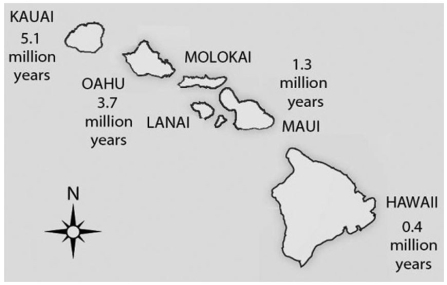 Figure 21.2
Soon after the island of Hawaii rose above the sea surface (somewhat less than 1 million years ago),the evolution of life on this new island should have been most strongly influenced by
Figure 21.2
Soon after the island of Hawaii rose above the sea surface (somewhat less than 1 million years ago),the evolution of life on this new island should have been most strongly influenced by (Multiple Choice)
4.7/5 (78)
(78) In evolution,which driving factor most consistently requires a small population as a precondition for its occurrence?
(Multiple Choice)
4.9/5 (79)
(79) Please use the following information to answer the questions below.
You are studying three populations of birds.Population A has 10 birds,of which 1 is brown (a recessive trait)and 9 are red.Population B has 100 birds,of which 10 are brown.Population C has 30 birds,and 3 of them are brown.
-In which population would it be least likely that an accident would significantly alter the frequency of the brown allele?
(Multiple Choice)
4.8/5 (88)
(88) Considering the overall human population of the U.S.mainland at the time when the slave trade brought large numbers of people from equatorial Africa,what was primarily acting to change the frequency of the sickle-cell allele in the overall U.S.population?
(Multiple Choice)
4.8/5 (71)
(71) A fruit fly population has a gene with two alleles,A1 and A2.Tests show that 70% of the gametes produced in the population contain the A1 allele.If the population is in Hardy-Weinberg equilibrium,what proportion of the flies carry both A1 and A2?
(Multiple Choice)
4.8/5 (91)
(91) Although selection is clearly present,if the ideal equilibrium of alleles existed,what should be the proportion of heterozygous individuals in populations who live here?
(Multiple Choice)
4.8/5 (76)
(76) Identify the statement that describes the imperfection of natural selection.
(Multiple Choice)
5.0/5 (76)
(76) Imagine you predict a particular frequency for a genotype,based upon detailed knowledge of that genotype frequency in population "X" of a species.Then,using the Hardy-Weinberg model,you find that the observed genotype frequency in a different population,named "Y" of the same species,is not significantly different from what you predicted/expected based on population "X."
Which of the following should you conclude?
(Multiple Choice)
4.7/5 (80)
(80) 
Filters
- Essay(0)
- Multiple Choice(0)
- Short Answer(0)
- True False(0)
- Matching(0)