



 Chat with AI
Exam 21: The Evolution of Populations

Exam 1: Introduction: Evolution and the Foundations of Biology36 Questions
Exam 2: The Chemical Context of Life135 Questions
Exam 3: Carbon and the Molecular Diversity of Life136 Questions
Exam 4: A Tour of the Cell75 Questions
Exam 5: Membrane Transport and Cell Signaling86 Questions
Exam 6: An Introduction to Metabolism79 Questions
Exam 7: Cellular Respiration and Fermentation99 Questions
Exam 8: Photosynthesis68 Questions
Exam 9: The Cell Cycle57 Questions
Exam 10: Meiosis and Sexual Life Cycles59 Questions
Exam 11: Mendel and the Gene Idea57 Questions
Exam 12: The Chromosomal Basis of Inheritance43 Questions
Exam 13: The Molecular Basis of Inheritance62 Questions
Exam 14: Gene Expression: From Gene to Protein77 Questions
Exam 15: Regulation of Gene Expression48 Questions
Exam 16: Development,stem Cells,and Cancer34 Questions
Exam 17: Viruses35 Questions
Exam 18: Genomes and Their Evolution31 Questions
Exam 19: Descent With Modification61 Questions
Exam 20: Phylogeny72 Questions
Exam 21: The Evolution of Populations81 Questions
Exam 22: The Origin of Species75 Questions
Exam 23: Broad Patterns of Evolution60 Questions
Exam 24: Early Life and the Diversification of Prokaryotes99 Questions
Exam 25: The Origin and Diversification of Eukaryotes80 Questions
Exam 26: The Colonization of Land by Plants and Fungi128 Questions
Exam 27: The Rise of Animal Diversity93 Questions
Exam 28: Plant Structure and Growth67 Questions
Exam 29: Resource Acquisition,nutrition,and Transport in Vascular Plants115 Questions
Exam 30: Reproduction and Domestication of Flowering Plants72 Questions
Exam 31: Plant Responses to Internal and External Signals74 Questions
Exam 32: Homeostasis and Endocrine Signaling116 Questions
Exam 33: Animal Nutrition75 Questions
Exam 34: Circulation and Gas Exchange94 Questions
Exam 35: The Immune System96 Questions
Exam 36: Reproduction and Development123 Questions
Exam 37: Neurons,synapses,and Signaling77 Questions
Exam 38: Nervous and Sensory Systems105 Questions
Exam 39: Motor Mechanisms and Behavior83 Questions
Exam 40: Population Ecology and the Distribution of Organisms93 Questions
Exam 41: Ecological Communities59 Questions
Exam 42: Ecosystems and Energy86 Questions
Exam 43: Conservation Biology and Global Change71 Questions
Select questions type


In a population of 200 mice,brown fur is dominant to gray fur.If 120 of the 200 mice have brown fur,what is the frequency of mice that are heterozygous?
(Multiple Choice)
4.8/5  (68)
(68) Please use the following information to answer the questions below.
A large population of laboratory animals has been allowed to breed randomly for a number of generations.After several generations,25% of the animals display a recessive trait (aa),the same percentage as at the beginning of the breeding program.The rest of the animals show the dominant phenotype,with heterozygotes indistinguishable from the homozygous dominants.
-What is the estimated frequency of allele A in the gene pool?
(Multiple Choice)
5.0/5 (79)
(79) The restriction enzymes of bacteria protect the bacteria from successful attack by bacteriophages,whose genomes can be degraded by the restriction enzymes.The bacterial genomes are not vulnerable to these restriction enzymes because bacterial DNA is methylated.This situation selects for bacteriophages whose genomes are also methylated.As new strains of resistant bacteriophages become more prevalent,this in turn selects for bacteria whose genomes are not methylated and whose restriction enzymes instead degrade methylated DNA.The outcome of the conflict between bacteria and bacteriophage at any point in time results from
(Multiple Choice)
4.8/5 (85)
(85) Which of the following consistently improves the degree to which organisms are well suited for life in their environment?
(Multiple Choice)
4.9/5 (78)
(78) Which process in sexual reproduction results in diversity at the nucleotide level?
(Multiple Choice)
4.7/5 (89)
(89) Mountains also have an unmatched power to drive human evolution.Starting tens of thousands of years ago,people moved to high altitudes,and there they experienced natural selection that has reworked their biology.In Tibet,for example,people have broader arteries and capillaries.In the Andes,they can dissolve more oxygen into their blood.These different traits of people who live in high altitudes illustrate
(Multiple Choice)
4.9/5 (85)
(85) In the formula for determining a population's genotype frequencies,the pq in the term 2pq is necessary because
(Multiple Choice)
4.8/5 (70)
(70) Please use the following information to answer the questions below.
In those parts of equatorial Africa where the malaria parasite is most common,the sickle-cell allele constitutes 20% of the β hemoglobin alleles in the human gene pool.
-With respect to the sickle-cell allele,what should be true of the ? hemoglobin locus in U.S.populations of African Americans whose ancestors were from equatorial Africa?
1)The average heterozygosity at this locus should be decreasing over time.
2)There is an increasing heterozygote advantage at this locus.
3)Diploidy is helping to preserve the sickle-cell allele at this locus.
4)Frequency-dependent selection is helping to preserve the sickle-cell allele at this locus.
(Multiple Choice)
4.8/5 (92)
(92) The frequency of a disease is 30/1000.This is a disease that follows a dominant/recessive pattern of inheritance on one gene (where the only affected individuals are all homozygous recessive).What is the frequency of the disease genotype q2?
(Multiple Choice)
4.7/5 (87)
(87) How can genetic variation at the whole gene level (gene variability)be quantified?
(Multiple Choice)
4.8/5 (73)
(73) Which of the following is most likely to produce an African butterfly species in the wild whose members have one pattern?
(Multiple Choice)
4.9/5 (84)
(84) Please use the following information to answer the question(s)below.
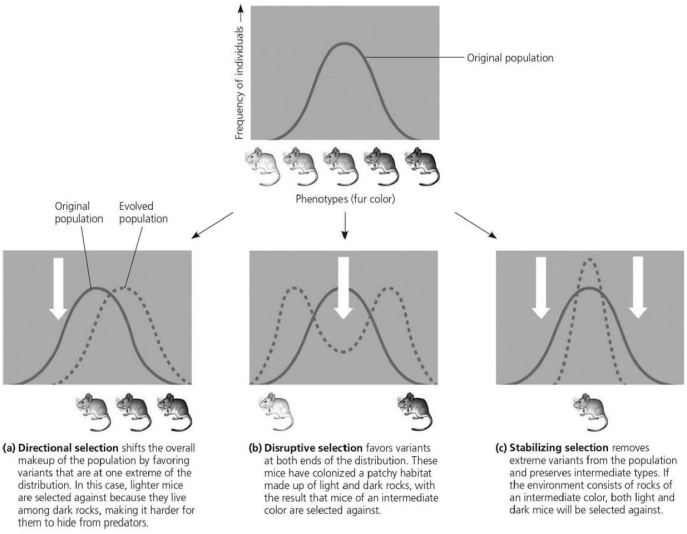 -Examining the figure,which type of selection eliminates extreme frequency of individuals' phenotype?
 (Multiple Choice)
4.9/5 (70)
(70) In the formula for determining a population's genotype frequencies,the 2 in the term 2pq is necessary because
(Multiple Choice)
4.8/5 (75)
(75) Adult male humans generally have deeper voices than do adult female humans,which is the direct result of higher levels of testosterone causing growth of the larynx.If the fossil records of apes and humans alike show a trend toward decreasing larynx size in adult females and increasing larynx size in adult males,then
(Multiple Choice)
4.7/5 (77)
(77) Which of the following statements best summarizes evolution as it is viewed today?
(Multiple Choice)
4.8/5 (85)
(85) Every HIV particle contains two RNA molecules.If two genes from one RNA molecule become detached and then,as a unit,get attached to one end of the other RNA molecule within a single HIV particle,which of these is true?
(Multiple Choice)
4.9/5 (77)
(77) Sparrows with average-sized wings survive severe storms better than those with longer or shorter wings,illustrating
(Multiple Choice)
4.9/5 (82)
(82) How did Mendel's model of inheritance help explain Darwin's theory of natural selection?
(Multiple Choice)
4.9/5 (88)
(88) 
Filters
- Essay(0)
- Multiple Choice(0)
- Short Answer(0)
- True False(0)
- Matching(0)