



 Chat with AI
Exam 37: Neurons,synapses,and Signaling

Exam 1: Introduction: Evolution and the Foundations of Biology36 Questions
Exam 2: The Chemical Context of Life135 Questions
Exam 3: Carbon and the Molecular Diversity of Life136 Questions
Exam 4: A Tour of the Cell75 Questions
Exam 5: Membrane Transport and Cell Signaling86 Questions
Exam 6: An Introduction to Metabolism79 Questions
Exam 7: Cellular Respiration and Fermentation99 Questions
Exam 8: Photosynthesis68 Questions
Exam 9: The Cell Cycle57 Questions
Exam 10: Meiosis and Sexual Life Cycles59 Questions
Exam 11: Mendel and the Gene Idea57 Questions
Exam 12: The Chromosomal Basis of Inheritance43 Questions
Exam 13: The Molecular Basis of Inheritance62 Questions
Exam 14: Gene Expression: From Gene to Protein77 Questions
Exam 15: Regulation of Gene Expression48 Questions
Exam 16: Development,stem Cells,and Cancer34 Questions
Exam 17: Viruses35 Questions
Exam 18: Genomes and Their Evolution31 Questions
Exam 19: Descent With Modification61 Questions
Exam 20: Phylogeny72 Questions
Exam 21: The Evolution of Populations81 Questions
Exam 22: The Origin of Species75 Questions
Exam 23: Broad Patterns of Evolution60 Questions
Exam 24: Early Life and the Diversification of Prokaryotes99 Questions
Exam 25: The Origin and Diversification of Eukaryotes80 Questions
Exam 26: The Colonization of Land by Plants and Fungi128 Questions
Exam 27: The Rise of Animal Diversity93 Questions
Exam 28: Plant Structure and Growth67 Questions
Exam 29: Resource Acquisition,nutrition,and Transport in Vascular Plants115 Questions
Exam 30: Reproduction and Domestication of Flowering Plants72 Questions
Exam 31: Plant Responses to Internal and External Signals74 Questions
Exam 32: Homeostasis and Endocrine Signaling116 Questions
Exam 33: Animal Nutrition75 Questions
Exam 34: Circulation and Gas Exchange94 Questions
Exam 35: The Immune System96 Questions
Exam 36: Reproduction and Development123 Questions
Exam 37: Neurons,synapses,and Signaling77 Questions
Exam 38: Nervous and Sensory Systems105 Questions
Exam 39: Motor Mechanisms and Behavior83 Questions
Exam 40: Population Ecology and the Distribution of Organisms93 Questions
Exam 41: Ecological Communities59 Questions
Exam 42: Ecosystems and Energy86 Questions
Exam 43: Conservation Biology and Global Change71 Questions
Select questions type


Motor neurons alter skeletal muscle activities by releasing neurotransmitters because
(Multiple Choice)
4.9/5  (88)
(88) Please use the following information to answer the questions below.
Tetraethylammonium (TEA)is a potent neurotoxin that results in death from respiratory failure within 10 to 30 minutes.When a neuron is incubated with TEA,researchers observed that action potentials could be generated,but the membrane potential remained positive and never returned to the resting membrane potential.
-What channel is TEA likely acting on?
(Multiple Choice)
4.9/5 (81)
(81) If a membrane is made more permeable to ________,then an inhibitory postsynaptic potential (IPSP)will occur.
(Multiple Choice)
4.8/5 (80)
(80) 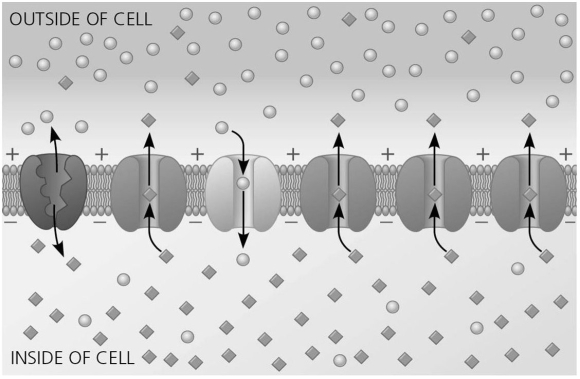 Figure 37.2
-Figure 37.2 shows many channels in a neuron membrane.The channel third from the left is a voltage-gated sodium channel.What would happen if this channel became blocked and thus unable to function?
Figure 37.2
-Figure 37.2 shows many channels in a neuron membrane.The channel third from the left is a voltage-gated sodium channel.What would happen if this channel became blocked and thus unable to function? (Multiple Choice)
4.9/5 (84)
(84) Neurons can be classified according to structure as well as function.If a neuron has a single projection from the cell body,it is a unipolar neuron.If it has two projections,it is a bipolar neuron.Finally,if it has more than two projections,it is a multipolar neuron.What structural type of neuron is a motor neuron?
(Multiple Choice)
4.8/5 (83)
(83) The operation of the sodium-potassium "pump" moves sodium ions ________ the cell and potassium ions ________ the cell.
(Multiple Choice)
4.9/5 (76)
(76) Researchers injected bark scorpion venom in mouse neurons (both a common house mouse and the southern grasshopper mouse)and measured the flow of sodium ions across the cell membrane.Their data are shown below. 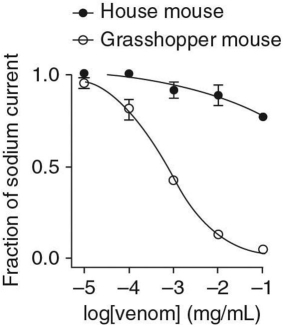 Based on these data,what effect do you think the venom is having on the grasshopper mouse?
 (Multiple Choice)
4.9/5 (78)
(78) The "undershoot" phase of after-hyperpolarization is due to
(Multiple Choice)
5.0/5 (78)
(78) A cation that is more abundant as a solute in the cytosol of a neuron than it is in the interstitial fluid outside the neuron is
(Multiple Choice)
4.8/5 (80)
(80) Which of the following is a direct result of depolarizing the presynaptic membrane of an axon terminal?
(Multiple Choice)
4.8/5 (76)
(76) Two fundamental concepts about the ion channels of a "resting" neuron are that the channels
(Multiple Choice)
4.9/5 (71)
(71) Most of the synapses in vertebrates conduct information in only one direction
(Multiple Choice)
4.8/5 (84)
(84) 
Filters
- Essay(0)
- Multiple Choice(0)
- Short Answer(0)
- True False(0)
- Matching(0)