



 Chat with AI
Exam 37: Neurons,synapses,and Signaling

Exam 1: Introduction: Evolution and the Foundations of Biology36 Questions
Exam 2: The Chemical Context of Life135 Questions
Exam 3: Carbon and the Molecular Diversity of Life136 Questions
Exam 4: A Tour of the Cell75 Questions
Exam 5: Membrane Transport and Cell Signaling86 Questions
Exam 6: An Introduction to Metabolism79 Questions
Exam 7: Cellular Respiration and Fermentation99 Questions
Exam 8: Photosynthesis68 Questions
Exam 9: The Cell Cycle57 Questions
Exam 10: Meiosis and Sexual Life Cycles59 Questions
Exam 11: Mendel and the Gene Idea57 Questions
Exam 12: The Chromosomal Basis of Inheritance43 Questions
Exam 13: The Molecular Basis of Inheritance62 Questions
Exam 14: Gene Expression: From Gene to Protein77 Questions
Exam 15: Regulation of Gene Expression48 Questions
Exam 16: Development,stem Cells,and Cancer34 Questions
Exam 17: Viruses35 Questions
Exam 18: Genomes and Their Evolution31 Questions
Exam 19: Descent With Modification61 Questions
Exam 20: Phylogeny72 Questions
Exam 21: The Evolution of Populations81 Questions
Exam 22: The Origin of Species75 Questions
Exam 23: Broad Patterns of Evolution60 Questions
Exam 24: Early Life and the Diversification of Prokaryotes99 Questions
Exam 25: The Origin and Diversification of Eukaryotes80 Questions
Exam 26: The Colonization of Land by Plants and Fungi128 Questions
Exam 27: The Rise of Animal Diversity93 Questions
Exam 28: Plant Structure and Growth67 Questions
Exam 29: Resource Acquisition,nutrition,and Transport in Vascular Plants115 Questions
Exam 30: Reproduction and Domestication of Flowering Plants72 Questions
Exam 31: Plant Responses to Internal and External Signals74 Questions
Exam 32: Homeostasis and Endocrine Signaling116 Questions
Exam 33: Animal Nutrition75 Questions
Exam 34: Circulation and Gas Exchange94 Questions
Exam 35: The Immune System96 Questions
Exam 36: Reproduction and Development123 Questions
Exam 37: Neurons,synapses,and Signaling77 Questions
Exam 38: Nervous and Sensory Systems105 Questions
Exam 39: Motor Mechanisms and Behavior83 Questions
Exam 40: Population Ecology and the Distribution of Organisms93 Questions
Exam 41: Ecological Communities59 Questions
Exam 42: Ecosystems and Energy86 Questions
Exam 43: Conservation Biology and Global Change71 Questions
Select questions type


Suppose a particular neurotransmitter causes an IPSP in postsynaptic cell X and an EPSP in postsynaptic cell Y.A likely explanation is that
(Multiple Choice)
4.8/5  (96)
(96) In a simple synapse,neurotransmitter chemicals are released by
(Multiple Choice)
4.7/5 (73)
(73) The activity of acetylcholine in a synapse is terminated by its
(Multiple Choice)
4.8/5 (84)
(84) A drug that specifically inhibits voltage-gated sodium channels in axons would be expected to
(Multiple Choice)
5.0/5 (77)
(77) Assume that a single IPSP has a negative magnitude of -0.5 mV at the axon hillock and that a single EPSP has a positive magnitude of +0.5 mV.For a neuron with an initial membrane potential of -70 mV,the net effect of the simultaneous arrival of six IPSPs and two EPSPs would be to move the membrane potential to
(Multiple Choice)
4.8/5 (91)
(91) Which of the following principles characterize gated ion channels in the neuronal membrane? Select all that apply.
I.Channels are always open.
II.Channels are always closed.
III.Channels open and close depending on stimuli.
IV.Channels are specific to which ions can traverse them.
V.Channels are nonspecific to which ions can traverse them.
(Multiple Choice)
4.8/5 (91)
(91) The observation that the acetylcholine released into the junction between a motor neuron and a skeletal muscle binds to a sodium channel and opens it is an example of a
(Multiple Choice)
4.9/5 (71)
(71) The membrane potential that exactly offsets an ion's concentration gradient is called the
(Multiple Choice)
4.9/5 (67)
(67) The fastest possible conduction velocity of action potentials is observed in
(Multiple Choice)
4.8/5 (70)
(70) ________ occurs when several excitatory postsynaptic potentials (EPSPs)arrive at the axon hillock from different dendritic locations and then depolarize the postsynaptic cell to threshold for an action potential
(Multiple Choice)
4.8/5 (87)
(87) Suppose you are a researcher examining the impacts of ion channels on resting membrane potential in typical neurons.By using a drug,you artificially open all sodium channels and keep all other ion channels closed.What value of the resting membrane potential should you observe?
(Multiple Choice)
4.7/5 (86)
(86) Functionally,which cellular location is the neuron's "decision-making site" as to whether or not an action potential will be initiated?
(Multiple Choice)
4.8/5 (84)
(84) Neurotransmitters that hyperpolarize neuron membranes are categorized as
(Multiple Choice)
4.9/5 (85)
(85) 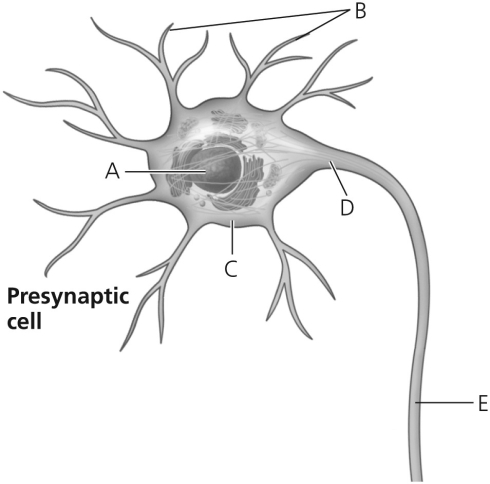 Figure 37.2
-Suppose you are studying a toxin from a new species of poisonous snake,and you find that neurons exposed to the toxin can initiate action potentials,but they cannot send electrical signals to other neurons.What structure in Figure 37.2 is the toxin targeting?
Figure 37.2
-Suppose you are studying a toxin from a new species of poisonous snake,and you find that neurons exposed to the toxin can initiate action potentials,but they cannot send electrical signals to other neurons.What structure in Figure 37.2 is the toxin targeting? (Multiple Choice)
4.9/5 (90)
(90) Although the membrane of a "resting" neuron is highly permeable to potassium ions,its membrane potential does not exactly match the equilibrium potential for potassium because the neuronal membrane is also
(Multiple Choice)
4.9/5 (75)
(75) 
Filters
- Essay(0)
- Multiple Choice(0)
- Short Answer(0)
- True False(0)
- Matching(0)