



 Chat with AI
Exam 40: Population Ecology and the Distribution of Organisms

Exam 1: Introduction: Evolution and the Foundations of Biology36 Questions
Exam 2: The Chemical Context of Life135 Questions
Exam 3: Carbon and the Molecular Diversity of Life136 Questions
Exam 4: A Tour of the Cell75 Questions
Exam 5: Membrane Transport and Cell Signaling86 Questions
Exam 6: An Introduction to Metabolism79 Questions
Exam 7: Cellular Respiration and Fermentation99 Questions
Exam 8: Photosynthesis68 Questions
Exam 9: The Cell Cycle57 Questions
Exam 10: Meiosis and Sexual Life Cycles59 Questions
Exam 11: Mendel and the Gene Idea57 Questions
Exam 12: The Chromosomal Basis of Inheritance43 Questions
Exam 13: The Molecular Basis of Inheritance62 Questions
Exam 14: Gene Expression: From Gene to Protein77 Questions
Exam 15: Regulation of Gene Expression48 Questions
Exam 16: Development,stem Cells,and Cancer34 Questions
Exam 17: Viruses35 Questions
Exam 18: Genomes and Their Evolution31 Questions
Exam 19: Descent With Modification61 Questions
Exam 20: Phylogeny72 Questions
Exam 21: The Evolution of Populations81 Questions
Exam 22: The Origin of Species75 Questions
Exam 23: Broad Patterns of Evolution60 Questions
Exam 24: Early Life and the Diversification of Prokaryotes99 Questions
Exam 25: The Origin and Diversification of Eukaryotes80 Questions
Exam 26: The Colonization of Land by Plants and Fungi128 Questions
Exam 27: The Rise of Animal Diversity93 Questions
Exam 28: Plant Structure and Growth67 Questions
Exam 29: Resource Acquisition,nutrition,and Transport in Vascular Plants115 Questions
Exam 30: Reproduction and Domestication of Flowering Plants72 Questions
Exam 31: Plant Responses to Internal and External Signals74 Questions
Exam 32: Homeostasis and Endocrine Signaling116 Questions
Exam 33: Animal Nutrition75 Questions
Exam 34: Circulation and Gas Exchange94 Questions
Exam 35: The Immune System96 Questions
Exam 36: Reproduction and Development123 Questions
Exam 37: Neurons,synapses,and Signaling77 Questions
Exam 38: Nervous and Sensory Systems105 Questions
Exam 39: Motor Mechanisms and Behavior83 Questions
Exam 40: Population Ecology and the Distribution of Organisms93 Questions
Exam 41: Ecological Communities59 Questions
Exam 42: Ecosystems and Energy86 Questions
Exam 43: Conservation Biology and Global Change71 Questions
Select questions type


In July 2008,the U.S.population was approximately 302,000,000.If the estimated 2008 growth rate was 0.88%,approximately how many total Americans were there in July 2009?
(Multiple Choice)
4.8/5  (81)
(81) Using the logistic growth model,population growth would be represented by dN/dt =
(Multiple Choice)
4.8/5 (78)
(78) A particular mountain range is subjected to prevailing winds.Which of the following contributes the most to a drier climate on the leeward side of the mountain range?
(Multiple Choice)
5.0/5 (72)
(72) Which of the following groups would be most likely to exhibit uniform dispersion?
(Multiple Choice)
4.8/5 (93)
(93) A population of snowshoe hares was introduced to an appropriate habitat also inhabited by their natural predators in northern Canada.Which of the following graphs illustrates the growth over several seasons of the snowshoe hares?
(Multiple Choice)
4.8/5 (72)
(72) Which of the following choices causes all of the others in creating global terrestrial climates?
(Multiple Choice)
4.9/5 (100)
(100) Figure 40.2 shows a generalized cross section of the marine environment with various zones labeled with letters.Choose the number that best answers the question(s).
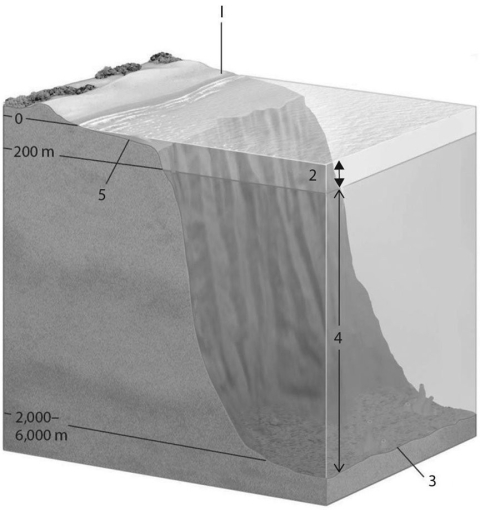 Figure 40.2
-Which zone has a condition of constant temperature?
Figure 40.2
-Which zone has a condition of constant temperature? (Multiple Choice)
5.0/5 (86)
(86) Coral reefs can be found on the southeast coast of the United States but not at similar latitudes on the southwest coast.Differences in which of the following most likely account for this?
(Multiple Choice)
4.9/5 (86)
(86) Which of the following levels of ecological organization is arranged in the correct sequence from most to least inclusive?
(Multiple Choice)
4.9/5 (91)
(91) 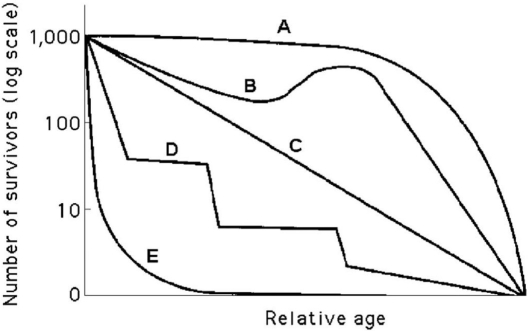 Figure 40.3
-Which statement best explains survivorship curve B?
Figure 40.3
-Which statement best explains survivorship curve B? (Multiple Choice)
4.9/5 (94)
(94) Which marine zone is expected to have the lowest rates of primary productivity (photosynthesis)?
(Multiple Choice)
4.9/5 (71)
(71) If a meteor impact or volcanic eruption injected a lot of dust into the atmosphere and reduced the sunlight reaching Earth's surface by 70% for one year,which of the following marine communities most likely would be least affected?
(Multiple Choice)
4.9/5 (80)
(80) Which variables define the ecological life history of a species?
(Multiple Choice)
4.9/5 (67)
(67) Which of the following statements best describes the effect of climate on biome distribution?
(Multiple Choice)
4.9/5 (84)
(84) The main reason that polar regions are cooler than the equator is that
(Multiple Choice)
4.9/5 (81)
(81) Please use the following information to answer the question(s)below.
The eight climographs in Figure 40.1 show yearly temperature (line graph and left vertical axis)and precipitation (bar graph and right vertical axis)averages for each month for some locations on Earth.Choose the climograph that best answers the question.
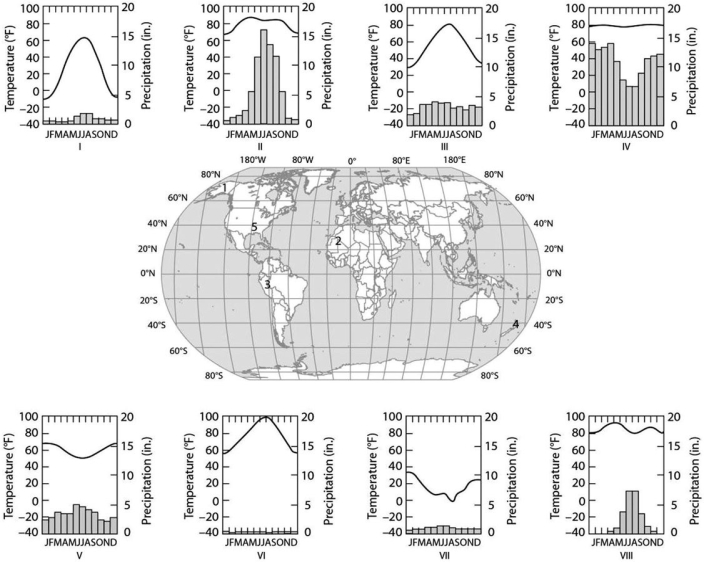 Figure 40.1
-Which climograph shows the climate for location 3?
Figure 40.1
-Which climograph shows the climate for location 3? (Multiple Choice)
4.9/5 (83)
(83) A certain species of pine tree survives only in scattered locations at elevations above 2,800 m in the western United States.To understand why this tree grows only in these specific places,an ecologist should
(Multiple Choice)
4.8/5 (81)
(81) 
Filters
- Essay(0)
- Multiple Choice(0)
- Short Answer(0)
- True False(0)
- Matching(0)