



 Chat with AI
Exam 41: Ecological Communities

Exam 1: Introduction: Evolution and the Foundations of Biology36 Questions
Exam 2: The Chemical Context of Life135 Questions
Exam 3: Carbon and the Molecular Diversity of Life136 Questions
Exam 4: A Tour of the Cell75 Questions
Exam 5: Membrane Transport and Cell Signaling86 Questions
Exam 6: An Introduction to Metabolism79 Questions
Exam 7: Cellular Respiration and Fermentation99 Questions
Exam 8: Photosynthesis68 Questions
Exam 9: The Cell Cycle57 Questions
Exam 10: Meiosis and Sexual Life Cycles59 Questions
Exam 11: Mendel and the Gene Idea57 Questions
Exam 12: The Chromosomal Basis of Inheritance43 Questions
Exam 13: The Molecular Basis of Inheritance62 Questions
Exam 14: Gene Expression: From Gene to Protein77 Questions
Exam 15: Regulation of Gene Expression48 Questions
Exam 16: Development,stem Cells,and Cancer34 Questions
Exam 17: Viruses35 Questions
Exam 18: Genomes and Their Evolution31 Questions
Exam 19: Descent With Modification61 Questions
Exam 20: Phylogeny72 Questions
Exam 21: The Evolution of Populations81 Questions
Exam 22: The Origin of Species75 Questions
Exam 23: Broad Patterns of Evolution60 Questions
Exam 24: Early Life and the Diversification of Prokaryotes99 Questions
Exam 25: The Origin and Diversification of Eukaryotes80 Questions
Exam 26: The Colonization of Land by Plants and Fungi128 Questions
Exam 27: The Rise of Animal Diversity93 Questions
Exam 28: Plant Structure and Growth67 Questions
Exam 29: Resource Acquisition,nutrition,and Transport in Vascular Plants115 Questions
Exam 30: Reproduction and Domestication of Flowering Plants72 Questions
Exam 31: Plant Responses to Internal and External Signals74 Questions
Exam 32: Homeostasis and Endocrine Signaling116 Questions
Exam 33: Animal Nutrition75 Questions
Exam 34: Circulation and Gas Exchange94 Questions
Exam 35: The Immune System96 Questions
Exam 36: Reproduction and Development123 Questions
Exam 37: Neurons,synapses,and Signaling77 Questions
Exam 38: Nervous and Sensory Systems105 Questions
Exam 39: Motor Mechanisms and Behavior83 Questions
Exam 40: Population Ecology and the Distribution of Organisms93 Questions
Exam 41: Ecological Communities59 Questions
Exam 42: Ecosystems and Energy86 Questions
Exam 43: Conservation Biology and Global Change71 Questions
Select questions type


Use the diagram in Figure 41.4 of five islands formed at around the same time near a particular mainland,as well as MacArthur and Wilson's island biogeography principles,to answer the following question(s).
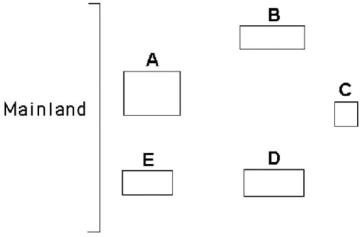 Figure 41.4
-Which island would likely exhibit the least species diversity?
Figure 41.4
-Which island would likely exhibit the least species diversity? (Multiple Choice)
4.7/5  (77)
(77) In a lake with three trophic levels (non-native fish,zooplankton,algae),how might an algal bloom be prevented?
(Multiple Choice)
4.9/5 (83)
(83) Which of the following is considered to be a pioneer species colonizing Glacier Bay during primary succession?
(Multiple Choice)
5.0/5 (90)
(90) Imagine five forest communities,each with 100 individuals distributed among four different tree species (W,X,Y,and Z).Which forest community would be most diverse?
(Multiple Choice)
4.9/5 (86)
(86) How might an ecologist test whether a species is occupying a fundamental niche or a realized niche?
(Multiple Choice)
4.8/5 (81)
(81) Based on the Shannon Diversity calculations,which of the following communities is most diverse?
(Multiple Choice)
4.7/5 (76)
(76) Based on the intermediate disturbance hypothesis,a community's species diversity is increased by
(Multiple Choice)
4.8/5 (80)
(80) As you study two closely related predatory insect species,the two-spot and the three-spot avenger beetles,you notice that each species seeks prey at dawn in areas without the other species.However,where their ranges overlap,the two-spot avenger beetle hunts at night,and the three-spot hunts in the morning.When you bring them into the laboratory and isolate the two different species,you discover that the offspring of both species are nocturnal.You have discovered an example of
(Multiple Choice)
4.9/5 (97)
(97) Two species of bacteria with identical fundamental niches cannot permanently coexist together in a community.This phenomenon is best described as
(Multiple Choice)
4.7/5 (90)
(90) Which of the following is a likely explanation for why invasive species take over communities into which they have been introduced?
(Multiple Choice)
4.9/5 (68)
(68) Zoonotic diseases,like West Nile virus,are concentrated in distinct regions and spread at different rates.The difference in the rate of spread is most directly related to
(Multiple Choice)
4.8/5 (78)
(78) Resource partitioning would be most likely to occur between
(Multiple Choice)
4.7/5 (80)
(80) According to the competitive exclusion principle,two species cannot continue to occupy the same
(Multiple Choice)
4.9/5 (84)
(84) What are usually the first photosynthetic organisms to colonize during primary succession?
(Multiple Choice)
5.0/5 (70)
(70) Please use the following information to answer the question(s)below.
The effect of invasive species on the diversity of communities can be large,and protecting native communities from the invasion of non-native species is often a priority for conservation.You conduct an experiment to study how the impact of invasive plant species on the diversity of plant communities varies as a function of distance from the source of the invasive species.In this experiment,you create five communities with equal numbers of three native plant species at the beginning.Each of these communities is located at increasing distances from a large patch of an invasive species.You and your research assistant return 1 year later to measure the relative abundance of each species.The results are shown in the table.
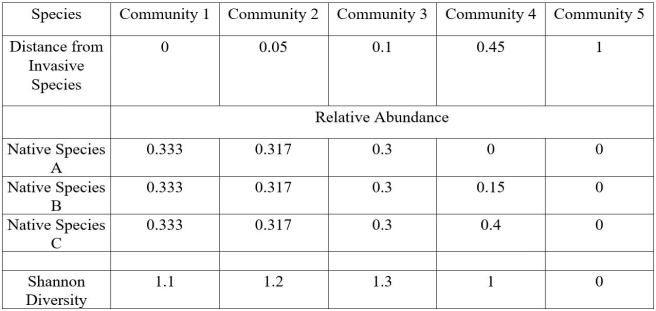 -The biological hypothesis for your experiment is based on the model of island biogeography.What is the independent variable of your experiment?
 (Multiple Choice)
4.9/5 (65)
(65) Please use the following information to answer the question(s)below.
The symbols +,-,and 0 are to be used to show the results of interactions between individuals and groups of individuals in the examples that follow.The symbol + denotes a positive interaction,- denotes a negative interaction,and 0 denotes an interaction that has no effect on the individuals involved.The first symbol refers to the first organism mentioned.
-What interactions exist between the cattle egret and grazing cattle?
(Multiple Choice)
4.9/5 (74)
(74) Which of the following phrases best describes an ecological niche?
(Multiple Choice)
4.7/5 (86)
(86) 
Filters
- Essay(0)
- Multiple Choice(0)
- Short Answer(0)
- True False(0)
- Matching(0)