



 Chat with AI
Exam 43: Conservation Biology and Global Change

Exam 1: Introduction: Evolution and the Foundations of Biology36 Questions
Exam 2: The Chemical Context of Life135 Questions
Exam 3: Carbon and the Molecular Diversity of Life136 Questions
Exam 4: A Tour of the Cell75 Questions
Exam 5: Membrane Transport and Cell Signaling86 Questions
Exam 6: An Introduction to Metabolism79 Questions
Exam 7: Cellular Respiration and Fermentation99 Questions
Exam 8: Photosynthesis68 Questions
Exam 9: The Cell Cycle57 Questions
Exam 10: Meiosis and Sexual Life Cycles59 Questions
Exam 11: Mendel and the Gene Idea57 Questions
Exam 12: The Chromosomal Basis of Inheritance43 Questions
Exam 13: The Molecular Basis of Inheritance62 Questions
Exam 14: Gene Expression: From Gene to Protein77 Questions
Exam 15: Regulation of Gene Expression48 Questions
Exam 16: Development,stem Cells,and Cancer34 Questions
Exam 17: Viruses35 Questions
Exam 18: Genomes and Their Evolution31 Questions
Exam 19: Descent With Modification61 Questions
Exam 20: Phylogeny72 Questions
Exam 21: The Evolution of Populations81 Questions
Exam 22: The Origin of Species75 Questions
Exam 23: Broad Patterns of Evolution60 Questions
Exam 24: Early Life and the Diversification of Prokaryotes99 Questions
Exam 25: The Origin and Diversification of Eukaryotes80 Questions
Exam 26: The Colonization of Land by Plants and Fungi128 Questions
Exam 27: The Rise of Animal Diversity93 Questions
Exam 28: Plant Structure and Growth67 Questions
Exam 29: Resource Acquisition,nutrition,and Transport in Vascular Plants115 Questions
Exam 30: Reproduction and Domestication of Flowering Plants72 Questions
Exam 31: Plant Responses to Internal and External Signals74 Questions
Exam 32: Homeostasis and Endocrine Signaling116 Questions
Exam 33: Animal Nutrition75 Questions
Exam 34: Circulation and Gas Exchange94 Questions
Exam 35: The Immune System96 Questions
Exam 36: Reproduction and Development123 Questions
Exam 37: Neurons,synapses,and Signaling77 Questions
Exam 38: Nervous and Sensory Systems105 Questions
Exam 39: Motor Mechanisms and Behavior83 Questions
Exam 40: Population Ecology and the Distribution of Organisms93 Questions
Exam 41: Ecological Communities59 Questions
Exam 42: Ecosystems and Energy86 Questions
Exam 43: Conservation Biology and Global Change71 Questions
Select questions type


What is the biological significance of genetic diversity between populations?
(Multiple Choice)
4.9/5  (77)
(77) It is estimated that 99% of all species that ever lived are now extinct.Why,then,do we say we are now experiencing an extinction (loss of biodiversity)crisis?
(Multiple Choice)
5.0/5 (76)
(76) What causes extremely high levels of toxic chemicals in fish-eating birds?
(Multiple Choice)
4.9/5 (80)
(80) Which of the following is true about the current research regarding forest fragmentation?
(Multiple Choice)
4.9/5 (74)
(74) How are movement corridors potentially harmful to certain species?
(Multiple Choice)
4.9/5 (87)
(87) According to the small-population approach,what would be the best strategy for saving a population from extinction in its current environment?
(Multiple Choice)
4.8/5 (64)
(64) Which of the following conditions is the most likely indicator of a population in an extinction vortex?
(Multiple Choice)
4.9/5 (87)
(87) The scientist wishes to summarize the data in a way that can be compared to other studies on biological magnification of heavy metals in insect-eating birds that live in other forest fragments.What is the best way for the scientist to summarize the data for comparative purposes?
(Multiple Choice)
4.9/5 (70)
(70) The difference between an endangered species and a threatened one is that
(Multiple Choice)
4.9/5 (81)
(81) Overharvesting encourages extinction and is most likely to affect
(Multiple Choice)
4.8/5 (82)
(82) The main cause of the increase in the amount of CO2 in Earth's atmosphere over the past 150 years is
(Multiple Choice)
5.0/5 (90)
(90) Please use the following information to answer the questions below.
Three forest areas are being considered for a conservation reserve.Each area contains the same number of trees and is the same cumulative size.The area surrounding the forest patches is a mix of agricultural land and residential homes.
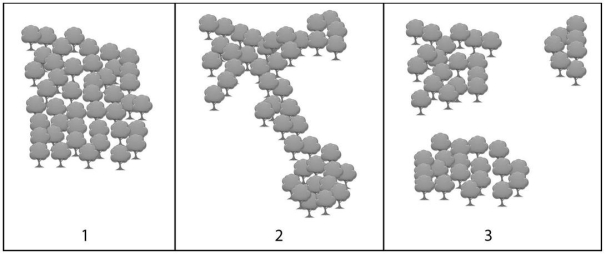 -Which area(s)would be most suitable for conserving amphibians,which are highly susceptible to a pathogenic (disease-causing)chytrid fungus?
 (Multiple Choice)
4.9/5 (83)
(83) Many temperate regions are affected by climate change.Which of the following investigations would lend understanding to the future distribution of organisms in temperate regions?
(Multiple Choice)
4.9/5 (73)
(73) Humans alter natural ecosystems.Which of the following would be the most likely detrimental effect of human disturbance of a natural ecosystem for the purpose of urban development?
(Multiple Choice)
4.7/5 (84)
(84) The wood turtle (Glyptemys insculpta)is endangered through much of its range in North America.As the populations shrink in size,it becomes even more difficult for turtles to find mates,and small populations have steadily become smaller.What best describes what the wood turtles in small populations are experiencing?
(Multiple Choice)
4.9/5 (89)
(89) One characteristic that distinguishes a population in an extinction vortex from most other populations is that
(Multiple Choice)
4.7/5 (85)
(85) Review the formula for effective population size: Ne (effective population)=  .Imagine a total population of 1,000 small rodents.Of these,300 are breeding females,300 are breeding males,and 400 are nonbreeding juveniles.What is the effective population size?
 (Multiple Choice)
4.9/5 (86)
(86) Brown-headed cowbirds,an edge-adapted species,utilize fragmented forests effectively by
(Multiple Choice)
4.9/5 (82)
(82) Which of the following strategies would most rapidly increase the genetic diversity of a population in an extinction vortex?
(Multiple Choice)
4.9/5 (88)
(88) 
Filters
- Essay(0)
- Multiple Choice(0)
- Short Answer(0)
- True False(0)
- Matching(0)