



 Chat with AI
Exam 43: Conservation Biology and Global Change

Exam 1: Introduction: Evolution and the Foundations of Biology36 Questions
Exam 2: The Chemical Context of Life135 Questions
Exam 3: Carbon and the Molecular Diversity of Life136 Questions
Exam 4: A Tour of the Cell75 Questions
Exam 5: Membrane Transport and Cell Signaling86 Questions
Exam 6: An Introduction to Metabolism79 Questions
Exam 7: Cellular Respiration and Fermentation99 Questions
Exam 8: Photosynthesis68 Questions
Exam 9: The Cell Cycle57 Questions
Exam 10: Meiosis and Sexual Life Cycles59 Questions
Exam 11: Mendel and the Gene Idea57 Questions
Exam 12: The Chromosomal Basis of Inheritance43 Questions
Exam 13: The Molecular Basis of Inheritance62 Questions
Exam 14: Gene Expression: From Gene to Protein77 Questions
Exam 15: Regulation of Gene Expression48 Questions
Exam 16: Development,stem Cells,and Cancer34 Questions
Exam 17: Viruses35 Questions
Exam 18: Genomes and Their Evolution31 Questions
Exam 19: Descent With Modification61 Questions
Exam 20: Phylogeny72 Questions
Exam 21: The Evolution of Populations81 Questions
Exam 22: The Origin of Species75 Questions
Exam 23: Broad Patterns of Evolution60 Questions
Exam 24: Early Life and the Diversification of Prokaryotes99 Questions
Exam 25: The Origin and Diversification of Eukaryotes80 Questions
Exam 26: The Colonization of Land by Plants and Fungi128 Questions
Exam 27: The Rise of Animal Diversity93 Questions
Exam 28: Plant Structure and Growth67 Questions
Exam 29: Resource Acquisition,nutrition,and Transport in Vascular Plants115 Questions
Exam 30: Reproduction and Domestication of Flowering Plants72 Questions
Exam 31: Plant Responses to Internal and External Signals74 Questions
Exam 32: Homeostasis and Endocrine Signaling116 Questions
Exam 33: Animal Nutrition75 Questions
Exam 34: Circulation and Gas Exchange94 Questions
Exam 35: The Immune System96 Questions
Exam 36: Reproduction and Development123 Questions
Exam 37: Neurons,synapses,and Signaling77 Questions
Exam 38: Nervous and Sensory Systems105 Questions
Exam 39: Motor Mechanisms and Behavior83 Questions
Exam 40: Population Ecology and the Distribution of Organisms93 Questions
Exam 41: Ecological Communities59 Questions
Exam 42: Ecosystems and Energy86 Questions
Exam 43: Conservation Biology and Global Change71 Questions
Select questions type


The success with which plants extend their range northward following glacial retreat is best determined by
(Multiple Choice)
4.8/5  (75)
(75) Which of the following best illustrates the sustainable use of a resource?
(Multiple Choice)
4.8/5 (78)
(78) As the climate changes because of global warming,species' ranges of plants in the Northern Hemisphere may move northward,using effective reproductive adaptations to disperse their seeds.The trees that are most likely to avoid extinction in such an environment are those that
(Multiple Choice)
4.8/5 (81)
(81) Considering the most important ecological issue of the future,what is the biggest challenge that Costa Rica will likely face in its dedication to conservation and restoration in the future?
(Multiple Choice)
4.8/5 (61)
(61) Which of the following is the most sustainable source of energy?
(Multiple Choice)
4.9/5 (71)
(71) Please use the following information to answer the questions below.
Three forest areas are being considered for a conservation reserve.Each area contains the same number of trees and is the same cumulative size.The area surrounding the forest patches is a mix of agricultural land and residential homes.
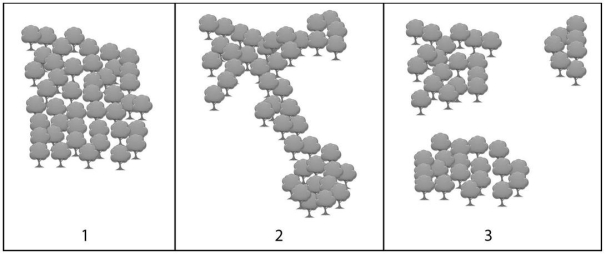 -The American lady butterfly (Vanessa virginiensis)inhabits only forest edges and does not disperse well across unsuitable habitat.Which of the following area(s)would support the highest numbers of this butterfly?
 (Multiple Choice)
4.9/5 (79)
(79) Why were ecologists concerned about the shift in the peak caterpillar season from June 3,1980,to May 15,2000?
(Multiple Choice)
4.9/5 (72)
(72) How should the scientist draw a graph of the data to best address the hypothesis?
(Multiple Choice)
4.8/5 (74)
(74) Which of the following ecological locations,if destroyed,would result in the greatest loss of species diversity?
(Multiple Choice)
4.9/5 (71)
(71) Which of the following is consistent with forest fragmentation research?
(Multiple Choice)
4.9/5 (85)
(85) Please use the following information to answer the questions below.
Three forest areas are being considered for a conservation reserve.Each area contains the same number of trees and is the same cumulative size.The area surrounding the forest patches is a mix of agricultural land and residential homes.
-Which area(s)would be able to support the most scarlet tanagers,a bird species that is restricted to forest interior habitat?
-Which area(s)would be able to support the most scarlet tanagers,a bird species that is restricted to forest interior habitat? (Multiple Choice)
4.9/5 (76)
(76) Burning fossil fuels releases oxides of sulfur and nitrogen.These air pollutants can be responsible for
(Multiple Choice)
4.7/5 (87)
(87) Although extinction is a natural process,current extinctions are of concern to environmentalists because
(Multiple Choice)
4.9/5 (70)
(70) Please use the following information to answer the questions below.
A scientist hypothesizes that biological magnification of heavy metals in fragment-dwelling,insect-eating birds should be greater in forest fragments with relatively more edge habitat.This is because edge-dwelling bird species may forage for insects in areas contaminated by heavy metals outside of the forest.Forest fragments with more interior habitat would not have as much biological magnification because insect-eating interior bird species would have less exposure to insects that contain heavy metals.
-To test this hypothesis,the scientist conducts an experiment.Which of the following designs would be most informative?
(Multiple Choice)
4.8/5 (82)
(82) The typical ecological footprint for a person in the United States is 8 global hectares (gha).How would you estimate the number of Earths required to support the entire population of the United States?
(Multiple Choice)
4.9/5 (76)
(76) The word triage originated during World War I and was first used by French doctors in prioritizing patients based on the severity of their wounds because there were more wounded soldiers in need of urgent care than there were resources to treat them.Conservation biologists have to make similar determinations with degraded ecosystems.Which of the following is the most important consideration when it comes to managing for maintenance of biodiversity?
(Multiple Choice)
4.8/5 (84)
(84) Which of the following is the most direct threat to global biodiversity?
(Multiple Choice)
5.0/5 (71)
(71) 
Filters
- Essay(0)
- Multiple Choice(0)
- Short Answer(0)
- True False(0)
- Matching(0)