



 Chat with AI
Exam 6: Energy and Metabolism

Exam 1: The Science of Biology58 Questions
Exam 2: The Nature of Molecules and the Properties of Water76 Questions
Exam 3: The Chemical Building Blocks of Life74 Questions
Exam 4: Cell Structure63 Questions
Exam 5: Membranes76 Questions
Exam 6: Energy and Metabolism53 Questions
Exam 7: How Cells Harvest Energy59 Questions
Exam 8: Photosynthesis67 Questions
Exam 9: Cell Communication45 Questions
Exam 10: How Cells Divide62 Questions
Exam 11: Sexual Reproduction and Meiosis53 Questions
Exam 12: Patterns of Inheritance64 Questions
Exam 13: Chromosomes, mapping, and the Meiosisinheritance Connection58 Questions
Exam 14: Dna: the Genetic Material68 Questions
Exam 15: Genes and How They Work79 Questions
Exam 16: Control of Gene Expression62 Questions
Exam 17: Biotechnology48 Questions
Exam 18: Genomics52 Questions
Exam 19: Cellular Mechanisms of Development56 Questions
Exam 20: Genes Within Populations78 Questions
Exam 21: The Evidence for Evolution65 Questions
Exam 22: The Origin of Species67 Questions
Exam 23: Systematics,phylogenies,and Comparative Biology67 Questions
Exam 24: Genome Evolution54 Questions
Exam 25: The Origin and Diversity of Life35 Questions
Exam 26: Viruses62 Questions
Exam 27: Prokaryotes61 Questions
Exam 28: Protists55 Questions
Exam 29: Seedless Plants44 Questions
Exam 30: Seed Plants36 Questions
Exam 31: Fungi63 Questions
Exam 32: Animal Diversity and the Evolution of Body Plans42 Questions
Exam 33: Protostomes79 Questions
Exam 34: Deuterostomes83 Questions
Exam 35: Plant Form55 Questions
Exam 36: Transport in Plants51 Questions
Exam 37: Plant Nutrition and Soils47 Questions
Exam 38: Plant Defense Responses42 Questions
Exam 39: Sensory Systems in Plants50 Questions
Exam 40: Plant Reproduction86 Questions
Exam 41: The Animal Body and Principles of Regulation75 Questions
Exam 42: The Nervous System78 Questions
Exam 43: Sensory Systems88 Questions
Exam 44: The Endocrine System87 Questions
Exam 45: The Musculoskeletal System57 Questions
Exam 46: The Digestive System59 Questions
Exam 47: The Respiratory System54 Questions
Exam 48: The Circulatory System53 Questions
Exam 49: Osmotic Regulation and the Urinary System46 Questions
Exam 50: The Immune System49 Questions
Exam 51: The Reproductive System79 Questions
Exam 52: Animal Development69 Questions
Exam 53: Behavioral Biology91 Questions
Exam 54: Ecology of Individuals and Populations69 Questions
Exam 55: Community Ecology59 Questions
Exam 56: Dynamics of Ecosystems48 Questions
Exam 57: The Biosphere and Human Impacts41 Questions
Exam 58: Conservation Biology49 Questions
Select questions type


Kinases are enzymes that can phosphorylate (transfer phosphate groups onto)macromolecules such as proteins.A particular kinase,Kinase 1 is known to promote cell division.It promotes cell division by phosphorylating Protein X.Phosphorylation of Protein X activates Protein X.Once activated,Protein X stimulates the production of other proteins such as Protein Y and Z that directly promote cell division.In order to function,Kinase 1 requires the presence of Metal A.However,in the presence of Protein A,Kinase 1 is nonfunctional.From the description,what is considered the substrate of Kinase 1?
(Multiple Choice)
4.8/5  (85)
(85) Does ADP contain the capacity to provide energy for the cell?
(Multiple Choice)
4.7/5 (81)
(81) Glucose is broken down through cellular respiration,which involves a large number of chemical reactions.At the end of the cellular respiration process,a large number of ATP molecules are generated,but yet,not all of the possible energy that is contained in a molecule of glucose can be harnessed through these chemical reactions to generate ATP.In other words,during cellular respiration,not all of the energy that is contained in a molecule of glucose is converted into the energy stored in ATP.What happens to the remaining energy?
(Multiple Choice)
4.9/5 (81)
(81) The inorganic nonprotein components that participate in enzyme catalysis are known as
(Multiple Choice)
4.8/5 (82)
(82) In a chemical reaction,1,3-bisphosphoglycerate + ADP yields 3-phosphoglycerate plus ATP.What is the delta G for this reaction?
(Multiple Choice)
4.7/5 (89)
(89) AMP-activated protein kinase (AMPK)is an enzyme that is activated by high levels of AMP in cells.If levels of AMP are high in cells,that means that levels of ATP are low.Once active,AMPK activates catabolic pathways and inhibits anabolic pathways in the cell.Why do you think that is the case? Choose the answer that best explains the role of AMPK.
(Multiple Choice)
4.7/5 (73)
(73) Oxidation and reduction reactions are chemical processes that result in a gain or loss of:
(Multiple Choice)
4.9/5 (70)
(70) A molecule that closely resembles the shape of a substrate for an enzyme and that decreases the activity of the enzyme would most likely serve as a(n)
(Multiple Choice)
4.7/5 (82)
(82) In order to reuse an enzyme after the conclusion of an enzyme catalyzed reaction,what must occur?
(Multiple Choice)
4.8/5 (74)
(74) The Law of Thermodynamics that states that increases in entropy are favored is:
(Multiple Choice)
4.7/5 (67)
(67) If you were able to increase the kinetic energy of the molecules inside your body,how would this affect your body temperature?
(Multiple Choice)
4.7/5 (72)
(72) The chemistry of living systems representing all chemical reactions is called
(Multiple Choice)
4.8/5 (71)
(71) You are working with a specific enzyme-catalyzed reaction in the lab.You are a very careful experimentalist,and as a result,at the beginning of each of your experiments,you measure the temperature in the lab.On days 1 through 5,the temperature in the lab was 20oC.Today is day 6 of your experiment,and the temperature in the lab is 30oC.How do you predict that this will alter the rate of your enzyme-catalyzed reaction?
(Multiple Choice)
4.8/5 (66)
(66) Kinases are enzymes that can phosphorylate (transfer phosphate groups onto)macromolecules such as proteins.A particular kinase,Kinase 1 is known to promote cell division.It promotes cell division by phosphorylating Protein X.Phosphorylation of Protein X activates Protein X.Once activated,Protein X stimulates the production of other proteins such as Protein Y and Z that directly promote cell division.In order to function,Kinase 1 requires the presence of Metal A.However,in the presence of Protein A,Kinase 1 is nonfunctional.From the description,what is considered a cofactor of Kinase 1?
(Multiple Choice)
4.9/5 (84)
(84) You are studying an enzyme-catalyzed reaction that induces a particular cellular activity in the lab.If you wanted to slow down that particular cellular activity by controlling the enzyme,what could you do?
(Multiple Choice)
4.9/5 (79)
(79) Based on the graph,what are the optimal temperatures for the human enzyme and hotsprings prokaryote enzyme? 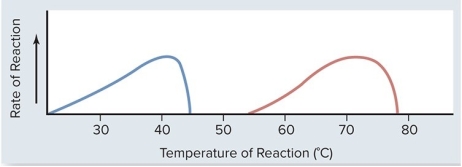
(Multiple Choice)
4.8/5 (88)
(88) Tacrolimus (FK-506)is a drug that inhibits an enzyme called calcineurin.Calcineurin is a protein phosphatase.This is an enzyme that dephosphorylates (removes phosphate groups)from proteins.When added to cells,tacrolimus can inhibit the dephosphorylation of a protein called NFAT,but it cannot prevent the dephosphorylation of a protein called CDK1.What is the most likely explanation for this finding?
(Multiple Choice)
4.7/5 (58)
(58) A ribozyme catalyzes a reaction on itself and actually changes shape.This is an example of.
(Multiple Choice)
4.7/5 (89)
(89) 
Filters
- Essay(0)
- Multiple Choice(0)
- Short Answer(0)
- True False(0)
- Matching(0)