



 Chat with AI
Exam 20: Genes Within Populations

Exam 1: The Science of Biology58 Questions
Exam 2: The Nature of Molecules and the Properties of Water76 Questions
Exam 3: The Chemical Building Blocks of Life74 Questions
Exam 4: Cell Structure63 Questions
Exam 5: Membranes76 Questions
Exam 6: Energy and Metabolism53 Questions
Exam 7: How Cells Harvest Energy59 Questions
Exam 8: Photosynthesis67 Questions
Exam 9: Cell Communication45 Questions
Exam 10: How Cells Divide62 Questions
Exam 11: Sexual Reproduction and Meiosis53 Questions
Exam 12: Patterns of Inheritance64 Questions
Exam 13: Chromosomes, mapping, and the Meiosisinheritance Connection58 Questions
Exam 14: Dna: the Genetic Material68 Questions
Exam 15: Genes and How They Work79 Questions
Exam 16: Control of Gene Expression62 Questions
Exam 17: Biotechnology48 Questions
Exam 18: Genomics52 Questions
Exam 19: Cellular Mechanisms of Development56 Questions
Exam 20: Genes Within Populations78 Questions
Exam 21: The Evidence for Evolution65 Questions
Exam 22: The Origin of Species67 Questions
Exam 23: Systematics,phylogenies,and Comparative Biology67 Questions
Exam 24: Genome Evolution54 Questions
Exam 25: The Origin and Diversity of Life35 Questions
Exam 26: Viruses62 Questions
Exam 27: Prokaryotes61 Questions
Exam 28: Protists55 Questions
Exam 29: Seedless Plants44 Questions
Exam 30: Seed Plants36 Questions
Exam 31: Fungi63 Questions
Exam 32: Animal Diversity and the Evolution of Body Plans42 Questions
Exam 33: Protostomes79 Questions
Exam 34: Deuterostomes83 Questions
Exam 35: Plant Form55 Questions
Exam 36: Transport in Plants51 Questions
Exam 37: Plant Nutrition and Soils47 Questions
Exam 38: Plant Defense Responses42 Questions
Exam 39: Sensory Systems in Plants50 Questions
Exam 40: Plant Reproduction86 Questions
Exam 41: The Animal Body and Principles of Regulation75 Questions
Exam 42: The Nervous System78 Questions
Exam 43: Sensory Systems88 Questions
Exam 44: The Endocrine System87 Questions
Exam 45: The Musculoskeletal System57 Questions
Exam 46: The Digestive System59 Questions
Exam 47: The Respiratory System54 Questions
Exam 48: The Circulatory System53 Questions
Exam 49: Osmotic Regulation and the Urinary System46 Questions
Exam 50: The Immune System49 Questions
Exam 51: The Reproductive System79 Questions
Exam 52: Animal Development69 Questions
Exam 53: Behavioral Biology91 Questions
Exam 54: Ecology of Individuals and Populations69 Questions
Exam 55: Community Ecology59 Questions
Exam 56: Dynamics of Ecosystems48 Questions
Exam 57: The Biosphere and Human Impacts41 Questions
Exam 58: Conservation Biology49 Questions
Select questions type


The frequency of a particular allele within a population can be changed,over time,by
(Multiple Choice)
4.9/5  (87)
(87) The genetic preservation of the features that increase the likelihood of survival and reproduction of some individuals within a population is called the process of
(Multiple Choice)
4.8/5 (82)
(82) The observation that most pureblood Native Americans have type O blood is best explained by ________
(Multiple Choice)
4.9/5 (79)
(79) Two parents who do not have sickle cell anemia have a child that has the disease.The parents are both:
(Multiple Choice)
4.8/5 (81)
(81) Pea fowl (peacocks and peahens)show sexual dimorphism -- males have long blue-green tail feathers with eyespots,while females have short brown tail feathers.Which statement best describes the graphed data about peacocks? 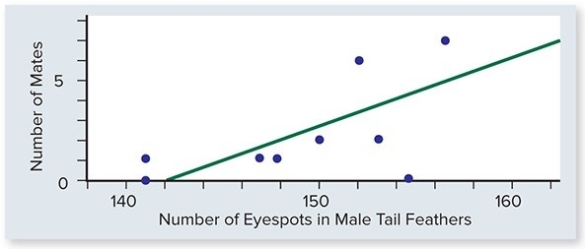
(Multiple Choice)
4.9/5 (90)
(90) Large ears is a rare trait in a mainland population of mice.A few female mice homozygous for very large ears arrive at an island that already contains mice after sneaking onto a boat.This will lead to a population with a higher incidence of big ears than the mainland population because of ________
(Multiple Choice)
4.8/5 (80)
(80) Genotypes are said to be in ________ equilibrium if there is random mating and no other forces tend to alter the proportions of alleles from one generation to the next.
(Multiple Choice)
4.8/5 (74)
(74) In a forest,trees that get more sunlight grow taller than other nearby trees.This is a form of ________
(Multiple Choice)
5.0/5 (69)
(69) Platys and swordtails are related tropical freshwater fish.In studies,researchers have shown that female platys prefer males with swordtails,even though males of their own species do not have them.This was discovered by attaching artificial swordtails to platys males.What does this suggest about the origin of the swordtail feature?
(Multiple Choice)
4.9/5 (87)
(87) A study finds a positive correlation between the number of spots on the tail of male peacocks and their mating success.What would be the best followup experiment?
(Multiple Choice)
4.8/5 (91)
(91) Darwin proposed that natural selection occurs in an environment by
(Multiple Choice)
4.8/5 (85)
(85) A human autosomal recessive trait appears in 1 in 100 births.What percent of people are homozygous dominant for this trait?
(Multiple Choice)
5.0/5 (85)
(85) Natural selection for a certain phenotype will affect the ________.
(Multiple Choice)
4.9/5 (91)
(91) The recessive phenotype of a trait occurs in 16% of a population.What is the frequency of the dominant allele?
(Multiple Choice)
4.7/5 (84)
(84) 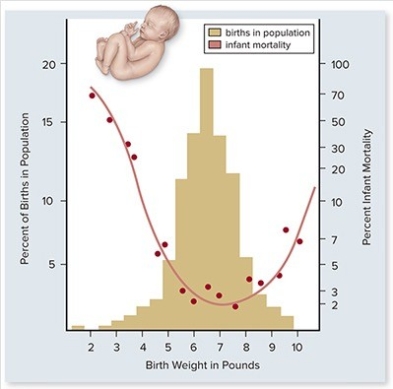 In the graph above,which baby characteristics would explain the percent infant mortality curve and any subsequent effects on fitness?
 (Multiple Choice)
4.9/5 (87)
(87) 
Filters
- Essay(0)
- Multiple Choice(0)
- Short Answer(0)
- True False(0)
- Matching(0)