



 Chat with AI
Exam 20: Genes Within Populations

Exam 1: The Science of Biology58 Questions
Exam 2: The Nature of Molecules and the Properties of Water76 Questions
Exam 3: The Chemical Building Blocks of Life74 Questions
Exam 4: Cell Structure63 Questions
Exam 5: Membranes76 Questions
Exam 6: Energy and Metabolism53 Questions
Exam 7: How Cells Harvest Energy59 Questions
Exam 8: Photosynthesis67 Questions
Exam 9: Cell Communication45 Questions
Exam 10: How Cells Divide62 Questions
Exam 11: Sexual Reproduction and Meiosis53 Questions
Exam 12: Patterns of Inheritance64 Questions
Exam 13: Chromosomes, mapping, and the Meiosisinheritance Connection58 Questions
Exam 14: Dna: the Genetic Material68 Questions
Exam 15: Genes and How They Work79 Questions
Exam 16: Control of Gene Expression62 Questions
Exam 17: Biotechnology48 Questions
Exam 18: Genomics52 Questions
Exam 19: Cellular Mechanisms of Development56 Questions
Exam 20: Genes Within Populations78 Questions
Exam 21: The Evidence for Evolution65 Questions
Exam 22: The Origin of Species67 Questions
Exam 23: Systematics,phylogenies,and Comparative Biology67 Questions
Exam 24: Genome Evolution54 Questions
Exam 25: The Origin and Diversity of Life35 Questions
Exam 26: Viruses62 Questions
Exam 27: Prokaryotes61 Questions
Exam 28: Protists55 Questions
Exam 29: Seedless Plants44 Questions
Exam 30: Seed Plants36 Questions
Exam 31: Fungi63 Questions
Exam 32: Animal Diversity and the Evolution of Body Plans42 Questions
Exam 33: Protostomes79 Questions
Exam 34: Deuterostomes83 Questions
Exam 35: Plant Form55 Questions
Exam 36: Transport in Plants51 Questions
Exam 37: Plant Nutrition and Soils47 Questions
Exam 38: Plant Defense Responses42 Questions
Exam 39: Sensory Systems in Plants50 Questions
Exam 40: Plant Reproduction86 Questions
Exam 41: The Animal Body and Principles of Regulation75 Questions
Exam 42: The Nervous System78 Questions
Exam 43: Sensory Systems88 Questions
Exam 44: The Endocrine System87 Questions
Exam 45: The Musculoskeletal System57 Questions
Exam 46: The Digestive System59 Questions
Exam 47: The Respiratory System54 Questions
Exam 48: The Circulatory System53 Questions
Exam 49: Osmotic Regulation and the Urinary System46 Questions
Exam 50: The Immune System49 Questions
Exam 51: The Reproductive System79 Questions
Exam 52: Animal Development69 Questions
Exam 53: Behavioral Biology91 Questions
Exam 54: Ecology of Individuals and Populations69 Questions
Exam 55: Community Ecology59 Questions
Exam 56: Dynamics of Ecosystems48 Questions
Exam 57: The Biosphere and Human Impacts41 Questions
Exam 58: Conservation Biology49 Questions
Select questions type


________ would keep a population in Hardy-Weinberg equilibrium.
(Multiple Choice)
4.9/5  (82)
(82) Male Mormon crickets choose larger females as their mates.Which of the following statements best interprets the graph? 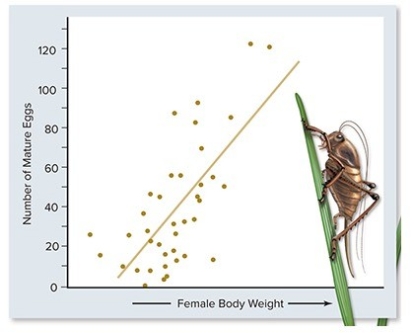
(Multiple Choice)
4.8/5 (81)
(81) In a small population of cockroaches living in your kitchen,only a few roaches mate in one year.This can lead to random changes in allele frequency in the population through ________
(Multiple Choice)
4.8/5 (69)
(69) Since females take on the larger parenting role in most species,what tendency do they have?
(Multiple Choice)
4.9/5 (77)
(77) An island is on the migration route of sea birds.This island also has abundant tree nesting birds that live on the island permanently and are not found on any other island.The tree nesting birds are more likely than the sea birds to be in Hardy-Weinberg equilibrium because:
(Multiple Choice)
4.9/5 (82)
(82) Many male songbirds are brightly colored.However,the color of the birds is determined by a balance of
(Multiple Choice)
4.9/5 (85)
(85) The several hundred species of picture-winged fruit flies of the Hawaiian Islands are genetically very similar,yet they all differ markedly from their ancestral population in Asia.This is probably an example of ________
(Multiple Choice)
4.8/5 (80)
(80) ________ would produce the smallest evolutionary change in a given period of time in a population of birds.
(Multiple Choice)
4.8/5 (73)
(73) 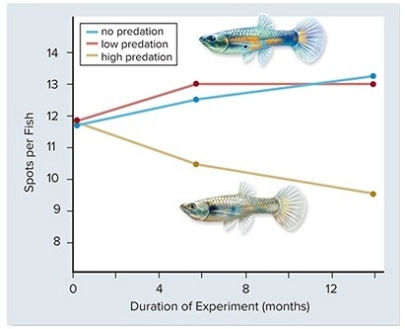 Based on the graph above,the color of male guppies can be seen as a balance between positive and negative selections.Bright colors are an advantage in ________,but a disadvantage in ________.
 (Multiple Choice)
4.8/5 (85)
(85) If a population was in Hardy-Weinberg equilibrium,then ________ would occur in that population.
(Multiple Choice)
4.9/5 (97)
(97) If the frequency of an autosomal recessive trait in humans is 1 out of 100 births,what would be the expected frequency of heterozygote carriers for the trait if we assume that the gene is in Hardy-Weinberg equilibrium?
(Multiple Choice)
4.8/5 (64)
(64) You are studying a population of geese in which there are two color phases,brown and gray.Color in this species is controlled by a single gene,with brown dominant to gray.A random sample of 250 geese shows that 210 are brown.What percentage of the brown geese are heterozygous? (Assume that the population is in Hardy-Weinberg equilibrium.)
(Multiple Choice)
5.0/5 (61)
(61) People homozygous for the sickle-cell anemia allele develop a life threatening disease,while those homozygous for the normal allele are at the highest risk of dying from malaria.Carriers have some resistance to malaria,but do not develop sickle cell anemia.This is an example of ________
(Multiple Choice)
4.9/5 (78)
(78) Antigens on red blood cells are hereditary traits that allow blood to be typed in different ways.One system is based on a gene with two alleles,M and N.If the frequency of the M allele in a population is 0.4,then according to the Hardy-Weinberg rule,the expected frequency of the heterozygous MN genotype is ________.
(Multiple Choice)
4.7/5 (67)
(67) Gene flow,defined as the movement of genes from one population to another,can take place by migration,as well as
(Multiple Choice)
4.8/5 (89)
(89) 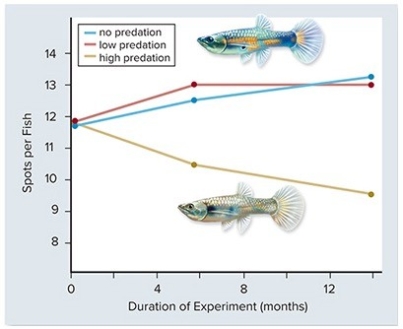 In the experiment above,guppy color patterns (spots)were measured in populations exposed to increasing amounts of predation.From this you could conclude that ________.
 (Multiple Choice)
4.7/5 (85)
(85) In the phalarope,or wadepiper bird,the male is unusual in playing the larger parenting role -- he performs all the egg incubation and chick care.What unusual behavior might you predict for the female of the species?
(Multiple Choice)
4.9/5 (67)
(67) Average human males are most likely to be attracted to women with a waist to hip ratio of 0.72.Women with this waist to hip ratio are also the most fertile.By being attracted to women with a waist to hip ratio,a male is increasing his chances of having children and thus improve his ________.
(Multiple Choice)
4.9/5 (73)
(73) During a drought on the Galapagos islands,finches with larger beaks were able to crack the large tough seeds produced by plants that survived the dry conditions.This is an example of ________.
(Multiple Choice)
4.8/5 (73)
(73) In a large population of randomly reproducing rabbits,a recessive allele r comprises 80% of the alleles for a gene.What percentage of the rabbits would you expect to have the recessive phenotype?
(Multiple Choice)
4.7/5 (92)
(92) 
Filters
- Essay(0)
- Multiple Choice(0)
- Short Answer(0)
- True False(0)
- Matching(0)