



 Chat with AI
Exam 21: The Evidence for Evolution

Exam 1: The Science of Biology58 Questions
Exam 2: The Nature of Molecules and the Properties of Water76 Questions
Exam 3: The Chemical Building Blocks of Life74 Questions
Exam 4: Cell Structure63 Questions
Exam 5: Membranes76 Questions
Exam 6: Energy and Metabolism53 Questions
Exam 7: How Cells Harvest Energy59 Questions
Exam 8: Photosynthesis67 Questions
Exam 9: Cell Communication45 Questions
Exam 10: How Cells Divide62 Questions
Exam 11: Sexual Reproduction and Meiosis53 Questions
Exam 12: Patterns of Inheritance64 Questions
Exam 13: Chromosomes, mapping, and the Meiosisinheritance Connection58 Questions
Exam 14: Dna: the Genetic Material68 Questions
Exam 15: Genes and How They Work79 Questions
Exam 16: Control of Gene Expression62 Questions
Exam 17: Biotechnology48 Questions
Exam 18: Genomics52 Questions
Exam 19: Cellular Mechanisms of Development56 Questions
Exam 20: Genes Within Populations78 Questions
Exam 21: The Evidence for Evolution65 Questions
Exam 22: The Origin of Species67 Questions
Exam 23: Systematics,phylogenies,and Comparative Biology67 Questions
Exam 24: Genome Evolution54 Questions
Exam 25: The Origin and Diversity of Life35 Questions
Exam 26: Viruses62 Questions
Exam 27: Prokaryotes61 Questions
Exam 28: Protists55 Questions
Exam 29: Seedless Plants44 Questions
Exam 30: Seed Plants36 Questions
Exam 31: Fungi63 Questions
Exam 32: Animal Diversity and the Evolution of Body Plans42 Questions
Exam 33: Protostomes79 Questions
Exam 34: Deuterostomes83 Questions
Exam 35: Plant Form55 Questions
Exam 36: Transport in Plants51 Questions
Exam 37: Plant Nutrition and Soils47 Questions
Exam 38: Plant Defense Responses42 Questions
Exam 39: Sensory Systems in Plants50 Questions
Exam 40: Plant Reproduction86 Questions
Exam 41: The Animal Body and Principles of Regulation75 Questions
Exam 42: The Nervous System78 Questions
Exam 43: Sensory Systems88 Questions
Exam 44: The Endocrine System87 Questions
Exam 45: The Musculoskeletal System57 Questions
Exam 46: The Digestive System59 Questions
Exam 47: The Respiratory System54 Questions
Exam 48: The Circulatory System53 Questions
Exam 49: Osmotic Regulation and the Urinary System46 Questions
Exam 50: The Immune System49 Questions
Exam 51: The Reproductive System79 Questions
Exam 52: Animal Development69 Questions
Exam 53: Behavioral Biology91 Questions
Exam 54: Ecology of Individuals and Populations69 Questions
Exam 55: Community Ecology59 Questions
Exam 56: Dynamics of Ecosystems48 Questions
Exam 57: The Biosphere and Human Impacts41 Questions
Exam 58: Conservation Biology49 Questions
Select questions type


The evolution of similar forms in different lineages when exposed to the same selective pressures is
(Multiple Choice)
4.9/5  (80)
(80) Some of the most dramatic evidence for evolution has come from human agriculture.One of the most highly artificially selected crop plants is
(Multiple Choice)
4.9/5 (90)
(90) The figure below shows results of bristle number in Drosophila flies after 35 generations of artificial selection.This figure suggests that 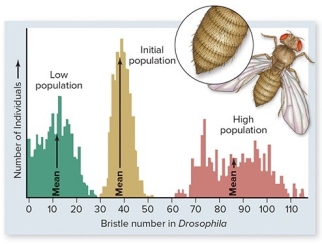
(Multiple Choice)
4.8/5 (64)
(64) Which statement factors into artificial but not natural selection?
(Multiple Choice)
4.8/5 (79)
(79) Inhabitants of oceanic islands resemble forms of the nearest mainland but show some differences.This is an example of
(Multiple Choice)
4.9/5 (74)
(74) Which one of the following is not important to the concept of homology?
(Multiple Choice)
4.9/5 (79)
(79) The streamlined bodies seen in sharks,tuna,and dolphins best relate to
(Multiple Choice)
4.9/5 (94)
(94) Evolution does not violate the second law of thermodynamics because
(Multiple Choice)
4.9/5 (85)
(85) Select the pairs of organism characteristics that are homologous structures.Check all that apply.
(Multiple Choice)
4.8/5 (85)
(85) Why can't "scientific creationism" be considered a science? Check all that apply.
(Multiple Choice)
4.9/5 (65)
(65) The evidence for industrial melanism being caused by an increase in the dark allele was provided from field tests carried out by
(Multiple Choice)
4.9/5 (73)
(73) Choose the evidence supporting that snakes evolved from legged lizards.Check all that apply.
(Multiple Choice)
4.9/5 (75)
(75) The half-life of carbon-14 is 5,600 years.A fossil that has one-eighth the normal proportion of carbon-14 to carbon-12 is probably
(Multiple Choice)
4.9/5 (66)
(66) The figure below shows the relationship between beak depth in the medium ground finch on Daphne Major and relative fitness.Assuming that beak depth is heritable,what do you predict about beak depth in the next generation? 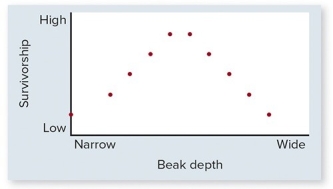
(Multiple Choice)
5.0/5 (89)
(89) Marsupials are a very ancestral form of mammal,evolving before placental mammals over 70 million years ago.Today Australian marsupials can be compared to placental mammals on other continents.
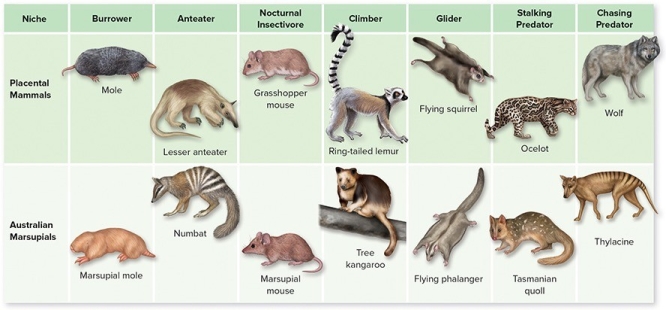 -When you compare Australian marsupials to placental mammals today
 (Multiple Choice)
4.9/5 (72)
(72) Which aspect(s)of natural selection is(are)illustrated by the figure below (21.2b)? Check all that apply. 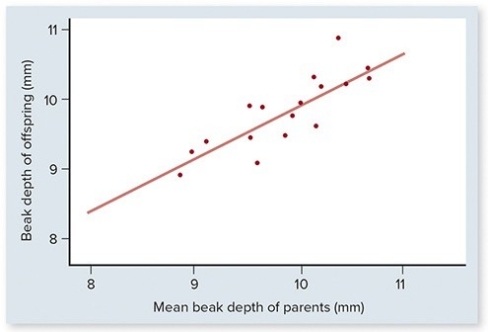
(Multiple Choice)
4.9/5 (79)
(79) Choose the scientific evidence that supports evolutionary theory.Check all that apply.
(Multiple Choice)
4.9/5 (74)
(74) The shape of the beaks of Darwin's finches and industrial melanism are often cited as examples of the process of ________ leading to evolutionary change.
(Multiple Choice)
4.9/5 (69)
(69) The marsupials in Australia closely resemble the placental animals of the rest of the world.This is an example of
(Multiple Choice)
5.0/5 (74)
(74) 
Filters
- Essay(0)
- Multiple Choice(0)
- Short Answer(0)
- True False(0)
- Matching(0)