



 Chat with AI
Exam 21: The Evidence for Evolution

Exam 1: The Science of Biology58 Questions
Exam 2: The Nature of Molecules and the Properties of Water76 Questions
Exam 3: The Chemical Building Blocks of Life74 Questions
Exam 4: Cell Structure63 Questions
Exam 5: Membranes76 Questions
Exam 6: Energy and Metabolism53 Questions
Exam 7: How Cells Harvest Energy59 Questions
Exam 8: Photosynthesis67 Questions
Exam 9: Cell Communication45 Questions
Exam 10: How Cells Divide62 Questions
Exam 11: Sexual Reproduction and Meiosis53 Questions
Exam 12: Patterns of Inheritance64 Questions
Exam 13: Chromosomes, mapping, and the Meiosisinheritance Connection58 Questions
Exam 14: Dna: the Genetic Material68 Questions
Exam 15: Genes and How They Work79 Questions
Exam 16: Control of Gene Expression62 Questions
Exam 17: Biotechnology48 Questions
Exam 18: Genomics52 Questions
Exam 19: Cellular Mechanisms of Development56 Questions
Exam 20: Genes Within Populations78 Questions
Exam 21: The Evidence for Evolution65 Questions
Exam 22: The Origin of Species67 Questions
Exam 23: Systematics,phylogenies,and Comparative Biology67 Questions
Exam 24: Genome Evolution54 Questions
Exam 25: The Origin and Diversity of Life35 Questions
Exam 26: Viruses62 Questions
Exam 27: Prokaryotes61 Questions
Exam 28: Protists55 Questions
Exam 29: Seedless Plants44 Questions
Exam 30: Seed Plants36 Questions
Exam 31: Fungi63 Questions
Exam 32: Animal Diversity and the Evolution of Body Plans42 Questions
Exam 33: Protostomes79 Questions
Exam 34: Deuterostomes83 Questions
Exam 35: Plant Form55 Questions
Exam 36: Transport in Plants51 Questions
Exam 37: Plant Nutrition and Soils47 Questions
Exam 38: Plant Defense Responses42 Questions
Exam 39: Sensory Systems in Plants50 Questions
Exam 40: Plant Reproduction86 Questions
Exam 41: The Animal Body and Principles of Regulation75 Questions
Exam 42: The Nervous System78 Questions
Exam 43: Sensory Systems88 Questions
Exam 44: The Endocrine System87 Questions
Exam 45: The Musculoskeletal System57 Questions
Exam 46: The Digestive System59 Questions
Exam 47: The Respiratory System54 Questions
Exam 48: The Circulatory System53 Questions
Exam 49: Osmotic Regulation and the Urinary System46 Questions
Exam 50: The Immune System49 Questions
Exam 51: The Reproductive System79 Questions
Exam 52: Animal Development69 Questions
Exam 53: Behavioral Biology91 Questions
Exam 54: Ecology of Individuals and Populations69 Questions
Exam 55: Community Ecology59 Questions
Exam 56: Dynamics of Ecosystems48 Questions
Exam 57: The Biosphere and Human Impacts41 Questions
Exam 58: Conservation Biology49 Questions
Select questions type


In 2006,scientists discovered a fossil that had scales and gills,a flat head with eyes on top like a crocodile,and fin and neck bones that would allow it to prop itself out of the water.The best explanation for this fossil is that it is
(Multiple Choice)
4.8/5  (83)
(83) The most likely explanation for why toothed whales have a blowhole is
(Multiple Choice)
4.8/5 (81)
(81) A scientist studying evolution of peppered moths (Biston betularia)in Michigan observed that the percentage of melanic moths increased by around 2% from 1960-1961.Has evolution occurred in this population?
(Multiple Choice)
4.9/5 (84)
(84) In studying the medium ground finch on Daphne Major,the Grants noted that each generation of finches had beaks
(Multiple Choice)
5.0/5 (77)
(77) In the laboratory,fruit flies (Drosophila)were artificially selected for the number of bristles on their bodies.One population (R)was selected for low numbers of bristles,a second population (S)for high numbers of bristles.
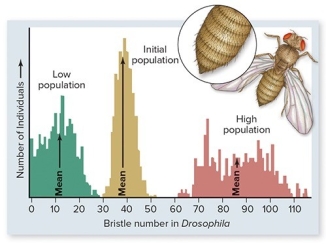 -In order for the scientists to artificially select Drosophila for their number of bristles,
 (Multiple Choice)
4.7/5 (75)
(75) Considerably more phenotypic variation exists in domesticated varieties of species like dogs and cabbages than exists in non-domesticated species like lions and maple trees.Which one of the following statements best explains why this is true?
(Multiple Choice)
5.0/5 (95)
(95) Which "alternate" hypothesis might also explain industrial melanism?
(Multiple Choice)
4.9/5 (73)
(73) Which statement best describes the correlation between beak depths and the dryness of the environment?
(Multiple Choice)
4.8/5 (83)
(83) Structures that have no apparent function but had a function in ancestral species are
(Multiple Choice)
4.8/5 (88)
(88) It could be said that today's Australian marsupials and today's placental mammals have
(Multiple Choice)
4.9/5 (77)
(77) Select the statements that provide direct biogeographical evidence for evolutionary theory.Check all that apply.
(Multiple Choice)
4.9/5 (73)
(73) The "scientific creationism" view includes all of the following beliefs except that
(Multiple Choice)
4.8/5 (83)
(83) A technique used in dating a rock can be used to accurately predict the age of the fossils occurring in the rocks.This technique involves
(Multiple Choice)
4.9/5 (93)
(93) Which observation(s)of the medium ground finch (Geospiza fortis)by Peter and Rosemary Grant verify Darwin's selection hypothesis? Check all that apply.
(Multiple Choice)
4.7/5 (82)
(82) 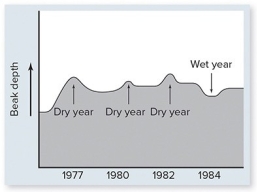 -The pattern of wet years and dry years shown will probably move the population toward
 (Multiple Choice)
4.8/5 (88)
(88) A new winged species is discovered in the Amazon rainforest.Select the evidence that supports that this species' wings are homologous to vertebrate animals and analogous to insect wings.Check all that apply.
(Multiple Choice)
4.9/5 (67)
(67) Progressive changes in the fossil record are evidence for evolution because
(Multiple Choice)
4.8/5 (85)
(85) 
Filters
- Essay(0)
- Multiple Choice(0)
- Short Answer(0)
- True False(0)
- Matching(0)