



 Chat with AI
Exam 45: The Musculoskeletal System

Exam 1: The Science of Biology58 Questions
Exam 2: The Nature of Molecules and the Properties of Water76 Questions
Exam 3: The Chemical Building Blocks of Life74 Questions
Exam 4: Cell Structure63 Questions
Exam 5: Membranes76 Questions
Exam 6: Energy and Metabolism53 Questions
Exam 7: How Cells Harvest Energy59 Questions
Exam 8: Photosynthesis67 Questions
Exam 9: Cell Communication45 Questions
Exam 10: How Cells Divide62 Questions
Exam 11: Sexual Reproduction and Meiosis53 Questions
Exam 12: Patterns of Inheritance64 Questions
Exam 13: Chromosomes, mapping, and the Meiosisinheritance Connection58 Questions
Exam 14: Dna: the Genetic Material68 Questions
Exam 15: Genes and How They Work79 Questions
Exam 16: Control of Gene Expression62 Questions
Exam 17: Biotechnology48 Questions
Exam 18: Genomics52 Questions
Exam 19: Cellular Mechanisms of Development56 Questions
Exam 20: Genes Within Populations78 Questions
Exam 21: The Evidence for Evolution65 Questions
Exam 22: The Origin of Species67 Questions
Exam 23: Systematics,phylogenies,and Comparative Biology67 Questions
Exam 24: Genome Evolution54 Questions
Exam 25: The Origin and Diversity of Life35 Questions
Exam 26: Viruses62 Questions
Exam 27: Prokaryotes61 Questions
Exam 28: Protists55 Questions
Exam 29: Seedless Plants44 Questions
Exam 30: Seed Plants36 Questions
Exam 31: Fungi63 Questions
Exam 32: Animal Diversity and the Evolution of Body Plans42 Questions
Exam 33: Protostomes79 Questions
Exam 34: Deuterostomes83 Questions
Exam 35: Plant Form55 Questions
Exam 36: Transport in Plants51 Questions
Exam 37: Plant Nutrition and Soils47 Questions
Exam 38: Plant Defense Responses42 Questions
Exam 39: Sensory Systems in Plants50 Questions
Exam 40: Plant Reproduction86 Questions
Exam 41: The Animal Body and Principles of Regulation75 Questions
Exam 42: The Nervous System78 Questions
Exam 43: Sensory Systems88 Questions
Exam 44: The Endocrine System87 Questions
Exam 45: The Musculoskeletal System57 Questions
Exam 46: The Digestive System59 Questions
Exam 47: The Respiratory System54 Questions
Exam 48: The Circulatory System53 Questions
Exam 49: Osmotic Regulation and the Urinary System46 Questions
Exam 50: The Immune System49 Questions
Exam 51: The Reproductive System79 Questions
Exam 52: Animal Development69 Questions
Exam 53: Behavioral Biology91 Questions
Exam 54: Ecology of Individuals and Populations69 Questions
Exam 55: Community Ecology59 Questions
Exam 56: Dynamics of Ecosystems48 Questions
Exam 57: The Biosphere and Human Impacts41 Questions
Exam 58: Conservation Biology49 Questions
Select questions type


All of the following statements about exoskeletons are correct EXCEPT
(Multiple Choice)
4.9/5  (79)
(79) The muscles that move the eye have a high proportion of fast-twitch fibers and reach maximum tension very fast.These fibers belong to the class of ________ fibers.
(Multiple Choice)
4.9/5 (83)
(83) Which of these muscles would you expect to have the greatest proportion of slow-twitch fibers?
(Multiple Choice)
4.7/5 (67)
(67) You decide to do an experiment with isolated myofibrils to explore the effects of ATP hydrolysis on myofibril function.You do this by bathing the myofibrils in a solution that contains a modified form of ATP,which cannot be split into ADP and Pi. At what step will myofibril function be arrested by using this compound instead of unmodified ATP?
(Multiple Choice)
4.8/5 (71)
(71) You witness a demonstration of a martial arts master breaking a large concrete block with his hand.Besides mastering the technique,what is another benefit of the repetitive practice of breaking concrete?
(Multiple Choice)
4.9/5 (79)
(79) In the power stroke shown in panel c below,the thin filaments are pulled towards the center of the sarcomere.What is the specific sequence of events that occurs during a power stroke? 
(Multiple Choice)
4.9/5 (71)
(71) A newborn baby dies soon after birth because her diaphragm and rib cage muscles failed to contract and she was unable to breathe on her own.Examination of the baby's DNA revealed that she had a genetic mutation in a gene that encoded a calcium-binding protein.Which protein was most likely defective in the baby?
(Multiple Choice)
4.9/5 (74)
(74) Identify the condition that will result in an increased level of calcium in the blood.
(Multiple Choice)
4.8/5 (79)
(79) Muscle fatigue is often accompanied by muscle pain.What is the most likely explanation for this pain?
(Multiple Choice)
4.9/5 (80)
(80) Which of the following joint types is not correctly matched with its example?
(Multiple Choice)
5.0/5 (95)
(95) A lab technician is preparing to dispose of a rat and a frog that were euthanized earlier in the day for a scientific study.Although the two animals died at the same time,the rat has rigor mortis while the frog does not yet show any signs of it.What is the best explanation for this time difference in the onset of rigor mortis?
(Multiple Choice)
4.8/5 (84)
(84) In order for a muscle to contract,calcium ions released from the sarcoplasmic reticulum must bind to
(Multiple Choice)
4.8/5 (86)
(86) Which of the following statements relating to skeletal muscle and their functions is NOT correct?
(Multiple Choice)
4.7/5 (92)
(92) The mammalian jaw is an example of what kind of moveable joint?
(Multiple Choice)
4.8/5 (83)
(83) Select the incorrect statement about muscle and muscle fibers.
(Multiple Choice)
4.8/5 (69)
(69) Shown below is part of a myofibril from a relaxed muscle fiber.Which of the labeled regions will NOT shorten when the muscle contracts? 
(Multiple Choice)
4.8/5 (89)
(89) Select the incorrect statement related to sarcomere structure and function.
(Multiple Choice)
4.9/5 (94)
(94) 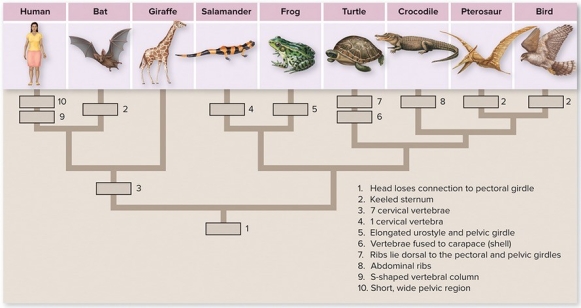 Based on the above diagram and other information from your text,what is the most likely (e.g.,most parsimonious)explanation for the evolution of flight in vertebrates?
 (Multiple Choice)
4.8/5 (82)
(82) 
Filters
- Essay(0)
- Multiple Choice(0)
- Short Answer(0)
- True False(0)
- Matching(0)