



 Chat with AI
Exam 51: The Reproductive System

Exam 1: The Science of Biology58 Questions
Exam 2: The Nature of Molecules and the Properties of Water76 Questions
Exam 3: The Chemical Building Blocks of Life74 Questions
Exam 4: Cell Structure63 Questions
Exam 5: Membranes76 Questions
Exam 6: Energy and Metabolism53 Questions
Exam 7: How Cells Harvest Energy59 Questions
Exam 8: Photosynthesis67 Questions
Exam 9: Cell Communication45 Questions
Exam 10: How Cells Divide62 Questions
Exam 11: Sexual Reproduction and Meiosis53 Questions
Exam 12: Patterns of Inheritance64 Questions
Exam 13: Chromosomes, mapping, and the Meiosisinheritance Connection58 Questions
Exam 14: Dna: the Genetic Material68 Questions
Exam 15: Genes and How They Work79 Questions
Exam 16: Control of Gene Expression62 Questions
Exam 17: Biotechnology48 Questions
Exam 18: Genomics52 Questions
Exam 19: Cellular Mechanisms of Development56 Questions
Exam 20: Genes Within Populations78 Questions
Exam 21: The Evidence for Evolution65 Questions
Exam 22: The Origin of Species67 Questions
Exam 23: Systematics,phylogenies,and Comparative Biology67 Questions
Exam 24: Genome Evolution54 Questions
Exam 25: The Origin and Diversity of Life35 Questions
Exam 26: Viruses62 Questions
Exam 27: Prokaryotes61 Questions
Exam 28: Protists55 Questions
Exam 29: Seedless Plants44 Questions
Exam 30: Seed Plants36 Questions
Exam 31: Fungi63 Questions
Exam 32: Animal Diversity and the Evolution of Body Plans42 Questions
Exam 33: Protostomes79 Questions
Exam 34: Deuterostomes83 Questions
Exam 35: Plant Form55 Questions
Exam 36: Transport in Plants51 Questions
Exam 37: Plant Nutrition and Soils47 Questions
Exam 38: Plant Defense Responses42 Questions
Exam 39: Sensory Systems in Plants50 Questions
Exam 40: Plant Reproduction86 Questions
Exam 41: The Animal Body and Principles of Regulation75 Questions
Exam 42: The Nervous System78 Questions
Exam 43: Sensory Systems88 Questions
Exam 44: The Endocrine System87 Questions
Exam 45: The Musculoskeletal System57 Questions
Exam 46: The Digestive System59 Questions
Exam 47: The Respiratory System54 Questions
Exam 48: The Circulatory System53 Questions
Exam 49: Osmotic Regulation and the Urinary System46 Questions
Exam 50: The Immune System49 Questions
Exam 51: The Reproductive System79 Questions
Exam 52: Animal Development69 Questions
Exam 53: Behavioral Biology91 Questions
Exam 54: Ecology of Individuals and Populations69 Questions
Exam 55: Community Ecology59 Questions
Exam 56: Dynamics of Ecosystems48 Questions
Exam 57: The Biosphere and Human Impacts41 Questions
Exam 58: Conservation Biology49 Questions
Select questions type


Ovulation occurs by a surge in the secretion of what hormone?
(Multiple Choice)
4.9/5  (79)
(79) There are exceptions to the general rule that amphibians lay eggs that develop in the water.These exceptions show extreme variation but they do have one thing in common.What is it?
(Multiple Choice)
4.9/5 (87)
(87) What is often -- but not always -- a feature that accompanies the evolution of internal fertilization?
(Multiple Choice)
4.9/5 (81)
(81) In agriculture,male animals are often castrated to modify their behavior and to produce desirable qualities in the meat.What would you predict about hormone levels in castrated male animals?
(Multiple Choice)
4.8/5 (82)
(82) Choose the letter of the best match from the following:
-Sperm destruction.
(Multiple Choice)
4.9/5 (87)
(87) 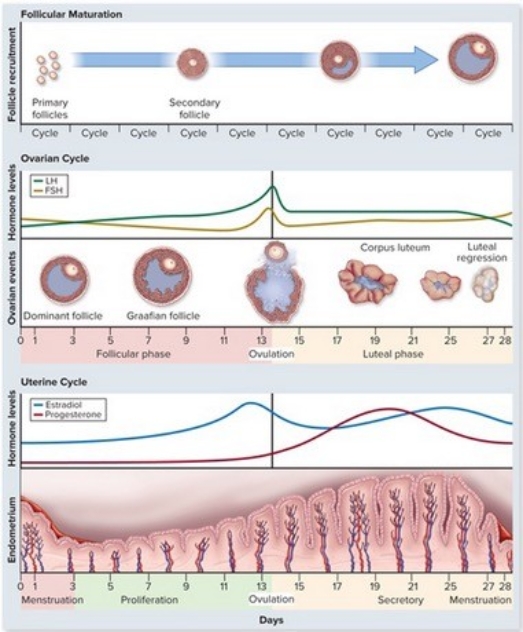 -According to the figure,what is a likely day of implantation?
 (Multiple Choice)
4.8/5 (79)
(79) Some internally fertilized eggs develop and hatch outside the mother's body.What is this developmental strategy called?
(Multiple Choice)
4.8/5 (82)
(82) There are numerous fish genera that have individuals that can change their sex during their lifetime.What is this called?
(Multiple Choice)
4.8/5 (83)
(83) Which hormone prevents the corpus luteum from degenerating?
(Multiple Choice)
4.9/5 (91)
(91) A patient at a fertility clinic has been diagnosed with "luteal phase defect" (LPD).Her progesterone levels are low and her cycles are short.What step of reproduction are these symptoms disrupting?
(Multiple Choice)
4.8/5 (80)
(80) Vertebrates that practice internal fertilization employ three strategies for embryonic and fetal development.In one strategy,the female retains the eggs within her body and the young are fully developed when they hatch inside of her.What is this called?
(Multiple Choice)
4.8/5 (83)
(83) Since men produce millions of sperm,but women produce only one oocyte per cycle,in the vast majority of cases infertility is due to a problem with the woman.
(True/False)
4.8/5 (88)
(88) Major extinctions of dinosaurs are associated with large meteor impacts,including the final extinction that wiped them out at the Cretaceous-Tertiary boundary.The particulate matter that would have arisen as a result of impact would have entered the atmosphere and had secondary impacts.Some scientists believe that a fundamental difference between mammals and dinosaurs allowed mammals to survive this event,but doomed the dinosaurs.What may have characterized the last generation of dinosaurs as they went extinct?
(Multiple Choice)
4.9/5 (79)
(79) 
Filters
- Essay(0)
- Multiple Choice(0)
- Short Answer(0)
- True False(0)
- Matching(0)