



 Chat with AI
Exam 54: Ecology of Individuals and Populations

Exam 1: The Science of Biology58 Questions
Exam 2: The Nature of Molecules and the Properties of Water76 Questions
Exam 3: The Chemical Building Blocks of Life74 Questions
Exam 4: Cell Structure63 Questions
Exam 5: Membranes76 Questions
Exam 6: Energy and Metabolism53 Questions
Exam 7: How Cells Harvest Energy59 Questions
Exam 8: Photosynthesis67 Questions
Exam 9: Cell Communication45 Questions
Exam 10: How Cells Divide62 Questions
Exam 11: Sexual Reproduction and Meiosis53 Questions
Exam 12: Patterns of Inheritance64 Questions
Exam 13: Chromosomes, mapping, and the Meiosisinheritance Connection58 Questions
Exam 14: Dna: the Genetic Material68 Questions
Exam 15: Genes and How They Work79 Questions
Exam 16: Control of Gene Expression62 Questions
Exam 17: Biotechnology48 Questions
Exam 18: Genomics52 Questions
Exam 19: Cellular Mechanisms of Development56 Questions
Exam 20: Genes Within Populations78 Questions
Exam 21: The Evidence for Evolution65 Questions
Exam 22: The Origin of Species67 Questions
Exam 23: Systematics,phylogenies,and Comparative Biology67 Questions
Exam 24: Genome Evolution54 Questions
Exam 25: The Origin and Diversity of Life35 Questions
Exam 26: Viruses62 Questions
Exam 27: Prokaryotes61 Questions
Exam 28: Protists55 Questions
Exam 29: Seedless Plants44 Questions
Exam 30: Seed Plants36 Questions
Exam 31: Fungi63 Questions
Exam 32: Animal Diversity and the Evolution of Body Plans42 Questions
Exam 33: Protostomes79 Questions
Exam 34: Deuterostomes83 Questions
Exam 35: Plant Form55 Questions
Exam 36: Transport in Plants51 Questions
Exam 37: Plant Nutrition and Soils47 Questions
Exam 38: Plant Defense Responses42 Questions
Exam 39: Sensory Systems in Plants50 Questions
Exam 40: Plant Reproduction86 Questions
Exam 41: The Animal Body and Principles of Regulation75 Questions
Exam 42: The Nervous System78 Questions
Exam 43: Sensory Systems88 Questions
Exam 44: The Endocrine System87 Questions
Exam 45: The Musculoskeletal System57 Questions
Exam 46: The Digestive System59 Questions
Exam 47: The Respiratory System54 Questions
Exam 48: The Circulatory System53 Questions
Exam 49: Osmotic Regulation and the Urinary System46 Questions
Exam 50: The Immune System49 Questions
Exam 51: The Reproductive System79 Questions
Exam 52: Animal Development69 Questions
Exam 53: Behavioral Biology91 Questions
Exam 54: Ecology of Individuals and Populations69 Questions
Exam 55: Community Ecology59 Questions
Exam 56: Dynamics of Ecosystems48 Questions
Exam 57: The Biosphere and Human Impacts41 Questions
Exam 58: Conservation Biology49 Questions
Select questions type


The rate at which a population of a given species will increase when no limits are placed on its rate of growth is called its
(Multiple Choice)
4.8/5  (82)
(82) Effects that are dependent on the size of the population and regulate the growth of populations are called ________ effects.
(Multiple Choice)
4.9/5 (89)
(89) Life history adaptations of ________ populations are characterized by an early age of first reproduction and short maturation time and life span.
(Multiple Choice)
4.9/5 (80)
(80) 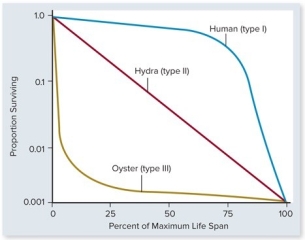 -What often describes organisms with a Type III life history?
 (Multiple Choice)
4.9/5 (93)
(93) A group of international students is having a heated discussion in the dining hall."Your country needs to get its population under control!" asserts a student from the United States."Perhaps," replies the Indian student,"But your country ________."
(Multiple Choice)
4.9/5 (71)
(71) A group of population members all of the same age is called a ________.
(Multiple Choice)
4.8/5 (83)
(83) There are three aspects of entire populations that are important and often studied.Select the best choice from the ones listed.
(Multiple Choice)
4.9/5 (85)
(85) An unscrupulous dog breeder has been selecting for dogs that have very large litters,with the goal of maximizing profits.Why might this strategy be counterproductive?
(Multiple Choice)
4.7/5 (79)
(79) An r-selected species is more likely to become an invasive pest than a K-selected species.
(True/False)
4.8/5 (67)
(67) What kind of population spacing would you expect for a species that is strongly territorial?
(Multiple Choice)
4.9/5 (85)
(85) You and your friend are on vacation at Yellowstone Park.The plaque in front of a sulfur hot spring reads: "This sulfur spring is 80°C,has a pH of 2,and contains large amounts of sulfur which is oxidized by Sulfolobus species of archaea." Your friend is excited."Boy,if those microbes are that tough they should be easy to grow in the lab.I think I'll work with those for my summer project." What do you think?
(Multiple Choice)
4.8/5 (88)
(88) A farmer's land includes a wilderness area that is home to an endangered species of bird.He wants to sell the land to a developer,and you have been hired to evaluate the environmental concerns."This little patch of land is not crucial for the bird species!" the farmer says,"In fact,my land is surrounded by several other wilderness patches that also have that bird." You reply: "It is possible that your land acts as the ________ and the other areas are ________.If that's the case,development would be devastating to the population."
(Multiple Choice)
4.8/5 (76)
(76) Which of the following describe source-sink metapopulations?
(Multiple Choice)
4.7/5 (84)
(84)
-Which of the following statements about the graph is true?
-Which of the following statements about the graph is true? (Multiple Choice)
4.8/5 (83)
(83) A zoo in Southern California has been successfully breeding arctic wolves and they want to exchange some of their extra wolves for kangaroos from a zoo in southwestern Australia.Since it is July,it is quite cold in the other zoo compared to Southern California.What discussion might the zookeepers have about transferring the wolves?
(Multiple Choice)
4.9/5 (72)
(72) What would be the best approach to curbing excessive human population growth?
(Multiple Choice)
4.9/5 (86)
(86) The statistical study of populations including sex ratio,age structure,and predicting growth rates is called ________.
(Multiple Choice)
4.9/5 (96)
(96) Most density-dependent factors show negative feedback relative to population size.Which one of the following is more likely to show positive feedback relative to population size?
(Multiple Choice)
4.8/5 (74)
(74) Within a genus that normally produces large numbers of offspring,one particular species evolves maternal care behavior.What do you predict will happen to the survivorship curve?
(Multiple Choice)
4.8/5 (78)
(78) 
Filters
- Essay(0)
- Multiple Choice(0)
- Short Answer(0)
- True False(0)
- Matching(0)