



 Chat with AI
Exam 54: Ecology of Individuals and Populations

Exam 1: The Science of Biology58 Questions
Exam 2: The Nature of Molecules and the Properties of Water76 Questions
Exam 3: The Chemical Building Blocks of Life74 Questions
Exam 4: Cell Structure63 Questions
Exam 5: Membranes76 Questions
Exam 6: Energy and Metabolism53 Questions
Exam 7: How Cells Harvest Energy59 Questions
Exam 8: Photosynthesis67 Questions
Exam 9: Cell Communication45 Questions
Exam 10: How Cells Divide62 Questions
Exam 11: Sexual Reproduction and Meiosis53 Questions
Exam 12: Patterns of Inheritance64 Questions
Exam 13: Chromosomes, mapping, and the Meiosisinheritance Connection58 Questions
Exam 14: Dna: the Genetic Material68 Questions
Exam 15: Genes and How They Work79 Questions
Exam 16: Control of Gene Expression62 Questions
Exam 17: Biotechnology48 Questions
Exam 18: Genomics52 Questions
Exam 19: Cellular Mechanisms of Development56 Questions
Exam 20: Genes Within Populations78 Questions
Exam 21: The Evidence for Evolution65 Questions
Exam 22: The Origin of Species67 Questions
Exam 23: Systematics,phylogenies,and Comparative Biology67 Questions
Exam 24: Genome Evolution54 Questions
Exam 25: The Origin and Diversity of Life35 Questions
Exam 26: Viruses62 Questions
Exam 27: Prokaryotes61 Questions
Exam 28: Protists55 Questions
Exam 29: Seedless Plants44 Questions
Exam 30: Seed Plants36 Questions
Exam 31: Fungi63 Questions
Exam 32: Animal Diversity and the Evolution of Body Plans42 Questions
Exam 33: Protostomes79 Questions
Exam 34: Deuterostomes83 Questions
Exam 35: Plant Form55 Questions
Exam 36: Transport in Plants51 Questions
Exam 37: Plant Nutrition and Soils47 Questions
Exam 38: Plant Defense Responses42 Questions
Exam 39: Sensory Systems in Plants50 Questions
Exam 40: Plant Reproduction86 Questions
Exam 41: The Animal Body and Principles of Regulation75 Questions
Exam 42: The Nervous System78 Questions
Exam 43: Sensory Systems88 Questions
Exam 44: The Endocrine System87 Questions
Exam 45: The Musculoskeletal System57 Questions
Exam 46: The Digestive System59 Questions
Exam 47: The Respiratory System54 Questions
Exam 48: The Circulatory System53 Questions
Exam 49: Osmotic Regulation and the Urinary System46 Questions
Exam 50: The Immune System49 Questions
Exam 51: The Reproductive System79 Questions
Exam 52: Animal Development69 Questions
Exam 53: Behavioral Biology91 Questions
Exam 54: Ecology of Individuals and Populations69 Questions
Exam 55: Community Ecology59 Questions
Exam 56: Dynamics of Ecosystems48 Questions
Exam 57: The Biosphere and Human Impacts41 Questions
Exam 58: Conservation Biology49 Questions
Select questions type


The figure included shows the body temperature of lizards versus air temperature in two different habitats-open and shaded forest.Which one of the following conclusions is best supported by these data. 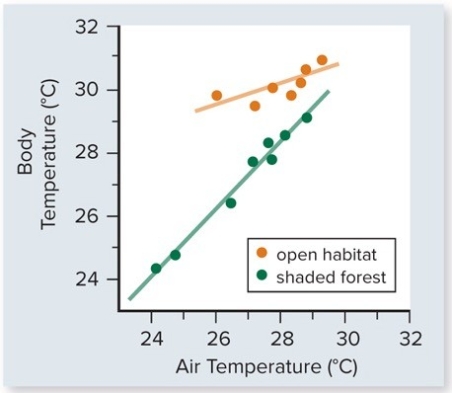
(Multiple Choice)
4.7/5  (81)
(81) In the sigmoid growth curve,the carrying capacity of the environment is indicated by what symbol?
(Multiple Choice)
4.9/5 (80)
(80) Which factor increases the likelihood of population extinction?
(Multiple Choice)
4.9/5 (84)
(84) What is the life history adaptation called where organisms produce offspring several times over many seasons?
(Multiple Choice)
4.8/5 (90)
(90) You are working in an aquarium that has been breeding an endangered species of fish for return into the wild.You have a batch of progeny from the first generation of breeding.The staff are discussing whether to return those fish to an area that has been completely depleted,or add them to a partially depleted population."Considering the Allee effect,what do you say?
(Multiple Choice)
4.9/5 (81)
(81) You and your friends have just stepped off the plane in Cusco,Peru (11,200 ft).Your friends are so eager to see Machu Picchu they want to start off hiking the Inca Trail right away and not waste any time.How do you respond?
(Multiple Choice)
4.9/5 (83)
(83) In the logistic growth model,as the number of individuals in the population (N)approaches the carrying capacity (K),what happens to the intrinsic rate of growth (ri)?
(Multiple Choice)
4.9/5 (82)
(82) Many times species are composed of networks of distinct populations called metapopulations.When do metapopulations occur?
(Multiple Choice)
4.8/5 (65)
(65) You are earning your Ph.D.in marine biology,studying the microbial ocean community.This year,you are shocked to discover that one of your study sites has become contaminated due to an industrial waste water pipe.This dumping is drastically raising the temperature and lowering the salinity of the water.What do you expect to find in your survey of the ecosystem,and what might you find in a survey years from now?
(Multiple Choice)
4.9/5 (86)
(86) In the sigmoid growth curve,the number of individuals at any one time is indicated by what symbol?
(Multiple Choice)
4.7/5 (72)
(72) Populations have three basic types of dispersion patterns-clumped,random,and uniform.What situation supports random distributions?
(Multiple Choice)
4.8/5 (74)
(74) What do we call populations of organisms that are usually near the carrying capacity?
(Multiple Choice)
4.8/5 (72)
(72) Demographic studies include all of the following except what?
(Multiple Choice)
4.8/5 (69)
(69) The size at which a population stabilizes in a particular place is defined as the ________ for that species.
(Multiple Choice)
4.7/5 (87)
(87) Kettle ponds derive from a hole left by a retreating glacier that is subsequently filled with rainwater.A certain region has a series of disconnected kettle ponds,but occasionally heavy rains flood them and create streams.Which type of animal is most likely to be present in this area as a metapopulation?
(Multiple Choice)
4.9/5 (80)
(80) What environmental challenge is posed to young plants by an old growth forest?
(Multiple Choice)
4.7/5 (79)
(79) A small group of mice are released on an island without mice but with abundant food for mice and no predators.Initially,the growth of the mouse population will be limited mainly by what?
(Multiple Choice)
4.8/5 (93)
(93) A developing nation with a rapidly increasing population is reaching its carrying capacity.What change(s)could allow it to increase its carrying capacity? (Check all that apply)
(Multiple Choice)
4.8/5 (94)
(94) This summer,you are returning to the research station in Costa Rica to follow up on the population of butterflies you have been studying.You are disappointed to find that there are fewer this year than last.In fact,at dinner your friends studying frogs and birds are complaining about the same thing.What type of influence do you suspect?
(Multiple Choice)
4.9/5 (67)
(67) 
Filters
- Essay(0)
- Multiple Choice(0)
- Short Answer(0)
- True False(0)
- Matching(0)