



 Chat with AI
Exam 14: Exchange Rates and the Foreign Exchange Market: an Asset Approach

Exam 1: Introduction37 Questions
Exam 2: World Trade: an Overview18 Questions
Exam 3: Labor Productivity and Comparative Advantage: the Ricardian Model47 Questions
Exam 4: Specific Factors and Income Distribution62 Questions
Exam 5: Resources and Trade: the Heckscher-Ohlin Model66 Questions
Exam 6: The Standard Trade Model45 Questions
Exam 7: External Economies of Scale and the International Location of Production37 Questions
Exam 8: Firms in the Global Economy: Export Decisions, Outsourcing, and Multinational Enterprises69 Questions
Exam 9: The Instruments of Trade Policy71 Questions
Exam 10: The Political Economy of Trade Policy57 Questions
Exam 11: Trade Policy in Developing Countries33 Questions
Exam 12: Controversies in Trade Policy46 Questions
Exam 13: National Income Accounting and the Balance of Payments72 Questions
Exam 14: Exchange Rates and the Foreign Exchange Market: an Asset Approach74 Questions
Exam 15: Money, Interest Rates, and Exchange Rates65 Questions
Exam 16: Price Levels and the Exchange Rate in the Long Run79 Questions
Exam 17: Output and the Exchange Rate in the Short Run114 Questions
Exam 18: Fixed Exchange Rates and Foreign Exchange Intervention80 Questions
Exam 19: International Monetary Systems: an Historical Overview153 Questions
Exam 20: Financial Globalization: Opportunity and Crisis113 Questions
Exam 21: Optimum Currency Areas and the Euro99 Questions
Exam 22: Developing Countries: Growth, Crisis, and Reform112 Questions
Select questions type


If the dollar interest rate is 10 percent, the euro interest rate is 12 percent, then
(Multiple Choice)
4.8/5  (66)
(66) 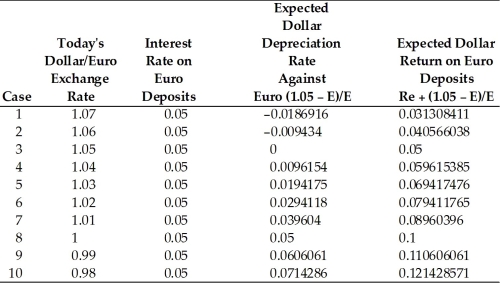 -Using the data in the table above, plot today's dollar/euro exchange rate against the expected dollar return on euro deposits.
 (Essay)
4.9/5 (70)
(70) The covered interest rate parity condition can be stated as follows: The interest rate on dollar deposits equals the interest rate on euro deposits ________ the forward ________ on dollars against euros.
(Multiple Choice)
4.9/5 (90)
(90) Discuss the effects of a rise in the interest rate paid by euro deposits on the exchange rate.
(Essay)
4.8/5 (83)
(83) Exxon Mobil wants to pay  160,000 to a German supplier. They get an exchange rate quotation from its own commercial bank and instructs it to debit their dollar account and pay
 160,000 to the supplier's German account. If the exchange rate quoted is $1.2 per euro, how much is debited to Exxon Mobil's account?
160,000 to a German supplier. They get an exchange rate quotation from its own commercial bank and instructs it to debit their dollar account and pay 160,000 to the supplier's German account. If the exchange rate quoted is $1.2 per euro, how much is debited to Exxon Mobil's account? (Multiple Choice)
4.7/5 (73)
(73) 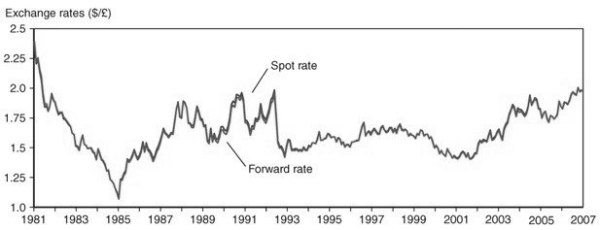
In the year 2012, Shinzo Abe became prime minister of Japan, promising bold policies to improve Japan's economy. What was the focus of his policies and how did they affect Japan's trade position?
(Essay)
4.9/5 (83)
(83) If the dollar interest rate is 4 percent, the euro interest rate is 6 percent, then
(Multiple Choice)
5.0/5 (85)
(85) For the following 15 cases, compare the dollar rates of return on dollar and euro deposits. 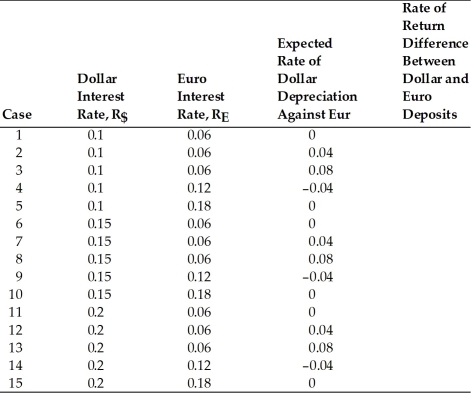
(Essay)
5.0/5 (93)
(93) If the dollar interest rate is 10 percent, the euro interest rate is 6 percent, then
(Multiple Choice)
4.9/5 (78)
(78) Which of the following is NOT a major actor in the foreign exchange market?
(Multiple Choice)
4.8/5 (84)
(84) Based on the case study, "Exchange Rates, Auto Prices, and Currency Wars," explain why exchange rates are of critical importance to firms in the automobile industry, and how Japan has benefited from changes in the value of the Yen.
(Essay)
4.8/5 (87)
(87) Show graphically a drop in the interest rate paid by euro deposits. What is the effect on the dollar?
(Essay)
4.8/5 (71)
(71) Which major actor is at the center of the foreign exchange market?
(Multiple Choice)
4.8/5 (78)
(78) 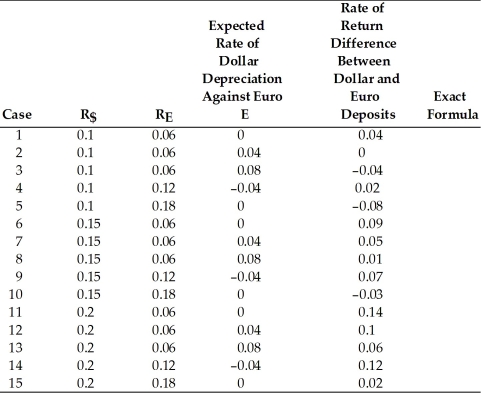
Explain what is a "vehicle currency." Why is the U.S. dollar considered a vehicle currency?
(Essay)
4.8/5 (86)
(86) Explain the purpose of the following figure 14-2 from the text in the context of the interest rates on the dollar and the Japanese Yen between 1980 and 2010. 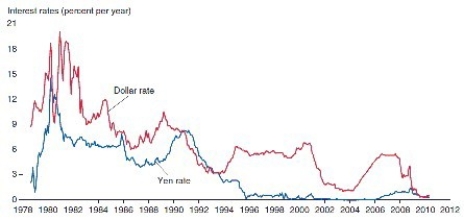
(Essay)
4.9/5 (76)
(76) 
Filters
- Essay(0)
- Multiple Choice(0)
- Short Answer(0)
- True False(0)
- Matching(0)