



 Chat with AI
Exam 3: Labor Productivity and Comparative Advantage: the Ricardian Model

Exam 1: Introduction37 Questions
Exam 2: World Trade: an Overview18 Questions
Exam 3: Labor Productivity and Comparative Advantage: the Ricardian Model47 Questions
Exam 4: Specific Factors and Income Distribution62 Questions
Exam 5: Resources and Trade: the Heckscher-Ohlin Model66 Questions
Exam 6: The Standard Trade Model45 Questions
Exam 7: External Economies of Scale and the International Location of Production37 Questions
Exam 8: Firms in the Global Economy: Export Decisions, Outsourcing, and Multinational Enterprises69 Questions
Exam 9: The Instruments of Trade Policy71 Questions
Exam 10: The Political Economy of Trade Policy57 Questions
Exam 11: Trade Policy in Developing Countries33 Questions
Exam 12: Controversies in Trade Policy46 Questions
Exam 13: National Income Accounting and the Balance of Payments72 Questions
Exam 14: Exchange Rates and the Foreign Exchange Market: an Asset Approach74 Questions
Exam 15: Money, Interest Rates, and Exchange Rates65 Questions
Exam 16: Price Levels and the Exchange Rate in the Long Run79 Questions
Exam 17: Output and the Exchange Rate in the Short Run114 Questions
Exam 18: Fixed Exchange Rates and Foreign Exchange Intervention80 Questions
Exam 19: International Monetary Systems: an Historical Overview153 Questions
Exam 20: Financial Globalization: Opportunity and Crisis113 Questions
Exam 21: Optimum Currency Areas and the Euro99 Questions
Exam 22: Developing Countries: Growth, Crisis, and Reform112 Questions
Select questions type


 -Given the information in the table above, if wages were to double in Home, then Home should
 (Multiple Choice)
4.8/5  (84)
(84) Which of the following is most likely to be an untraded good in a Ricardian two-country, multi-good model?
(Multiple Choice)
4.9/5 (69)
(69)
-Given the information in the table above, if it is ascertained that Foreign uses prison-slave labor to produce its exports, then home should
-Given the information in the table above, if it is ascertained that Foreign uses prison-slave labor to produce its exports, then home should (Multiple Choice)
4.9/5 (86)
(86) The Ricardian model attributes the gains from trade associated with the principle of comparative advantage result to
(Multiple Choice)
4.7/5 (70)
(70) If labor productivities were exactly proportional to wage levels internationally, this would
(Multiple Choice)
4.8/5 (80)
(80)
-Given the information in the table above, Home's opportunity cost of cloth is
-Given the information in the table above, Home's opportunity cost of cloth is (Multiple Choice)
4.9/5 (83)
(83) Use the information in the table below to answer the following questions. 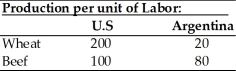 (a) Does either country have an absolute advantage in the production of wheat or beef? Explain.
(b) What is the opportunity cost of wheat in each country?
(c) What is the opportunity cost of beef in each country?
(d) Analyze comparative advantage and opportunities for trade between the U.S. and Argentina.
(a) Does either country have an absolute advantage in the production of wheat or beef? Explain.
(b) What is the opportunity cost of wheat in each country?
(c) What is the opportunity cost of beef in each country?
(d) Analyze comparative advantage and opportunities for trade between the U.S. and Argentina. (Essay)
4.9/5 (88)
(88) Use the information in the table below to answer the following questions. 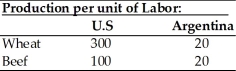 (a) Does either country have an absolute advantage in the production of wheat or beef? Explain.
(b) What is the opportunity cost of wheat in each country?
(c) What is the opportunity cost of beef in each country?
(d) Analyze comparative advantage and opportunities for trade between the U.S. and Argentina.
(a) Does either country have an absolute advantage in the production of wheat or beef? Explain.
(b) What is the opportunity cost of wheat in each country?
(c) What is the opportunity cost of beef in each country?
(d) Analyze comparative advantage and opportunities for trade between the U.S. and Argentina. (Essay)
4.7/5 (89)
(89) 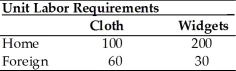 -Given the information in the table above. What is the opportunity cost of cloth in terms of Widgets in Foreign?
 (Short Answer)
4.8/5 (83)
(83)
-Given the information in the table above, Foreign's opportunity cost of cloth is
-Given the information in the table above, Foreign's opportunity cost of cloth is (Multiple Choice)
4.9/5 (90)
(90) In a two-country, two-product world, the statement "Germany enjoys a comparative advantage over France in autos relative to ships" is equivalent to
(Multiple Choice)
4.8/5 (77)
(77) An examination of the Ricardian model of comparative advantage yields the clear result that trade is (potentially) beneficial for each of the two trading partners since it allows for an expanded consumption choice for each. However, for the world as a whole the expansion of production of one product must involve a decrease in the availability of the other, so that it is not clear that trade is better for the world as a whole as compared to an initial situation of non-trade (but efficient production in each country). Are there in fact gains from trade for the world as a whole? Explain.
(Essay)
4.9/5 (84)
(84) If a production possibilities frontier is a straight line, then production occurs under conditions of
(Multiple Choice)
4.9/5 (79)
(79) Many countries in sub-Saharan Africa have very low labor productivities in many sectors, for example in manufacturing and agriculture. They often despair of even trying to attempt to build their industries unless it is done in an autarkic context, behind protectionist walls because they do not believe they can compete with more productive industries abroad. Discuss this issue in the context of the Ricardian model of comparative advantage.
(Essay)
4.9/5 (75)
(75) Use the information in the table below to answer the following questions. 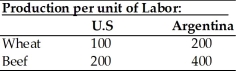 (a) Does either country have an absolute advantage in the production of wheat or beef? Explain.
(b) What is the opportunity cost of wheat in each country?
(c) What is the opportunity cost of beef in each country?
(d) Analyze comparative advantage and opportunities for trade between the U.S. and Argentina.
(a) Does either country have an absolute advantage in the production of wheat or beef? Explain.
(b) What is the opportunity cost of wheat in each country?
(c) What is the opportunity cost of beef in each country?
(d) Analyze comparative advantage and opportunities for trade between the U.S. and Argentina. (Essay)
4.9/5 (82)
(82) Which of the following has been confirmed by empirical tests of the Ricardian model?
(Multiple Choice)
4.9/5 (70)
(70)
-Given the information in the table above, if the Home economy suffered a meltdown, and the Unit Labor Requirements doubled to 20 for cloth and 40 for widgets then home should
-Given the information in the table above, if the Home economy suffered a meltdown, and the Unit Labor Requirements doubled to 20 for cloth and 40 for widgets then home should (Multiple Choice)
4.9/5 (80)
(80)
-Given the information in the table above, if the world equilibrium price of widgets were 4 cloth, then
-Given the information in the table above, if the world equilibrium price of widgets were 4 cloth, then (Multiple Choice)
4.7/5 (72)
(72) In a two-product, two-country world, international trade can lead to increases in
(Multiple Choice)
5.0/5 (81)
(81) 
Filters
- Essay(0)
- Multiple Choice(0)
- Short Answer(0)
- True False(0)
- Matching(0)