



 Chat with AI
Exam 6: Volcanoes and Other Igneous Activity

Exam 1: Introduction to Earth Science108 Questions
Exam 2: Matter and Minerals115 Questions
Exam 3: Rocks: Materials of the Solid Earth120 Questions
Exam 4: Plate Tectonics: a Scientific Revolution Unfolds89 Questions
Exam 5: Earthquakes and Earths Interior90 Questions
Exam 6: Volcanoes and Other Igneous Activity106 Questions
Exam 7: Crustal Deformation and Mountain Building97 Questions
Exam 8: Weathering, Soil, and Mass Movement124 Questions
Exam 9: Running Water and Groundwater134 Questions
Exam 10: Glaciers, Deserts, and Wind100 Questions
Exam 11: Geologic Time102 Questions
Exam 12: Earths Evolution Through Geologic Time129 Questions
Exam 13: The Ocean Floor92 Questions
Exam 14: Ocean Water and Ocean Life74 Questions
Exam 15: The Dynamic Ocean101 Questions
Exam 16: The Atmosphere: Composition, Structure, and Temperature85 Questions
Exam 17: Moisture, Clouds, and Precipitation101 Questions
Exam 18: Air Pressure and Wind97 Questions
Exam 19: Weather Patterns and Severe Storms96 Questions
Exam 20: World Climates and Global Climate Change105 Questions
Exam 21: Origins of Modern Astronomy101 Questions
Exam 22: Touring Our Solar System93 Questions
Exam 23: Light, Telescopes, and the Sun93 Questions
Exam 24: Beyond Our Solar System83 Questions
Select questions type


It has been said that living near a Hawaiian volcano puts buildings in danger but not humans. Why is that the case?
(Multiple Choice)
5.0/5  (82)
(82) A geologist is working in an area of old volcanic rocks exposed by erosion. He finds a large rock outcrop that contains flatlying gravels in the base of the outcrop. These gravels are overlain by basalt that forms a series of layers representing flows. The uppermost basalt lava flows have a dip of about 10 degrees to the west. What does this outcrop record?
(Multiple Choice)
4.9/5 (71)
(71) Examine the words and/or phrases below and determine the relationship among the majority of words/phrases. Choose the option which does not fit the pattern.
(Multiple Choice)
4.9/5 (81)
(81) Magmas are the product of melting in the deep part of the earth that forms a layer of partially molten material called the_______ .
(Multiple Choice)
5.0/5 (90)
(90) 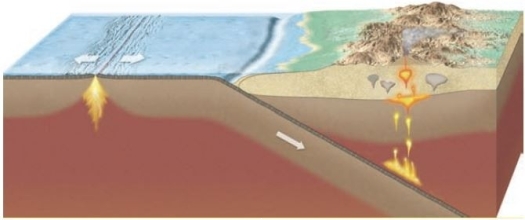 Explain the similarities and differences between the melting taking place at the mid- ocean ridge and at the zone.
 (Essay)
5.0/5 (82)
(82) Mt. St. Helens in the U. S. and Mt. Fujiyama in Japan are examples of _______.
(Multiple Choice)
4.9/5 (94)
(94) Compare and contrast the volcanoes of Alaska with the volcanoes of the Hawaiian islands.
(Essay)
4.9/5 (82)
(82) 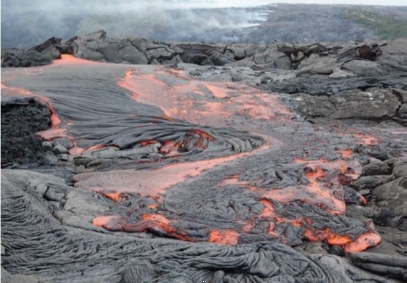 The streamlined ropy flowing lava pictured here has both orange and black parts because .
 (Multiple Choice)
4.8/5 (77)
(77) Which one of the following statements concerning volcanic blocks and bombs is true?
(Multiple Choice)
4.9/5 (71)
(71) Which of the following is a tabular intrusive body with subparallel intrusive contacts?
(Multiple Choice)
4.9/5 (72)
(72) 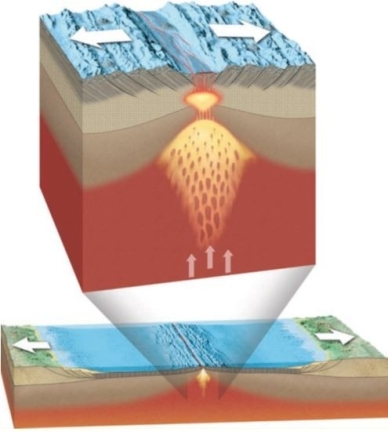 The image shows the nature of melting at the Mid- Ocean Ridge. The image indicates that melting is_______ .
 (Multiple Choice)
4.9/5 (78)
(78) Mount Pelée on the island of Martinique killed thousands of people in_______ .
(Multiple Choice)
4.9/5 (75)
(75) Mt. Rainier in Washington State is often thought to be the most hazardous volcano in the lower 48 states of the United States because_______ .
(Multiple Choice)
4.9/5 (93)
(93) _______magma is the most abundant type of magma erupted on Earth.
(Multiple Choice)
5.0/5 (88)
(88) 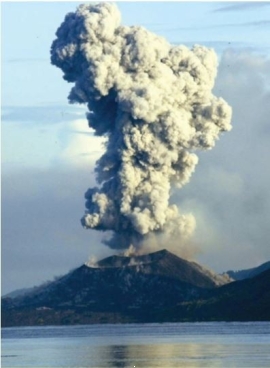 Eruption columns, such as the one pictured above, are unstable and often collapse towards the Ground because_______ .
 (Multiple Choice)
4.7/5 (82)
(82) 
Filters
- Essay(0)
- Multiple Choice(0)
- Short Answer(0)
- True False(0)
- Matching(0)