



 Chat with AI
Exam 6: Volcanoes and Other Igneous Activity

Exam 1: Introduction to Earth Science108 Questions
Exam 2: Matter and Minerals115 Questions
Exam 3: Rocks: Materials of the Solid Earth120 Questions
Exam 4: Plate Tectonics: a Scientific Revolution Unfolds89 Questions
Exam 5: Earthquakes and Earths Interior90 Questions
Exam 6: Volcanoes and Other Igneous Activity106 Questions
Exam 7: Crustal Deformation and Mountain Building97 Questions
Exam 8: Weathering, Soil, and Mass Movement124 Questions
Exam 9: Running Water and Groundwater134 Questions
Exam 10: Glaciers, Deserts, and Wind100 Questions
Exam 11: Geologic Time102 Questions
Exam 12: Earths Evolution Through Geologic Time129 Questions
Exam 13: The Ocean Floor92 Questions
Exam 14: Ocean Water and Ocean Life74 Questions
Exam 15: The Dynamic Ocean101 Questions
Exam 16: The Atmosphere: Composition, Structure, and Temperature85 Questions
Exam 17: Moisture, Clouds, and Precipitation101 Questions
Exam 18: Air Pressure and Wind97 Questions
Exam 19: Weather Patterns and Severe Storms96 Questions
Exam 20: World Climates and Global Climate Change105 Questions
Exam 21: Origins of Modern Astronomy101 Questions
Exam 22: Touring Our Solar System93 Questions
Exam 23: Light, Telescopes, and the Sun93 Questions
Exam 24: Beyond Our Solar System83 Questions
Select questions type


In what plate tectonic setting are magmas generated predominantly by fluids from ocean waters in trenches "fluxing" the melting process by decreasing melting temperature?
(Multiple Choice)
4.8/5  (75)
(75) Match the letter on the figure with the term.
 -Identify what letter A represents in the diagram.
 (Multiple Choice)
4.8/5 (73)
(73) _______is the major dissolved volatile constituent in both magmas and volcanic gases.
(Multiple Choice)
4.7/5 (99)
(99) What is the connection between the amount of silica in a melt and how viscous it is?
(Multiple Choice)
4.7/5 (84)
(84) Magmas are generated at mid- ocean ridges by _______melting.
(Multiple Choice)
4.8/5 (68)
(68) Which of the following best describes Shiprock, a famous volcanic feature in New Mexico?
(Multiple Choice)
4.8/5 (91)
(91) Volcanoes are generally not preserved in the geologic rock record because the upper part of the volcano is eroded away. However, the igneous rocks associated with volcanoes are often found preserved in the rock record as layers of volcanic rock and associated intrusions. How could you infer what type of volcano erupted in a given area based on the type of volcanic deposits? Give specific examples and briefly discuss if some materials may be linked to different types of volcanoes.
(Essay)
4.8/5 (90)
(90) The viscosities of magmas _______with increasing percentages of silica.
(Multiple Choice)
4.8/5 (86)
(86) The famous destruction of the Roman city of Pompeii was produced by_______ .
(Multiple Choice)
4.9/5 (81)
(81) The main mechanism for melting at spreading ridges is_______ .
(Multiple Choice)
4.8/5 (77)
(77) 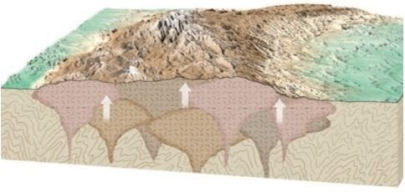 Note the image showing a series of batholiths on the landscape. How did those batholiths get exposed at the surface?
 (Multiple Choice)
4.8/5 (80)
(80) Match the letter on the figure with the term.
-Identify what letter B represents in the diagram.
-Identify what letter B represents in the diagram. (Multiple Choice)
4.8/5 (73)
(73) The rock pumice often floats yet the density of the rock is greater than water. Why does it float?
(Multiple Choice)
4.7/5 (86)
(86) What type of volcanic material is indicative of eruption under water?
(Multiple Choice)
4.8/5 (75)
(75) The average composition of rocks comprising a large composite cone or stratovolcano is generally_______ .
(Multiple Choice)
4.8/5 (87)
(87) 
Filters
- Essay(0)
- Multiple Choice(0)
- Short Answer(0)
- True False(0)
- Matching(0)