



 Chat with AI
Exam 3: North America in the Atlantic World

Exam 1: Three Old Worlds Create a New108 Questions
Exam 2: Europeans Colonize North America108 Questions
Exam 3: North America in the Atlantic World101 Questions
Exam 4: Becoming America112 Questions
Exam 5: The Ends of Empire133 Questions
Exam 6: American Revolutions109 Questions
Exam 7: Forging a Nation161 Questions
Exam 8: Defining the Nation170 Questions
Exam 9: The Rise of the South111 Questions
Exam 10: The Restless North177 Questions
Exam 11: The Contested West100 Questions
Exam 12: Politics and the Fate of the Union178 Questions
Exam 13: Transforming Fire: the Civil War160 Questions
Exam 14: Reconstruction: an Unfinished Revolution122 Questions
Select questions type


Which of the following was a consequence of King Philip's War?
(Multiple Choice)
5.0/5  (86)
(86) Discuss the economic philosophy of mercantilism, and examine Parliament's attempts to apply mercantilist philosophy to the economic relationship between England and its American colonies.
(Essay)
4.8/5 (82)
(82) Discuss the characteristics of New Netherland when it was acquired by James, the Duke of York, in 1664, and examine its development as an English colony during the late seventeenth century.
(Essay)
4.8/5 (66)
(66) Which of the following was a reason for the eventual division of Carolina into two separate colonies?
(Multiple Choice)
4.7/5 (68)
(68) Instructions:
∙ Identify each item. Give an explanation or description of the item. Answer the questions who, what, where, and when.
Explain the historical significance of each item. Establish the historical context in which the
∙ item exists. Establish the item as the result of or as the cause of other factors existing in the society under study. Answer this question: What were the political, social, economic,
and/or cultural consequences of this item?
-the "middle passage"
(Essay)
4.8/5 (75)
(75) The case of Eliza Lucas provides evidence for which of the following conclusions?
(Multiple Choice)
4.9/5 (88)
(88) Instructions:
∙ Identify each item. Give an explanation or description of the item. Answer the questions who, what, where, and when.
Explain the historical significance of each item. Establish the historical context in which the
∙ item exists. Establish the item as the result of or as the cause of other factors existing in the society under study. Answer this question: What were the political, social, economic,
and/or cultural consequences of this item?
-The task system
(Essay)
4.9/5 (76)
(76) Instructions:
∙ Identify each item. Give an explanation or description of the item. Answer the questions who, what, where, and when.
Explain the historical significance of each item. Establish the historical context in which the
∙ item exists. Establish the item as the result of or as the cause of other factors existing in the society under study. Answer this question: What were the political, social, economic,
and/or cultural consequences of this item?
-King Philip's War
(Essay)
4.8/5 (81)
(81) Why, beginning in the mid-1660s, did Chesapeake planters begin to purchase more African slaves?
(Multiple Choice)
4.8/5 (73)
(73) Map Exercise 3-1
You will need seven pens of different colors for this exercise. Use the outline map that follows:
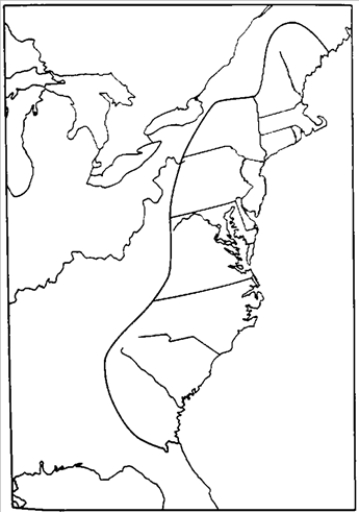 -Refer to Map Exercise 3-1. Label the following rivers and bodies of water: Atlantic Ocean
Gulf of Mexico Lake Erie Lake Huron Lake Ontario
St. Lawrence River
-Refer to Map Exercise 3-1. Label the following rivers and bodies of water: Atlantic Ocean
Gulf of Mexico Lake Erie Lake Huron Lake Ontario
St. Lawrence River (Essay)
4.9/5 (91)
(91) By the 1720s, which of the following was an important difference between northern and southern colonial societies?
(Multiple Choice)
4.9/5 (99)
(99) Examine the impact of the introduction of large-scale slavery on the political, social, economic, and cultural development of the South.
(Essay)
4.9/5 (90)
(90) Instructions:
∙ Identify each item. Give an explanation or description of the item. Answer the questions who, what, where, and when.
Explain the historical significance of each item. Establish the historical context in which the
∙ item exists. Establish the item as the result of or as the cause of other factors existing in the society under study. Answer this question: What were the political, social, economic,
and/or cultural consequences of this item?
-Louis de Baude de Frontenac
(Essay)
5.0/5 (76)
(76) Instructions:
∙ Identify each item. Give an explanation or description of the item. Answer the questions who, what, where, and when.
Explain the historical significance of each item. Establish the historical context in which the
∙ item exists. Establish the item as the result of or as the cause of other factors existing in the society under study. Answer this question: What were the political, social, economic,
and/or cultural consequences of this item?
-the Dominion of New England
(Essay)
4.8/5 (88)
(88) Instructions:
∙ Identify each item. Give an explanation or description of the item. Answer the questions who, what, where, and when.
Explain the historical significance of each item. Establish the historical context in which the
∙ item exists. Establish the item as the result of or as the cause of other factors existing in the society under study. Answer this question: What were the political, social, economic,
and/or cultural consequences of this item?
-King William's War
(Essay)
4.7/5 (79)
(79) Instructions:
∙ Identify each item. Give an explanation or description of the item. Answer the questions who, what, where, and when.
Explain the historical significance of each item. Establish the historical context in which the
∙ item exists. Establish the item as the result of or as the cause of other factors existing in the society under study. Answer this question: What were the political, social, economic,
and/or cultural consequences of this item?
-"court" parties versus the "country interest"
(Essay)
4.9/5 (65)
(65) Which of the following was a consequence of the Tuscarora War of 1711?
(Multiple Choice)
4.9/5 (72)
(72) 
Filters
- Essay(0)
- Multiple Choice(0)
- Short Answer(0)
- True False(0)
- Matching(0)