



 Chat with AI
Exam 6: American Revolutions

Exam 1: Three Old Worlds Create a New108 Questions
Exam 2: Europeans Colonize North America108 Questions
Exam 3: North America in the Atlantic World101 Questions
Exam 4: Becoming America112 Questions
Exam 5: The Ends of Empire133 Questions
Exam 6: American Revolutions109 Questions
Exam 7: Forging a Nation161 Questions
Exam 8: Defining the Nation170 Questions
Exam 9: The Rise of the South111 Questions
Exam 10: The Restless North177 Questions
Exam 11: The Contested West100 Questions
Exam 12: Politics and the Fate of the Union178 Questions
Exam 13: Transforming Fire: the Civil War160 Questions
Exam 14: Reconstruction: an Unfinished Revolution122 Questions
Select questions type


In negotiating the boundaries for the new American nation, the British
(Multiple Choice)
4.9/5  (83)
(83) Which of these statements is most consistent with the sentiments expressed in Common Sense?
(Multiple Choice)
5.0/5 (71)
(71) Map Exercise 6-3
On the outline map that follows:
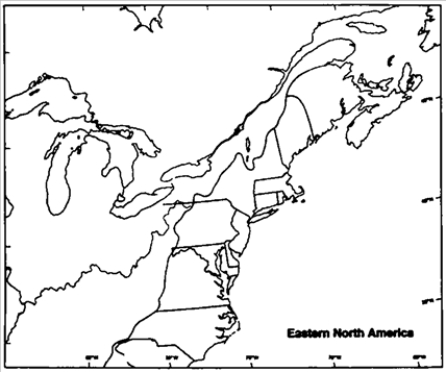 -Refer to Map Exercise 6-3. Label the following colonies: Delaware
Maryland Virginia
-Refer to Map Exercise 6-3. Label the following colonies: Delaware
Maryland Virginia (Short Answer)
4.8/5 (88)
(88) After taking command of the southern campaign for the Americans, Nathanael Greene
(Multiple Choice)
4.9/5 (81)
(81) Map Exercise 6-2
On the outline map that follows and referring to an historical atlas as a reference:
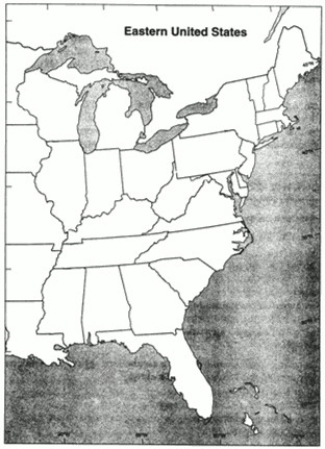 -Refer to Map Exercise 6-2. Label the following colonies: Georgia
North Carolina South Carolina Virginia
-Refer to Map Exercise 6-2. Label the following colonies: Georgia
North Carolina South Carolina Virginia (Short Answer)
4.9/5 (85)
(85) Which of the following was a consequence of Lord Dunmore's Proclamation of November 1775?
(Multiple Choice)
5.0/5 (78)
(78) Examine the process by which British political authority in the colonies came to an end and was replaced by American political authority.
(Essay)
4.9/5 (60)
(60) Instructions:
∙ Identify each item. Give an explanation or description of the item. Answer the questions who, what, where, and when.
Explain the historical significance of each item. Establish the historical context in which the
∙ item exists. Establish the item as the result of or as the cause of other factors existing in the society under study. Answer this question: What were the political, social, economic,
and/or cultural consequences of this item?
-Burgoyne's New York campaign
(Essay)
4.7/5 (77)
(77) When the delegates to the Second Continental Congress voted to accept the Declaration of Independence, they
(Multiple Choice)
4.8/5 (84)
(84) Which of the following was a false assumption made by the British concerning the Revolutionary War?
(Multiple Choice)
4.8/5 (76)
(76) Instructions:
∙ Identify each item. Give an explanation or description of the item. Answer the questions who, what, where, and when.
Explain the historical significance of each item. Establish the historical context in which the
∙ item exists. Establish the item as the result of or as the cause of other factors existing in the society under study. Answer this question: What were the political, social, economic,
and/or cultural consequences of this item?
-General Nathanael Greene
(Essay)
4.9/5 (78)
(78) Which of the following is true concerning the 1776 battle for New York City?
(Multiple Choice)
4.8/5 (90)
(90) The primary concern of those who wrote the state constitutions was
(Multiple Choice)
4.8/5 (82)
(82) Instructions:
∙ Identify each item. Give an explanation or description of the item. Answer the questions who, what, where, and when.
Explain the historical significance of each item. Establish the historical context in which the
∙ item exists. Establish the item as the result of or as the cause of other factors existing in the society under study. Answer this question: What were the political, social, economic,
and/or cultural consequences of this item?
-Sir Henry Clinton
(Essay)
4.9/5 (77)
(77) Instructions:
∙ Identify each item. Give an explanation or description of the item. Answer the questions who, what, where, and when.
Explain the historical significance of each item. Establish the historical context in which the
∙ item exists. Establish the item as the result of or as the cause of other factors existing in the society under study. Answer this question: What were the political, social, economic,
and/or cultural consequences of this item?
-Articles Four and Five of the 1783 Treaty of Paris
(Essay)
4.9/5 (75)
(75) Analyze the threat posed by the African American population to the revolutionary cause, and explain how patriot leaders turned the potential threat to their advantage.
(Essay)
4.8/5 (68)
(68) Instructions:
∙ Identify each item. Give an explanation or description of the item. Answer the questions who, what, where, and when.
Explain the historical significance of each item. Establish the historical context in which the
∙ item exists. Establish the item as the result of or as the cause of other factors existing in the society under study. Answer this question: What were the political, social, economic,
and/or cultural consequences of this item?
-the fall of Charleston
(Essay)
4.9/5 (81)
(81) The British incurred their greatest losses of the entire Revolutionary War in the Battle of
(Multiple Choice)
4.8/5 (87)
(87) 
Filters
- Essay(0)
- Multiple Choice(0)
- Short Answer(0)
- True False(0)
- Matching(0)