



 Chat with AI
Exam 1: The Central Idea

Exam 1: The Central Idea156 Questions
Exam 2: Observing and Explaining the Economy143 Questions
Exam 3: The Supply and Demand Model166 Questions
Exam 4: Subtleties of the Supply and Demand Model176 Questions
Exam 5: The Demand Curve and the Behavior of Consumers176 Questions
Exam 6: The Supply Curve and the Behavior of Firms179 Questions
Exam 7: The Efficiency of Markets163 Questions
Exam 8: Costs and the Changes at Firms Over Time191 Questions
Exam 9: The Rise and Fall of Industries139 Questions
Exam 10: Monopoly184 Questions
Exam 11: Product Differentiation, Monopolistic Competition, and Oligopoly169 Questions
Exam 12: Antitrust Policy and Regulation152 Questions
Exam 13: Labor Markets179 Questions
Exam 14: Taxes, Transfers, and Income Distribution179 Questions
Exam 15: Public Goods, Externalities, and Government Behavior197 Questions
Exam 16: Capital and Financial Markets188 Questions
Exam 17: Macroeconomics: the Big Picture159 Questions
Exam 18: Measuring the Production, Income, and Spending of Nations177 Questions
Exam 19: The Spending Allocation Model166 Questions
Exam 20: Unemployment and Employment212 Questions
Exam 21: Productivity and Economic Growth162 Questions
Exam 22: Money and Inflation153 Questions
Exam 23: The Nature and Causes of Economic Fluctuations185 Questions
Exam 24: The Economic Fluctuations Model205 Questions
Exam 25: Using the Economic Fluctuations Model176 Questions
Exam 26: Fiscal Policy138 Questions
Exam 27: Monetary Policy180 Questions
Exam 28: Economic Growth Around the World157 Questions
Exam 29: International Trade242 Questions
Exam 30: International Finance125 Questions
Select questions type


After purchasing a can of soda from a convenience store, David complained that the store had charged too much for the soda. Comment.
(Essay)
4.8/5  (69)
(69) Which of the following is held constant when constructing a production possibilities curve for the economy?
(Multiple Choice)
4.8/5 (74)
(74) Choices are necessary only for individuals but not for the economy as a whole.
(True/False)
5.0/5 (80)
(80) Exhibit 1-5 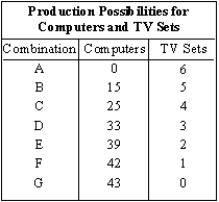 -Refer to Exhibit 1-5. The production possibilities curve representing the given schedule would be a
 (Multiple Choice)
4.9/5 (85)
(85) Josie has two classes: Biology and math. She finds out that the grades for both classes has improved without spending more time studying. Using the production possibilities curve, Josie's situation can be represented by
(Multiple Choice)
4.9/5 (66)
(66) If an economy produces only smartphones and toys, then producing more and more smartphones will most likely require
(Multiple Choice)
4.8/5 (77)
(77) Exhibit 1-2  -According to Exhibit 1-2, if Anne and Sam joined forces, the number of meals served would increase by
 (Multiple Choice)
4.9/5 (79)
(79) The production possibilities curve is immovable, meaning that it is fixed regardless of the availability of resources.
(True/False)
4.8/5 (90)
(90) James is a computer genius earning $2 million last year while working at a software company. He is also planning to enroll as an MBA student at Stanford University. What is his opportunity cost of earning the graduate MBA degree? How does it compare to your opportunity cost of a year in college?
(Essay)
4.8/5 (85)
(85) Moving from a point on the production possibilities curve to another point on the same curve implies a gain in production efficiency.
(True/False)
4.8/5 (61)
(61) What does a market economy use to determine the "what is produced, how, and for whom" problems?
(Multiple Choice)
4.9/5 (79)
(79) 
Filters
- Essay(0)
- Multiple Choice(0)
- Short Answer(0)
- True False(0)
- Matching(0)