



 Chat with AI
Exam 1: The Central Idea

Exam 1: The Central Idea156 Questions
Exam 2: Observing and Explaining the Economy143 Questions
Exam 3: The Supply and Demand Model166 Questions
Exam 4: Subtleties of the Supply and Demand Model176 Questions
Exam 5: The Demand Curve and the Behavior of Consumers176 Questions
Exam 6: The Supply Curve and the Behavior of Firms179 Questions
Exam 7: The Efficiency of Markets163 Questions
Exam 8: Costs and the Changes at Firms Over Time191 Questions
Exam 9: The Rise and Fall of Industries139 Questions
Exam 10: Monopoly184 Questions
Exam 11: Product Differentiation, Monopolistic Competition, and Oligopoly169 Questions
Exam 12: Antitrust Policy and Regulation152 Questions
Exam 13: Labor Markets179 Questions
Exam 14: Taxes, Transfers, and Income Distribution179 Questions
Exam 15: Public Goods, Externalities, and Government Behavior197 Questions
Exam 16: Capital and Financial Markets188 Questions
Exam 17: Macroeconomics: the Big Picture159 Questions
Exam 18: Measuring the Production, Income, and Spending of Nations177 Questions
Exam 19: The Spending Allocation Model166 Questions
Exam 20: Unemployment and Employment212 Questions
Exam 21: Productivity and Economic Growth162 Questions
Exam 22: Money and Inflation153 Questions
Exam 23: The Nature and Causes of Economic Fluctuations185 Questions
Exam 24: The Economic Fluctuations Model205 Questions
Exam 25: Using the Economic Fluctuations Model176 Questions
Exam 26: Fiscal Policy138 Questions
Exam 27: Monetary Policy180 Questions
Exam 28: Economic Growth Around the World157 Questions
Exam 29: International Trade242 Questions
Exam 30: International Finance125 Questions
Select questions type


Exhibit 1-3  -Refer to Exhibit 1-3. Suppose John and Jack can produce the above combinations of candy bars and ice cream bars in one hour. John and Jack can maximize their total production if
 (Multiple Choice)
4.8/5  (67)
(67) It is impossible for two people to increase their total production if one has a comparative advantage in the production of one particular good.
(True/False)
4.8/5 (71)
(71) Exhibit 1-6 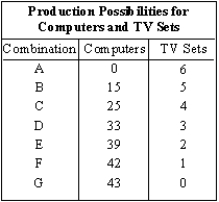 -Refer to the production possibilities schedule in Exhibit 1-6. A combination of 20 units of computers and 2 TV sets
 (Multiple Choice)
4.8/5 (86)
(86) When an economy is operating on its production possibilities curve, more production of one good means less production of another because
(Multiple Choice)
4.8/5 (81)
(81) What is division of labor, and why is this a reason for economic interaction?
(Essay)
4.8/5 (81)
(81) Exhibit 1-9  -Refer to Exhibit 1-9. If the economy depicted is at Point B, then
 (Multiple Choice)
4.9/5 (66)
(66) Which of the following refers to a decline in production and employment that lasts for six months or more?
(Multiple Choice)
4.8/5 (83)
(83) Exhibit 1-8  -Refer to Exhibit 1-8. The optimal point for the economy is
 (Multiple Choice)
4.8/5 (73)
(73) Trade enables people to specialize in activities in which they have a comparative advantage.
(True/False)
4.8/5 (75)
(75) If an increase in the price of lemonade results in people with lemonade stands having more income, then it can be argued that the price increase
(Multiple Choice)
4.8/5 (84)
(84) In a command economy, the what, how, and for whom problems are determined by
(Multiple Choice)
5.0/5 (85)
(85) Amy's parents tell her that the grades of the two courses (biology and economics) she takes will decline if she chooses to work a full-time job while going to college. How might this be possible? How would you represent this situation graphically using the production possibilities curve?
(Essay)
4.8/5 (86)
(86) When people specialize in the activity in which they have a comparative advantage,
(Multiple Choice)
4.8/5 (79)
(79) 
Filters
- Essay(0)
- Multiple Choice(0)
- Short Answer(0)
- True False(0)
- Matching(0)