



 Chat with AI
Exam 1: The Central Idea

Exam 1: The Central Idea156 Questions
Exam 2: Observing and Explaining the Economy143 Questions
Exam 3: The Supply and Demand Model166 Questions
Exam 4: Subtleties of the Supply and Demand Model176 Questions
Exam 5: The Demand Curve and the Behavior of Consumers176 Questions
Exam 6: The Supply Curve and the Behavior of Firms179 Questions
Exam 7: The Efficiency of Markets163 Questions
Exam 8: Costs and the Changes at Firms Over Time191 Questions
Exam 9: The Rise and Fall of Industries139 Questions
Exam 10: Monopoly184 Questions
Exam 11: Product Differentiation, Monopolistic Competition, and Oligopoly169 Questions
Exam 12: Antitrust Policy and Regulation152 Questions
Exam 13: Labor Markets179 Questions
Exam 14: Taxes, Transfers, and Income Distribution179 Questions
Exam 15: Public Goods, Externalities, and Government Behavior197 Questions
Exam 16: Capital and Financial Markets188 Questions
Exam 17: Macroeconomics: the Big Picture159 Questions
Exam 18: Measuring the Production, Income, and Spending of Nations177 Questions
Exam 19: The Spending Allocation Model166 Questions
Exam 20: Unemployment and Employment212 Questions
Exam 21: Productivity and Economic Growth162 Questions
Exam 22: Money and Inflation153 Questions
Exam 23: The Nature and Causes of Economic Fluctuations185 Questions
Exam 24: The Economic Fluctuations Model205 Questions
Exam 25: Using the Economic Fluctuations Model176 Questions
Exam 26: Fiscal Policy138 Questions
Exam 27: Monetary Policy180 Questions
Exam 28: Economic Growth Around the World157 Questions
Exam 29: International Trade242 Questions
Exam 30: International Finance125 Questions
Select questions type


Exhibit 1-4  -Refer to Exhibit 1-4. The opportunity cost of producing the sixth TV set is
 (Multiple Choice)
4.9/5  (76)
(76) Exhibit 1-6 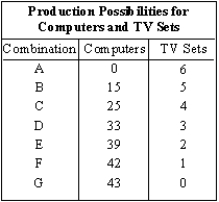 -Refer to the production possibilities schedule in Exhibit 1-6. A combination of 40 units of computers and 4 TV sets
 (Multiple Choice)
4.7/5 (80)
(80) If firms adopt a technology that can increase production without increasing labor or other resource inputs, then
(Multiple Choice)
4.8/5 (83)
(83) Exhibit 1-8  -If society begins by producing 3 units of X and 4 units of Y and then alters production so that it is now producing 4 units of X and 4 units of Y, and we know that the quantity and quality of resources were unchanged and that technology did not change, then
 (Multiple Choice)
4.8/5 (79)
(79) Trade benefits people only when they together produce more goods or services.
(True/False)
4.9/5 (76)
(76) International trade exists only when a country can gain a trade advantage over another country.
(True/False)
4.8/5 (75)
(75) Exhibit 1-7  -Refer to Exhibit 1-7. The production possibilities curve indicates that
 (Multiple Choice)
4.8/5 (79)
(79) If an increase in the price of lemonade causes more people to sell lemonade, then it can be argued that the price increase
(Multiple Choice)
4.9/5 (87)
(87) Exhibit 1-9  -Any point on the production possibilities curve represents the fact that resources are efficiently allocated.
 (True/False)
4.8/5 (85)
(85) Suppose Ashley and Allison can produce the following combinations of pizza and cakes in a day: 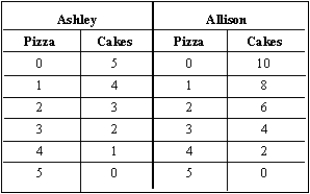

(Essay)
4.9/5 (79)
(79) Which of the following does a production possibilities curve best illustrate?
(Multiple Choice)
4.8/5 (79)
(79) What does a company need to take into consideration when deciding whether to set up its own IT department or to contract for maintenance on its computer equipment?
(Essay)
4.8/5 (79)
(79) The opportunity cost of an activity is the total value of all activities that a person cannot do.
(True/False)
4.8/5 (83)
(83) John is a high school student. He has ranked his three options of what he can do during the Christmas school break in the following order: (1) work in a fast-food restaurant full-time and earn $2,000; (2) work in a department store for the first two weeks of the break and earn $1,000, and spend the rest of the break traveling; and (3) work in his father's shoe factory full-time and earn $1,500. What is the opportunity cost of his choice?
(Essay)
4.7/5 (90)
(90) 
Filters
- Essay(0)
- Multiple Choice(0)
- Short Answer(0)
- True False(0)
- Matching(0)