



 Chat with AI
Exam 1: The Central Idea

Exam 1: The Central Idea156 Questions
Exam 2: Observing and Explaining the Economy143 Questions
Exam 3: The Supply and Demand Model166 Questions
Exam 4: Subtleties of the Supply and Demand Model176 Questions
Exam 5: The Demand Curve and the Behavior of Consumers176 Questions
Exam 6: The Supply Curve and the Behavior of Firms179 Questions
Exam 7: The Efficiency of Markets163 Questions
Exam 8: Costs and the Changes at Firms Over Time191 Questions
Exam 9: The Rise and Fall of Industries139 Questions
Exam 10: Monopoly184 Questions
Exam 11: Product Differentiation, Monopolistic Competition, and Oligopoly169 Questions
Exam 12: Antitrust Policy and Regulation152 Questions
Exam 13: Labor Markets179 Questions
Exam 14: Taxes, Transfers, and Income Distribution179 Questions
Exam 15: Public Goods, Externalities, and Government Behavior197 Questions
Exam 16: Capital and Financial Markets188 Questions
Exam 17: Macroeconomics: the Big Picture159 Questions
Exam 18: Measuring the Production, Income, and Spending of Nations177 Questions
Exam 19: The Spending Allocation Model166 Questions
Exam 20: Unemployment and Employment212 Questions
Exam 21: Productivity and Economic Growth162 Questions
Exam 22: Money and Inflation153 Questions
Exam 23: The Nature and Causes of Economic Fluctuations185 Questions
Exam 24: The Economic Fluctuations Model205 Questions
Exam 25: Using the Economic Fluctuations Model176 Questions
Exam 26: Fiscal Policy138 Questions
Exam 27: Monetary Policy180 Questions
Exam 28: Economic Growth Around the World157 Questions
Exam 29: International Trade242 Questions
Exam 30: International Finance125 Questions
Select questions type


Exhibit 1-7  -Refer to Exhibit 1-7. Assume the economy is operating at Point C. This indicates that
 (Multiple Choice)
4.9/5  (86)
(86) Explain how a market economy works to enable the production and allocation of smartphones.
(Essay)
4.8/5 (90)
(90) Given a production possibilities curve for defense goods and nondefense goods, a production point outside the curve
(Multiple Choice)
4.8/5 (76)
(76) The movement from a point inside a production possibilities curve to a point outside the curve is likely to result in no change in an economy's total production.
(True/False)
4.9/5 (83)
(83) To say that a change in taste causes prices to rise is to claim that
(Multiple Choice)
4.9/5 (76)
(76) Exhibit 1-7
-Refer to Exhibit 1-7. A movement from Point B to Point D indicates
-Refer to Exhibit 1-7. A movement from Point B to Point D indicates (Multiple Choice)
4.9/5 (81)
(81) Maria has two options to spend her school break in the summer: get a summer job that pays $3,000 or travel in Mexico. The opportunity cost of the summer job is that Maria
(Multiple Choice)
4.9/5 (90)
(90) 
Exhibit 1-2 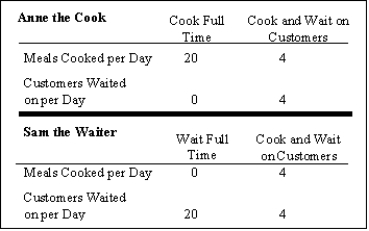 -According to Exhibit 1-2, if Sam did all the cooking as well as waited on tables, how many customers would he be able to serve per day?
 (Multiple Choice)
4.9/5 (86)
(86) Explain how trade between two different countries is similar to trade occurring between two individuals within a country.
(Essay)
5.0/5 (84)
(84) Economic growth in the future can be encouraged by tradeoffs made today.
(True/False)
4.9/5 (78)
(78) Exhibit 1-9  -Refer to Exhibit 1-9. A movement of the economy from Point C to Point A
 (Multiple Choice)
4.9/5 (74)
(74) Trade always results in a gain for one or both participants in the trade
(True/False)
4.7/5 (67)
(67) Suppose a financial crisis prevents many companies to get loans so that their production levels fall as they are unable to purchase the same amount of inputs as before. We can conclude that the economy is
(Multiple Choice)
4.9/5 (83)
(83) 
Filters
- Essay(0)
- Multiple Choice(0)
- Short Answer(0)
- True False(0)
- Matching(0)