



 Chat with AI
Exam 16: Capital and Financial Markets

Exam 1: The Central Idea156 Questions
Exam 2: Observing and Explaining the Economy143 Questions
Exam 3: The Supply and Demand Model166 Questions
Exam 4: Subtleties of the Supply and Demand Model176 Questions
Exam 5: The Demand Curve and the Behavior of Consumers176 Questions
Exam 6: The Supply Curve and the Behavior of Firms179 Questions
Exam 7: The Efficiency of Markets163 Questions
Exam 8: Costs and the Changes at Firms Over Time191 Questions
Exam 9: The Rise and Fall of Industries139 Questions
Exam 10: Monopoly184 Questions
Exam 11: Product Differentiation, Monopolistic Competition, and Oligopoly169 Questions
Exam 12: Antitrust Policy and Regulation152 Questions
Exam 13: Labor Markets179 Questions
Exam 14: Taxes, Transfers, and Income Distribution179 Questions
Exam 15: Public Goods, Externalities, and Government Behavior197 Questions
Exam 16: Capital and Financial Markets188 Questions
Exam 17: Macroeconomics: the Big Picture159 Questions
Exam 18: Measuring the Production, Income, and Spending of Nations177 Questions
Exam 19: The Spending Allocation Model166 Questions
Exam 20: Unemployment and Employment212 Questions
Exam 21: Productivity and Economic Growth162 Questions
Exam 22: Money and Inflation153 Questions
Exam 23: The Nature and Causes of Economic Fluctuations185 Questions
Exam 24: The Economic Fluctuations Model205 Questions
Exam 25: Using the Economic Fluctuations Model176 Questions
Exam 26: Fiscal Policy138 Questions
Exam 27: Monetary Policy180 Questions
Exam 28: Economic Growth Around the World157 Questions
Exam 29: International Trade242 Questions
Exam 30: International Finance125 Questions
Select questions type


Suppose a stock has the same expected rate of return as a bank account. Explain why this is not an equilibrium situation.
(Essay)
4.7/5  (84)
(84) If the interest rate at which a firm can borrow or lend is 10 percent, then the firm will own
(Multiple Choice)
4.9/5 (75)
(75) Which of the following asset markets offers the least systematic risk?
(Multiple Choice)
4.7/5 (74)
(74) The percentage rate used to calculate the value of a future sum is called the
(Multiple Choice)
5.0/5 (73)
(73) Label each of the following as financial capital or physical capital.
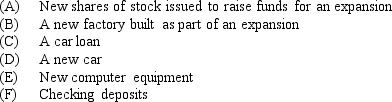
(Essay)
5.0/5 (81)
(81) Suppose a stock has a higher expected rate of return than a bank account. Then
(Multiple Choice)
4.8/5 (80)
(80) Suppose the U.S. government issues a two-year Treasury note with a face value of $4,000 and an 8-percent coupon.

(Essay)
4.8/5 (84)
(84) Discounting is the process of calculating how much future sums of money are worth today.
(True/False)
4.8/5 (78)
(78) With zero inflation, a dollar received today is worth ____ a dollar received one year from now.
(Multiple Choice)
4.7/5 (82)
(82) Suppose an investor buys a share of stock for $40 and sells it for $45 after one year. At the end of that year, the dividend per stock is $1. The company has 100,000 shares outstanding and a total profit for the year of $500,000. Calculate the price-earnings ratio for this firm at the time the stock was sold.
(Essay)
4.8/5 (85)
(85) The present discounted value is today's value of future payments.
(True/False)
5.0/5 (90)
(90) One major aspect of bank regulation is to require banks to keep
(Multiple Choice)
4.9/5 (79)
(79) Which of the following is an example of an equity contract?
(Multiple Choice)
5.0/5 (77)
(77) The dividend yield for a stock is the dividend divided by the price of the stock.
(True/False)
4.9/5 (86)
(86) Suppose a friend wants to borrow $500 and offers to pay you back over the next five years by paying $100 at the end of two years, $200 at the end of three years, $150 at the end of four years, and $125 at the end of five years. You want to at least break even over the five years, and you could earn 7 percent interest on the money if you kept it. Should you make the loan? (Hint: Calculate the present discounted value of the payments. Show your work.)
(Essay)
4.8/5 (77)
(77) 
Filters
- Essay(0)
- Multiple Choice(0)
- Short Answer(0)
- True False(0)
- Matching(0)