



 Chat with AI
Exam 16: Capital and Financial Markets

Exam 1: The Central Idea156 Questions
Exam 2: Observing and Explaining the Economy143 Questions
Exam 3: The Supply and Demand Model166 Questions
Exam 4: Subtleties of the Supply and Demand Model176 Questions
Exam 5: The Demand Curve and the Behavior of Consumers176 Questions
Exam 6: The Supply Curve and the Behavior of Firms179 Questions
Exam 7: The Efficiency of Markets163 Questions
Exam 8: Costs and the Changes at Firms Over Time191 Questions
Exam 9: The Rise and Fall of Industries139 Questions
Exam 10: Monopoly184 Questions
Exam 11: Product Differentiation, Monopolistic Competition, and Oligopoly169 Questions
Exam 12: Antitrust Policy and Regulation152 Questions
Exam 13: Labor Markets179 Questions
Exam 14: Taxes, Transfers, and Income Distribution179 Questions
Exam 15: Public Goods, Externalities, and Government Behavior197 Questions
Exam 16: Capital and Financial Markets188 Questions
Exam 17: Macroeconomics: the Big Picture159 Questions
Exam 18: Measuring the Production, Income, and Spending of Nations177 Questions
Exam 19: The Spending Allocation Model166 Questions
Exam 20: Unemployment and Employment212 Questions
Exam 21: Productivity and Economic Growth162 Questions
Exam 22: Money and Inflation153 Questions
Exam 23: The Nature and Causes of Economic Fluctuations185 Questions
Exam 24: The Economic Fluctuations Model205 Questions
Exam 25: Using the Economic Fluctuations Model176 Questions
Exam 26: Fiscal Policy138 Questions
Exam 27: Monetary Policy180 Questions
Exam 28: Economic Growth Around the World157 Questions
Exam 29: International Trade242 Questions
Exam 30: International Finance125 Questions
Select questions type


Suppose your company owns a computer that cost $10,000 and depreciates $500 per year. If the interest rate is 5 percent, what is the implicit rental price of the computer? When interest rates increase, are firms more or less likely to purchase equipment?
(Essay)
4.8/5  (80)
(80) A firm has been making relatively large profits lately and has an extra $20,000 to invest. The firm is choosing among three investment options: improving the training of store employees, buying new computer equipment, or saving the $20,000 in a bank account and using it at a later date. How should the firm decide which option to choose? Which option is least risky? Most risky?
(Essay)
4.7/5 (78)
(78) In the long run, the rate of return on a capital investment is, on average, directly related to its risk.
(True/False)
4.9/5 (77)
(77) Exhibit 16-1 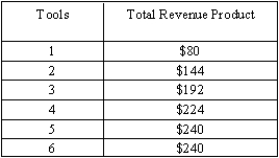 -Refer to Exhibit 16-1. Suppose that the price of tools is $32. Then a profit-maximizing firm will buy a total of
 (Multiple Choice)
4.7/5 (71)
(71) What is the difference between financial capital and physical capital?
(Essay)
4.7/5 (84)
(84) Refer to the table below. Graph the data on risk and expected rate of return for the following securities. 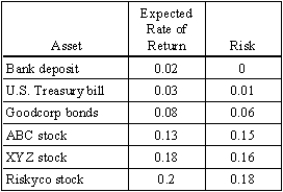 Draw the risk-return line through your graph. Which asset will experience a change in price in the near future? In which direction will the price change? Explain.
(Essay)
4.9/5 (88)
(88) The amount of principal that will be paid back when a bond matures is called the
(Multiple Choice)
4.8/5 (68)
(68) On the maturity date, the firm or government that issued a bond must pay
(Multiple Choice)
4.8/5 (76)
(76) Firms use physical capital markets to raise funds for expansion.
(True/False)
4.7/5 (78)
(78) Suppose the news indicates that stock prices have been higher in January than in other months of the year. What would be the likely reaction of the stock market?
(Essay)
4.8/5 (73)
(73) When a firm pays cash for a piece of equipment, the implicit rental price is zero.
(True/False)
4.8/5 (80)
(80) A profit-maximizing firm will rent or purchase a quantity of capital such that the
(Multiple Choice)
4.9/5 (84)
(84) The equilibrium rental price of capital is determined by the
(Multiple Choice)
5.0/5 (73)
(73) One of the reasons why capitalism works is that managers always act in the best interest of the stock holders.
(True/False)
4.9/5 (66)
(66) Calculate the expected return on a $6,000 bond that pays 6 percent of face value and whose price has a 30-percent chance of falling by $1,000 and a 70-percent chance of rising by $1,000.
(Multiple Choice)
4.8/5 (93)
(93) The amount of money the borrower agrees to pay the bondholder each year is called the
(Multiple Choice)
4.8/5 (77)
(77) 
Filters
- Essay(0)
- Multiple Choice(0)
- Short Answer(0)
- True False(0)
- Matching(0)