



 Chat with AI
Exam 16: Capital and Financial Markets

Exam 1: The Central Idea156 Questions
Exam 2: Observing and Explaining the Economy143 Questions
Exam 3: The Supply and Demand Model166 Questions
Exam 4: Subtleties of the Supply and Demand Model176 Questions
Exam 5: The Demand Curve and the Behavior of Consumers176 Questions
Exam 6: The Supply Curve and the Behavior of Firms179 Questions
Exam 7: The Efficiency of Markets163 Questions
Exam 8: Costs and the Changes at Firms Over Time191 Questions
Exam 9: The Rise and Fall of Industries139 Questions
Exam 10: Monopoly184 Questions
Exam 11: Product Differentiation, Monopolistic Competition, and Oligopoly169 Questions
Exam 12: Antitrust Policy and Regulation152 Questions
Exam 13: Labor Markets179 Questions
Exam 14: Taxes, Transfers, and Income Distribution179 Questions
Exam 15: Public Goods, Externalities, and Government Behavior197 Questions
Exam 16: Capital and Financial Markets188 Questions
Exam 17: Macroeconomics: the Big Picture159 Questions
Exam 18: Measuring the Production, Income, and Spending of Nations177 Questions
Exam 19: The Spending Allocation Model166 Questions
Exam 20: Unemployment and Employment212 Questions
Exam 21: Productivity and Economic Growth162 Questions
Exam 22: Money and Inflation153 Questions
Exam 23: The Nature and Causes of Economic Fluctuations185 Questions
Exam 24: The Economic Fluctuations Model205 Questions
Exam 25: Using the Economic Fluctuations Model176 Questions
Exam 26: Fiscal Policy138 Questions
Exam 27: Monetary Policy180 Questions
Exam 28: Economic Growth Around the World157 Questions
Exam 29: International Trade242 Questions
Exam 30: International Finance125 Questions
Select questions type


If the marginal revenue product of capital for a profit-maximizing firm is $800 and the price of capital is $600, then the firm
(Multiple Choice)
4.8/5  (78)
(78) One possible role for government is to intervene to prevent the failure of large financial institutions and thereby prevent instability in the financial markets. Indeed, during 2008 the federal government intervened in several ways by loaning or investing funds to help some of these financial institutions.
(True/False)
4.9/5 (80)
(80) A problem can be created when there are different levels of information available to different people in an economic interaction or exchange. This is known in economic and financial theory as
(Multiple Choice)
4.9/5 (70)
(70) The price of a good with a vertical market supply is called
(Multiple Choice)
4.9/5 (74)
(74) The face value of a bond is the principal that will be paid back when the bond matures.
(True/False)
4.9/5 (58)
(58) One major reason for the outbreak of the financial crisis was too much government regulation in the banking system.
(True/False)
4.9/5 (84)
(84) Draw a diagram of a market in which economic rent occurs. Be sure to label the rent in the diagram.
(Essay)
4.9/5 (77)
(77) If the price of a stock rises from $80 to $100 over the course of a year and the dividend paid is $5, the capital gain is
(Multiple Choice)
4.8/5 (81)
(81) 
Suppose the U.S. government issues a one-year Treasury bill with a face value of $5,000 and a $100 coupon payment. If the market interest rate is 9 percent, what is the market price of the bond based on its present discounted value? If bond prices rise by 4 percent, what must have happened to the market interest rate? Explain.
(Essay)
4.9/5 (83)
(83) You are considering two work contracts, each of which lasts for five years. The two contracts are summarized in the following table. 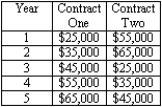 Assume that you will be paid at the end of each year. Contract 1 includes a signing bonus of $5,000 to be paid at the beginning of year 1, whereas contract 2 does not include a signing bonus. If the interest rate is 5 percent, which is the better offer?
(Essay)
4.8/5 (82)
(82) What is the yield on a very long-term bond with a $500 face value, a coupon of $35, and a current price of $650?
(Multiple Choice)
4.8/5 (80)
(80) Many experts think a major reason for the housing boom during the years leading up to the housing bust in 2006 was that mortgage interest rates were very low.
(True/False)
4.7/5 (79)
(79) The equilibrium risk-return curve for a risk-averse person is positively sloped.
(True/False)
4.9/5 (78)
(78) The U.S. government did not intervene to prevent the failure of any financial institution during the 2007-2008 financial crisis.
(True/False)
4.7/5 (74)
(74) Suppose a bond with a face value of $1,000 pays a coupon of $200, and the bond matures in 50 years. If the interest rate is currently 15 percent, calculate the approximate price of the bond.
(Essay)
4.9/5 (79)
(79) The equilibrium risk-return curve for a risk-neutral individual will be
(Multiple Choice)
4.9/5 (86)
(86) The Federal Reserve is the only government authority that oversees U.S. banks.
(True/False)
4.9/5 (87)
(87) 
Filters
- Essay(0)
- Multiple Choice(0)
- Short Answer(0)
- True False(0)
- Matching(0)